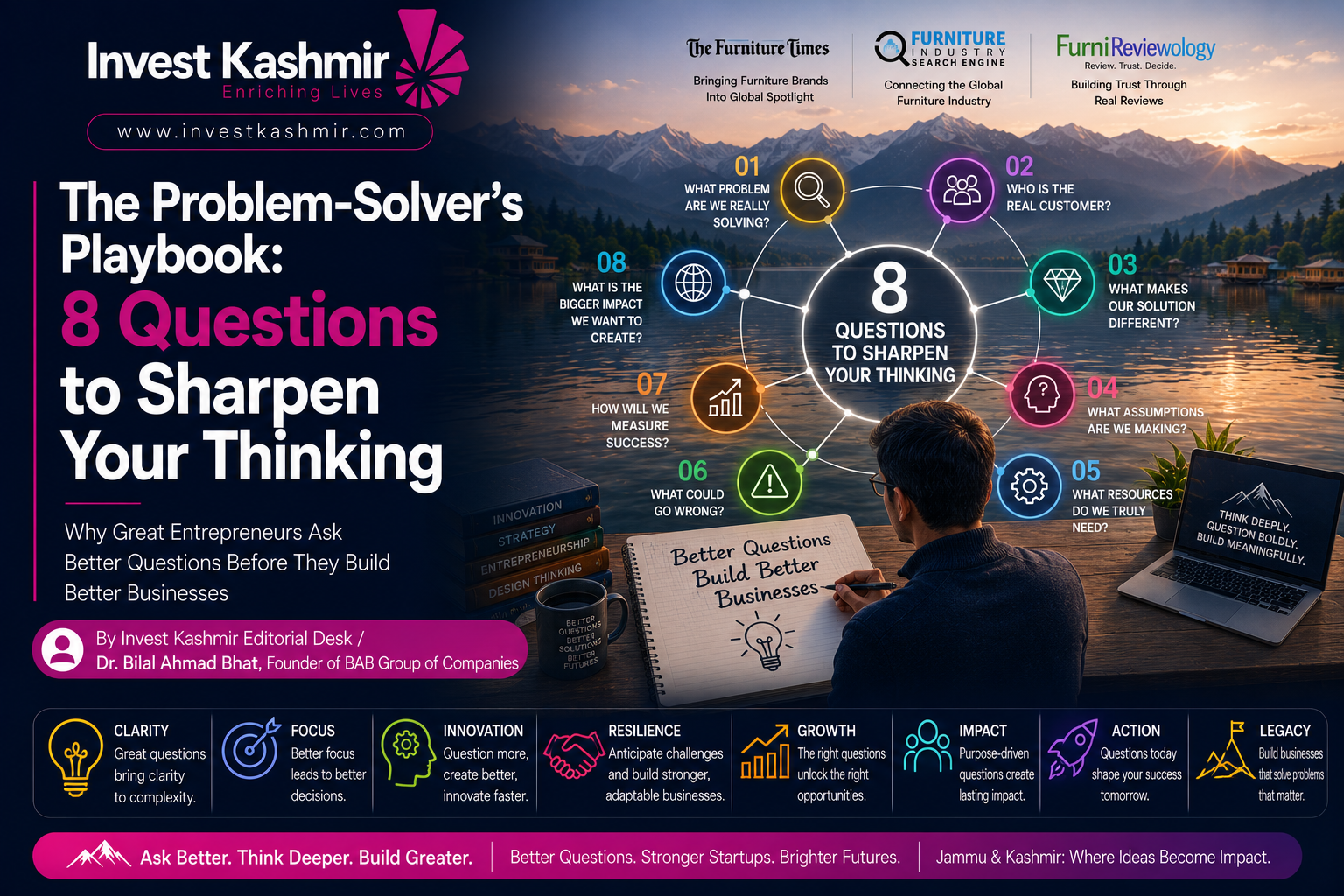
Why Great Entrepreneurs Ask Better Questions Before They Build Better Businesses
By Invest Kashmir Editorial Desk / Dr. Bilal Ahmad Bhat, Founder of BAB Group of Companies
Every successful entrepreneur is known for solving problems.
However, the world’s most successful founders rarely begin by searching for answers.
They begin by asking better questions.
Behind every groundbreaking startup, transformative innovation, successful investment, and resilient business lies a disciplined thinking process driven by curiosity, critical analysis, and thoughtful decision-making. Entrepreneurs who consistently ask meaningful questions are better equipped to identify opportunities, reduce risk, improve products, strengthen customer relationships, and adapt to rapidly changing markets.
In today’s world of Artificial Intelligence, digital transformation, global competition, and economic uncertainty, information has become abundant.
Clear thinking has become the true competitive advantage.
Entrepreneurship educators and researchers increasingly emphasize that founders benefit from structured questioning that challenges assumptions, clarifies reasoning, and considers alternative perspectives before making important decisions. Purposeful questioning strengthens critical thinking and improves entrepreneurial decision-making.
For Jammu & Kashmir, where startups are emerging across tourism, AgriTech, HealthTech, renewable energy, manufacturing, handicrafts, education, information technology, and food processing, developing strong problem-solving skills will be just as important as attracting investment or adopting new technologies.
Why Questions Matter More Than Assumptions
Many businesses fail not because founders lacked ambition.
They fail because they solved the wrong problem.
Entrepreneurs often become emotionally attached to ideas before confirming whether customers actually need them.
The most successful innovators avoid this trap.
They continuously question:
- Their assumptions.
- Their business models.
- Customer behaviour.
- Market dynamics.
- Their own decisions.
Critical thinking is not about doubting everything.
It is about understanding enough to make better decisions based on evidence rather than assumptions.
Question One: What Problem Am I Actually Solving?
Every successful business begins with a meaningful problem.
Before discussing products, founders should ask:
What challenge does my customer face every day?
Many startups mistakenly build solutions looking for problems.
Successful entrepreneurs identify genuine customer pain points before designing products.
If the problem is significant, customers will actively seek solutions.
If the problem is minor, adoption becomes much more difficult.
Question Two: Who Benefits Most from This Solution?
Not every customer represents the ideal customer.
Entrepreneurs should clearly define:
- Primary users
- Secondary customers
- Purchasing decision-makers
- Customer behaviours
- Market segments
Understanding the right audience improves marketing, product development, pricing, and customer engagement.
Businesses that try to serve everyone often struggle to serve anyone exceptionally well.
Question Three: Why Would Customers Choose Us?
Competition exists in every industry.
Founders should honestly ask:
What makes our solution different?
Competitive advantages may include:
- Better quality
- Faster service
- Lower cost
- Greater convenience
- Stronger technology
- Local expertise
- Better customer experience
- Sustainability
Differentiation creates long-term value.
Question Four: What Assumptions Are We Making?
Every business plan contains assumptions.
Examples include:
- Customers will pay.
- The market is growing.
- Competitors will not respond.
- Technology will perform as expected.
The most disciplined entrepreneurs identify assumptions early and test them systematically instead of accepting them as facts.
Research into entrepreneurial decision-making highlights the importance of challenging assumptions and applying reflective, evidence-based thinking when navigating complex business environments.
Question Five: What Evidence Supports Our Decision?
Opinions create discussions.
Evidence creates confidence.
Before making important business decisions, founders should ask:
- What customer feedback do we have?
- What market research supports this?
- Which data confirms demand?
- Have we tested our assumptions?
Evidence reduces uncertainty while improving strategic decision-making.
Question Six: What Risks Have We Overlooked?
Entrepreneurship always involves uncertainty.
However, uncertainty becomes manageable through preparation.
Founders should identify:
- Financial risks
- Operational risks
- Technology risks
- Regulatory risks
- Market risks
- Talent risks
- Supply chain risks
Preparing for challenges does not eliminate them.
It improves resilience.
Question Seven: If This Doesn’t Work, What Will We Learn?
Failure should never be the objective.
Learning should.
Successful startups treat every product launch, customer interview, pilot project, and marketing campaign as opportunities to gather knowledge.
Instead of asking:
“Did we succeed?”
They ask:
“What did we discover?”
Learning accelerates innovation.
Question Eight: Does This Decision Create Long-Term Value?
Entrepreneurs frequently face decisions offering short-term benefits but long-term consequences.
Every important decision should consider:
- Customer trust
- Brand reputation
- Financial sustainability
- Employee wellbeing
- Environmental responsibility
- Community impact
- Innovation potential
Businesses that prioritize long-term value generally build stronger reputations and more sustainable growth.
Critical Thinking in the Age of Artificial Intelligence
Artificial Intelligence provides extraordinary capabilities.
It analyzes data.
Generates content.
Identifies patterns.
Supports decision-making.
Yet AI does not replace human judgment.
Entrepreneurs remain responsible for:
- Asking better questions.
- Evaluating evidence.
- Making ethical decisions.
- Understanding customer emotions.
- Setting strategic direction.
Human intelligence and Artificial Intelligence should complement one another rather than compete.
Problem Solving Is a Team Sport
Great decisions rarely emerge from isolated thinking.
Successful organizations encourage:
- Open discussion
- Constructive feedback
- Diverse perspectives
- Cross-functional collaboration
- Healthy debate
Research in entrepreneurship education shows that questioning assumptions, considering multiple viewpoints, and structured reflection improve decision quality and strengthen problem-solving capabilities.
Building Better Startups in Jammu & Kashmir
Jammu & Kashmir possesses tremendous entrepreneurial potential across:
- Tourism Technology
- Artificial Intelligence
- AgriTech
- HealthTech
- Renewable Energy
- Food Processing
- Manufacturing
- Education Technology
- Handicrafts
- Digital Commerce
Entrepreneurs within these industries will benefit enormously from disciplined thinking before committing significant resources.
Better questions often produce better businesses.
Universities and Entrepreneurial Thinking
Educational institutions can strengthen startup ecosystems by teaching students how to:
- Analyze problems.
- Challenge assumptions.
- Interpret evidence.
- Develop hypotheses.
- Test ideas.
- Communicate clearly.
- Think systematically.
Critical thinking should become as important as technical knowledge.
Investors Value Thoughtful Founders
Professional investors often evaluate how founders think rather than simply what they build.
Investors look for entrepreneurs who:
- Ask insightful questions.
- Understand customers.
- Evaluate evidence.
- Manage uncertainty.
- Adapt quickly.
- Learn continuously.
Thoughtful decision-making strengthens investor confidence.
A Culture of Curiosity
Innovation begins with curiosity.
Curiosity produces questions.
Questions generate understanding.
Understanding creates solutions.
Solutions create businesses.
Businesses strengthen economies.
For Jammu & Kashmir, encouraging curiosity among entrepreneurs, students, researchers, professionals, and policymakers can accelerate innovation while strengthening the region’s startup ecosystem.
Conclusion
Every entrepreneur dreams of finding the perfect answer.
The most successful entrepreneurs recognize that lasting success begins with asking the right questions.
Before building products…
Understand the problem.
Before raising investment…
Validate the opportunity.
Before scaling…
Understand the customer.
Before making decisions…
Challenge assumptions.
Before seeking certainty…
Seek understanding.
In a rapidly changing global economy, entrepreneurs who consistently ask thoughtful questions will outperform those who rely solely on instinct.
The future belongs not merely to those who think faster.
It belongs to those who think better.
For Jammu & Kashmir, building a culture of disciplined problem-solving, continuous learning, evidence-based decision-making, and entrepreneurial curiosity can help transform innovative ideas into globally competitive businesses that create employment, attract investment, strengthen industries, and contribute to sustainable economic development.
Every great innovation begins with a question.
The next transformative business from Jammu & Kashmir may begin with yours.