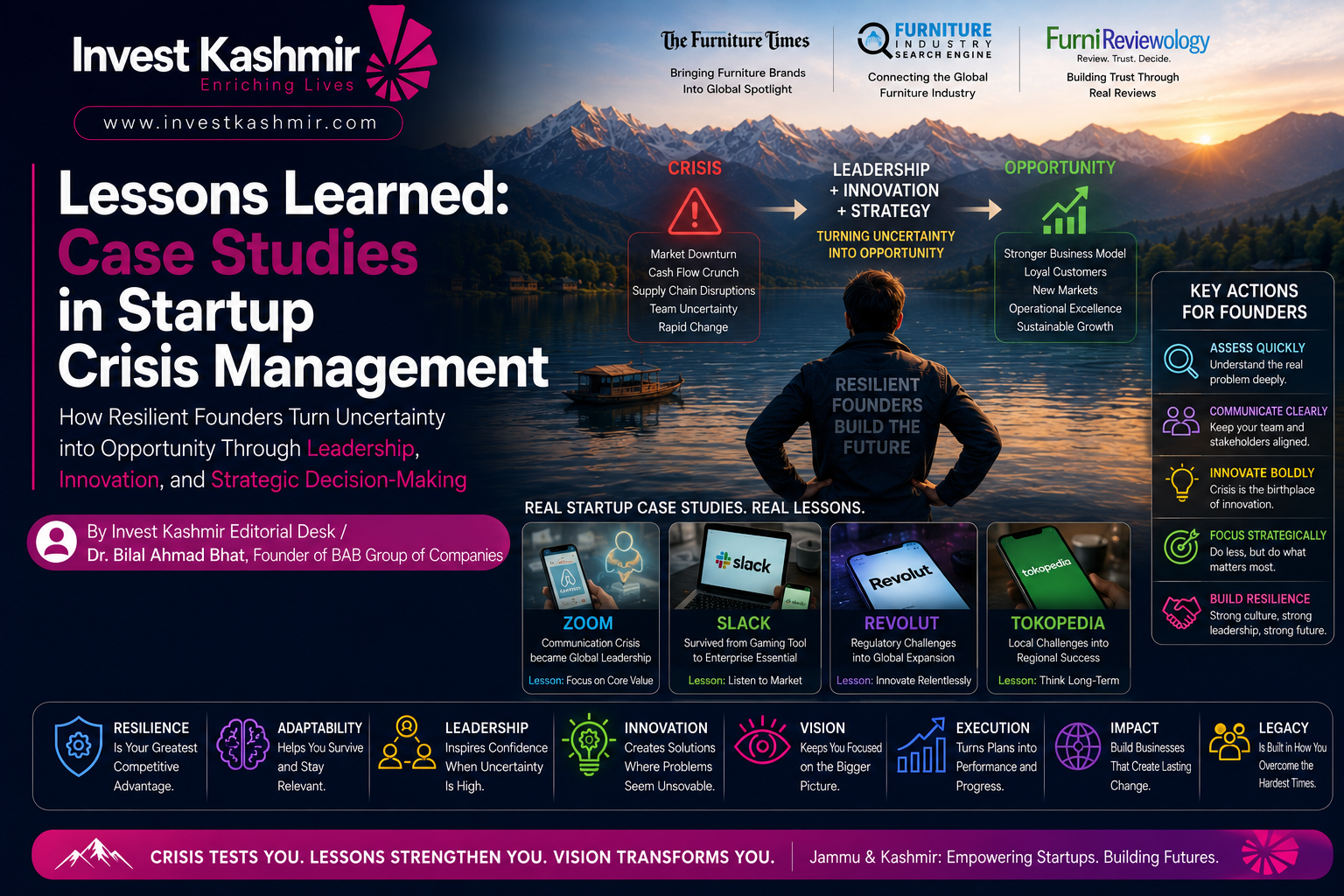
How Resilient Founders Turn Uncertainty into Opportunity Through Leadership, Innovation, and Strategic Decision-Making
By Invest Kashmir Editorial Desk / Dr. Bilal Ahmad Bhat, Founder of BAB Group of Companies
Every startup begins with optimism.
Founders launch businesses believing in their ideas, their teams, and their ability to solve meaningful problems. They imagine growth, innovation, customer success, investment, and long-term impact.
Yet every entrepreneurial journey eventually encounters adversity.
Funding may slow.
Markets may change.
Technology may fail.
Customers may shift their expectations.
Supply chains may become disrupted.
Economic uncertainty may affect demand.
Cybersecurity threats may emerge.
Key employees may leave.
The defining characteristic of successful startups is therefore not the absence of crises—it is their ability to respond, adapt, recover, and continue moving forward.
Around the world, startup ecosystems have repeatedly demonstrated that some of the strongest companies were shaped during difficult periods. Crisis management has become an essential leadership capability, requiring preparation, transparency, rapid learning, and disciplined execution. Crisis management specialists increasingly emphasize that startups benefit from identifying risks early, maintaining clear communication, preparing contingency plans, and treating disruption as an opportunity to improve rather than simply survive.
For Jammu & Kashmir, where entrepreneurship is expanding across tourism, AgriTech, HealthTech, renewable energy, education, manufacturing, handicrafts, information technology, and digital services, understanding crisis management can help founders build businesses capable of enduring uncertainty while creating sustainable long-term value.
Why Every Startup Will Face a Crisis
Entrepreneurs sometimes assume that crises affect only large corporations.
The reality is different.
Every startup, regardless of industry or size, will eventually encounter unexpected challenges.
Common startup crises include:
- Cash-flow shortages
- Declining customer demand
- Technology failures
- Product delays
- Regulatory changes
- Market disruption
- Supply chain interruptions
- Cybersecurity incidents
- Reputation challenges
- Leadership transitions
The objective is not to eliminate every crisis.
The objective is to become prepared for them.
Crisis Is a Test of Leadership
During periods of stability, leadership often appears straightforward.
During periods of uncertainty, leadership becomes visible.
Employees look for direction.
Customers expect transparency.
Investors seek confidence.
Partners require clarity.
The founder’s response often determines whether a crisis becomes temporary disruption or long-term damage.
Research into crisis governance consistently highlights that transparent communication, decisive leadership, preparation, and stakeholder trust are among the strongest predictors of successful recovery.
Case Study One: When Funding Becomes Limited
Imagine a technology startup preparing to expand internationally.
Unexpectedly, investment markets slow.
A planned funding round takes longer than expected.
Instead of continuing aggressive expansion, leadership chooses to:
- Reduce unnecessary expenses.
- Prioritize profitable customers.
- Improve operational efficiency.
- Extend financial runway.
- Focus on core products.
Rather than viewing reduced investment as failure, the company uses the period to strengthen its business fundamentals.
Lesson
Financial discipline creates resilience.
Businesses that understand cash flow are often better prepared to navigate uncertain economic conditions.
Case Study Two: Customer Needs Suddenly Change
A startup launches a product based on extensive research.
However, customer feedback reveals that users need a different solution.
Instead of defending the original product, the founders:
- Listen carefully.
- Conduct additional interviews.
- Analyze customer behaviour.
- Improve the product.
- Introduce new features.
This willingness to adapt transforms customer feedback into competitive advantage.
Lesson
Markets evolve.
Successful founders learn faster than markets change.
Case Study Three: A Technology Failure
A digital platform experiences an unexpected technical disruption.
Customers cannot access services.
Leadership responds by:
- Communicating immediately.
- Explaining the situation honestly.
- Providing regular updates.
- Restoring operations quickly.
- Reviewing internal systems.
Organizations that communicate promptly during disruptions are generally better positioned to maintain stakeholder trust than those that remain silent while speculation grows.
Lesson
Trust is built through transparency—not perfection.
Case Study Four: Losing a Key Employee
A startup unexpectedly loses one of its senior technical leaders.
Rather than relying entirely on one individual, the company had previously:
- Documented processes.
- Shared knowledge internally.
- Cross-trained team members.
- Built collaborative workflows.
Operations continue with minimal disruption.
Lesson
Strong systems outperform dependence on individuals.
Knowledge sharing strengthens organizational resilience.
Case Study Five: Reputation Under Pressure
A misunderstanding on social media creates public criticism.
Instead of reacting emotionally, leadership:
- Reviews the facts.
- Responds respectfully.
- Corrects misinformation.
- Engages constructively.
- Implements improvements where appropriate.
Modern reputation management increasingly depends on timely communication, accountability, and consistent stakeholder engagement.
Lesson
Reputation is protected through actions rather than statements alone.
Preparing Before a Crisis Occurs
The best crisis management begins long before problems emerge.
Every startup should develop:
- Risk assessments
- Financial contingency plans
- Communication strategies
- Technology backup systems
- Data protection policies
- Business continuity plans
- Leadership succession planning
Preparation reduces uncertainty while improving response speed.
Communication Is the First Response
During uncertainty, silence often creates confusion.
Employees require clarity.
Customers expect updates.
Investors seek transparency.
Partners need reassurance.
Effective communication should be:
- Honest
- Timely
- Accurate
- Respectful
- Consistent
Clear communication strengthens confidence even during challenging periods.
Building Financial Resilience
Financial resilience extends beyond raising investment.
It requires:
- Responsible budgeting
- Cash-flow forecasting
- Revenue diversification
- Cost management
- Sustainable growth
Founders who understand financial fundamentals make stronger decisions under pressure.
Innovation During Difficult Times
Some of the world’s most successful innovations emerged during periods of economic uncertainty.
Challenges encourage entrepreneurs to:
- Improve efficiency.
- Explore new markets.
- Develop better products.
- Strengthen customer relationships.
- Adopt new technologies.
Crisis frequently becomes a catalyst for innovation.
Artificial Intelligence and Crisis Management
Artificial Intelligence increasingly supports businesses by:
- Monitoring operational risks
- Forecasting demand
- Detecting cybersecurity threats
- Analyzing customer behaviour
- Improving decision support
- Automating routine processes
However, technology complements rather than replaces leadership.
Human judgment remains essential.
Universities and Entrepreneurial Resilience
Educational institutions can prepare future entrepreneurs by teaching:
- Risk management
- Critical thinking
- Crisis communication
- Financial planning
- Strategic leadership
- Business continuity
These capabilities strengthen startup ecosystems over the long term.
Opportunities for Jammu & Kashmir
Jammu & Kashmir’s emerging startup ecosystem spans:
- Tourism Technology
- AgriTech
- HealthTech
- Artificial Intelligence
- Food Processing
- Renewable Energy
- Manufacturing
- Education Technology
- Handicrafts
- Digital Commerce
Each sector will encounter unique challenges.
Founders who prepare proactively will be better positioned to transform adversity into opportunity.
Building a Crisis-Ready Startup Ecosystem
A resilient entrepreneurial ecosystem depends upon collaboration among:
- Entrepreneurs
- Investors
- Universities
- Government agencies
- Incubators
- Accelerators
- Financial institutions
- Technology companies
- Industry associations
Together, these stakeholders create stronger support systems that help startups recover, innovate, and grow.
Conclusion
Every startup story includes moments of uncertainty.
Some crises arrive unexpectedly.
Others develop gradually.
The businesses that endure are rarely those that avoid every challenge.
They are the organizations that:
- Prepare early.
- Communicate honestly.
- Learn continuously.
- Adapt rapidly.
- Protect customer trust.
- Support their people.
- Make disciplined decisions.
For Jammu & Kashmir, building resilient startups is just as important as building innovative startups.
The future belongs to founders who understand that resilience is not the opposite of growth—it is the foundation of sustainable growth.
Every challenge carries a lesson.
Every lesson strengthens leadership.
Every stronger leader builds a stronger business.
And every resilient business contributes to a more innovative, competitive, and prosperous Jammu & Kashmir.