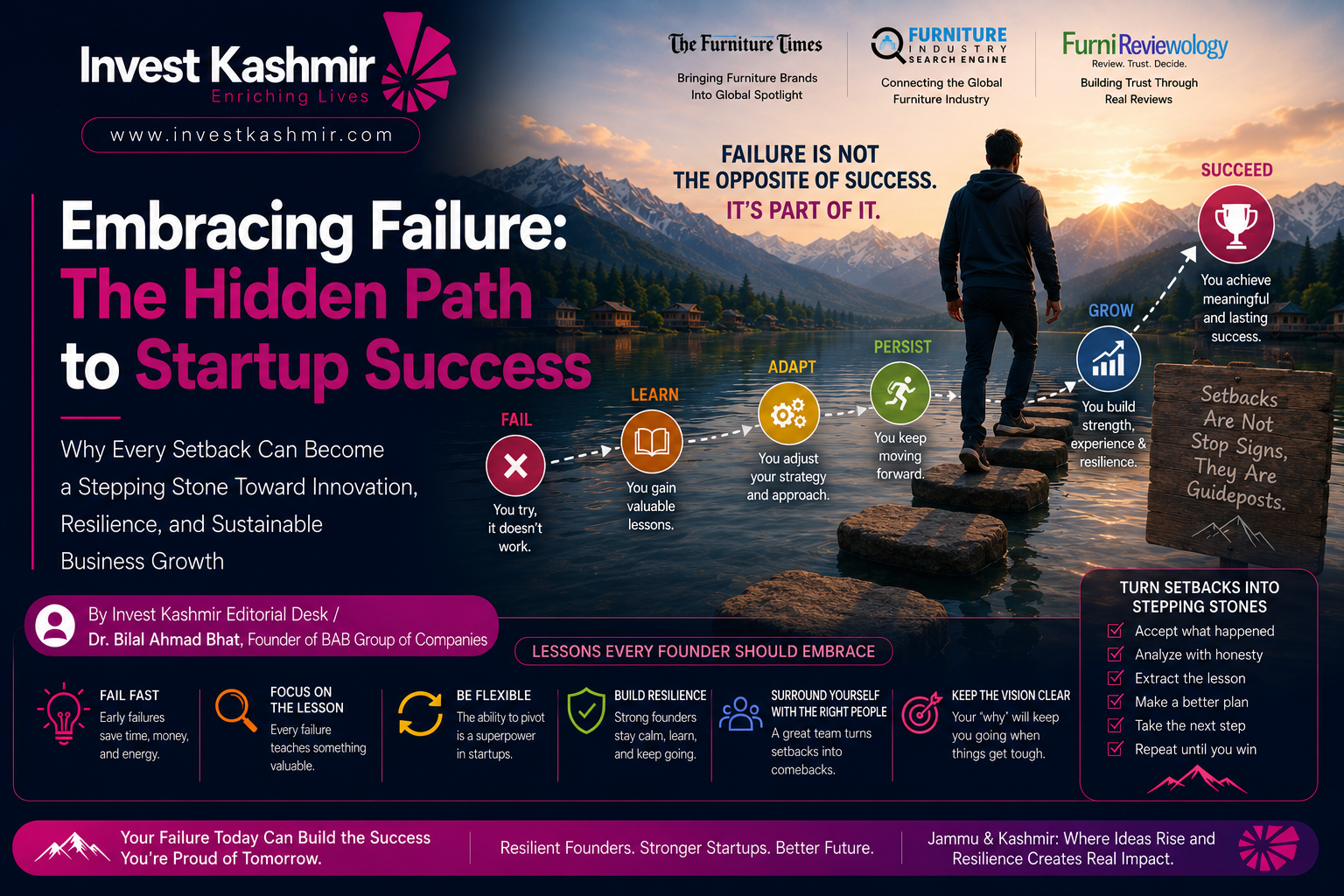
Why Every Setback Can Become a Stepping Stone Toward Innovation, Resilience, and Sustainable Business Growth
By Invest Kashmir Editorial Desk / Dr. Bilal Ahmad Bhat, Founder of BAB Group of Companies
Failure is perhaps the most misunderstood word in entrepreneurship.
For many aspiring founders, failure represents the end of a dream—a business that did not survive, a product that failed to gain customers, an investor who declined funding, or a strategy that simply did not work. Yet history shows that failure is not the opposite of success. More often, it is one of the most important stages on the journey toward building resilient and enduring businesses.
Every startup begins with uncertainty. Entrepreneurs make decisions using limited information, changing market conditions, evolving customer expectations, and finite financial resources. In such an environment, mistakes are inevitable. The critical difference between startups that disappear and those that succeed lies not in whether they experience setbacks, but in how they respond to them.
Research into entrepreneurial resilience consistently finds that founders who actively reflect on setbacks, regulate emotions, strengthen resilience, and apply lessons from failure are better prepared to recover and build stronger ventures.
For Jammu & Kashmir, where entrepreneurship is expanding across tourism, AgriTech, HealthTech, renewable energy, food processing, handicrafts, manufacturing, education, and digital technology, developing a healthy relationship with failure is essential to building a world-class innovation ecosystem.
Failure Is Part of Entrepreneurship
No entrepreneur launches a business expecting it to fail.
However, every entrepreneur should expect challenges.
Startups operate in environments where:
- Customer needs evolve.
- Technology changes rapidly.
- Competitors emerge unexpectedly.
- Regulations develop.
- Markets fluctuate.
- Economic conditions shift.
These realities make adaptation an essential entrepreneurial skill.
Rather than fearing failure, founders should prepare themselves to respond intelligently when difficulties arise.
Why Some Startups Learn While Others Repeat Mistakes
Failure alone does not create wisdom.
Reflection does.
Simply experiencing a setback does not automatically improve future performance. Entrepreneurs benefit when they deliberately analyze what happened, identify root causes, and convert experience into better decisions.
Founders should ask:
- What assumptions proved incorrect?
- What did customers tell us?
- Which decisions created unnecessary risk?
- What would we do differently next time?
Learning transforms setbacks into strategic assets.
Failure Often Reveals Customer Truth
Many startups initially build products based on assumptions.
Real customers frequently provide different answers.
Customer feedback may reveal that:
- The problem is different than expected.
- Pricing requires adjustment.
- Features need improvement.
- The target audience has changed.
- Distribution channels are ineffective.
Instead of defending original ideas, successful founders adapt quickly.
Customer feedback should be viewed as valuable information rather than criticism.
Resilience Is a Competitive Advantage
Resilience is not simply the ability to endure difficult times.
It is the ability to recover, adapt, and continue improving.
Entrepreneurial resilience includes:
- Emotional stability
- Strategic thinking
- Financial discipline
- Adaptability
- Continuous learning
- Positive leadership
Studies continue to show that resilience, recovery capability, self-efficacy, and reflective learning significantly influence how entrepreneurs benefit from failure and re-enter business with stronger capabilities.
The Difference Between Failing and Giving Up
Failure is an event.
Giving up is a decision.
Many globally successful businesses experienced unsuccessful products, rejected investment proposals, unsuccessful launches, or major strategic pivots before finding sustainable growth.
Entrepreneurship rewards persistence supported by learning—not persistence that ignores evidence.
Founders should remain committed to solving problems while remaining flexible about how those problems are solved.
Financial Discipline During Difficult Times
Cash flow challenges remain among the most common causes of startup failure.
Entrepreneurs should therefore prioritize:
- Budget management
- Revenue forecasting
- Expense control
- Financial transparency
- Emergency reserves
- Responsible scaling
Strong financial management provides businesses with valuable time to adapt when unexpected challenges arise.
The Importance of Pivoting
Sometimes success requires changing direction.
A startup may pivot by:
- Serving a different customer segment.
- Improving its product.
- Changing pricing.
- Introducing new technology.
- Revising its business model.
Research on startup pivots shows that customer feedback, weak product-market fit, and business model challenges are among the most common triggers for successful strategic changes.
A thoughtful pivot represents learning—not failure.
Leadership During Setbacks
Employees observe leaders most carefully during uncertainty.
Effective founders:
- Communicate honestly.
- Make informed decisions.
- Protect customer trust.
- Support employees.
- Remain calm under pressure.
- Focus on practical solutions.
Leadership built on transparency strengthens confidence throughout the organization.
Artificial Intelligence Can Support Better Decisions
Artificial Intelligence increasingly helps startups:
- Analyze customer behaviour.
- Forecast demand.
- Monitor financial performance.
- Detect operational risks.
- Improve decision support.
However, AI cannot replace human judgment.
Founders remain responsible for interpreting information, making ethical decisions, and setting strategic direction.
Technology should strengthen entrepreneurial thinking—not replace it.
Universities and Entrepreneurial Learning
Educational institutions play an essential role in changing perceptions about failure.
Universities can encourage entrepreneurship by teaching:
- Business experimentation.
- Customer validation.
- Risk management.
- Financial planning.
- Leadership.
- Innovation.
- Critical thinking.
Students who understand that setbacks are part of innovation often develop greater confidence to pursue entrepreneurial careers.
Opportunities for Jammu & Kashmir
Jammu & Kashmir possesses tremendous entrepreneurial opportunities across:
- Tourism Technology
- Artificial Intelligence
- AgriTech
- HealthTech
- Renewable Energy
- Food Processing
- Horticulture
- Handicrafts
- Manufacturing
- Digital Commerce
As these industries continue growing, entrepreneurs should embrace experimentation while maintaining disciplined execution and responsible business management.
Building a Culture That Learns
Strong startup ecosystems encourage founders to share lessons—not only successes.
When entrepreneurs openly discuss challenges, the broader ecosystem benefits.
Knowledge sharing helps:
- Reduce repeated mistakes.
- Strengthen collaboration.
- Improve investor confidence.
- Encourage innovation.
- Build resilient communities.
Learning collectively accelerates entrepreneurial development.
Investors Value Adaptability
Professional investors rarely expect founders to predict every challenge perfectly.
Instead, they evaluate:
- Problem-solving ability.
- Leadership.
- Adaptability.
- Customer understanding.
- Financial discipline.
- Resilience.
Founders who learn quickly often become stronger investment opportunities than those who simply avoid short-term setbacks.
The Road Ahead
Entrepreneurship is not a straight path.
It is a journey of discovery.
Every obstacle reveals new information.
Every customer conversation improves understanding.
Every unsuccessful experiment refines future strategy.
Every challenge develops stronger leadership.
For Jammu & Kashmir, building an innovation-driven economy requires entrepreneurs who are willing to experiment responsibly, learn continuously, adapt intelligently, and persist with purpose.
Failure should never be celebrated for its own sake.
Its value lies in the lessons it provides and the improvements it inspires.
The future belongs to entrepreneurs who do not allow setbacks to define them.
Instead, they allow setbacks to educate them.
Because in entrepreneurship, success is rarely built by avoiding failure.
It is built by learning from it, adapting to it, and using it as the foundation for stronger, smarter, and more resilient businesses that create employment, attract investment, strengthen communities, and contribute to the long-term prosperity of Jammu & Kashmir.