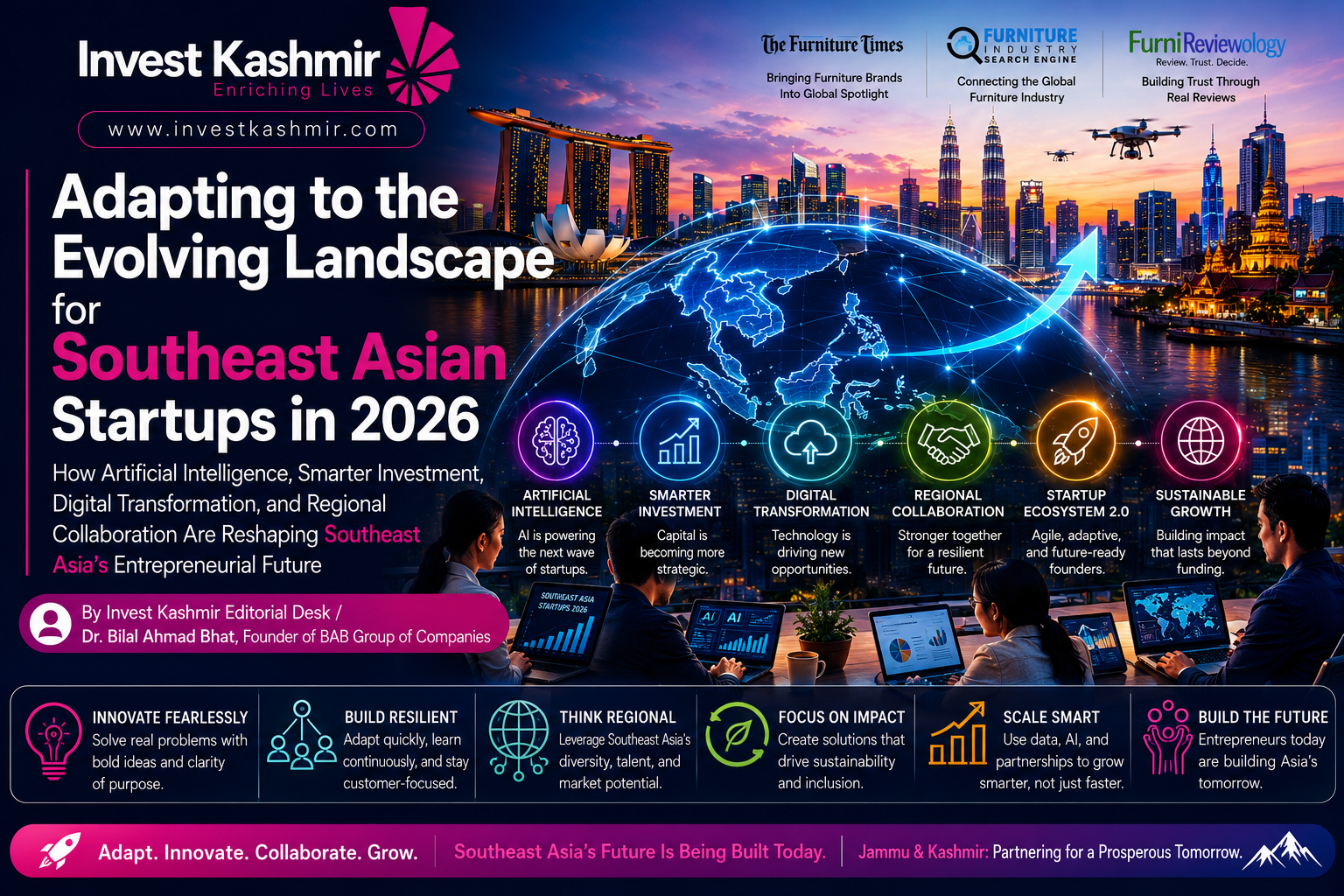
How Artificial Intelligence, Smarter Investment, Digital Transformation, and Regional Collaboration Are Reshaping Southeast Asia’s Entrepreneurial Future
By Invest Kashmir Editorial Desk / Dr. Bilal Ahmad Bhat, Founder of BAB Group of Companies
Southeast Asia has emerged as one of the world’s most exciting regions for entrepreneurship and innovation. Comprising dynamic economies such as Singapore, Indonesia, Malaysia, Thailand, Vietnam, the Philippines, Brunei, Cambodia, Laos, Myanmar, and Timor-Leste, the region is home to more than 680 million people and one of the fastest-growing digital economies globally.
Over the past decade, Southeast Asia has produced globally recognized technology companies, attracted billions of dollars in venture capital, accelerated digital transformation, and built thriving startup ecosystems that continue to reshape industries including financial technology, e-commerce, logistics, healthcare, education, agriculture, artificial intelligence, climate technology, and manufacturing.
However, 2026 represents a new chapter.
The era of rapid expansion driven primarily by abundant venture capital is giving way to a more disciplined ecosystem focused on profitability, operational excellence, technological innovation, and sustainable growth. While investment activity remains strong, investors are becoming increasingly selective, favouring startups with proven business models, clear customer value, strong governance, and scalable technology. Recent market data show that funding in Southeast Asia has become increasingly concentrated in larger, later-stage companies, while investors continue to prioritize AI, infrastructure, deep technology, and businesses with sustainable fundamentals.
For Jammu & Kashmir, Southeast Asia offers an important case study. The region demonstrates how coordinated investment in entrepreneurship, technology, education, digital infrastructure, and public-private partnerships can transform emerging economies into globally competitive innovation hubs.
Southeast Asia’s Entrepreneurial Transformation
Only a decade ago, Southeast Asia was primarily recognized as an attractive consumer market.
Today, it has become an innovation ecosystem where startups develop technologies serving both regional and global customers.
The region has experienced remarkable growth across sectors such as:
- Financial Technology (FinTech)
- Artificial Intelligence
- Digital Commerce
- HealthTech
- AgriTech
- Logistics Technology
- Climate Technology
- Education Technology
- Enterprise Software
- Smart Manufacturing
These industries continue to generate employment, attract international investment, and strengthen regional competitiveness.
A More Selective Investment Environment
The venture capital landscape has matured.
Earlier investment cycles often rewarded aggressive customer acquisition and rapid expansion.
Today’s investors increasingly evaluate:
- Sustainable revenue growth
- Capital efficiency
- Product-market fit
- Customer retention
- Strong leadership
- Financial discipline
- Long-term scalability
Rather than reducing innovation, this shift is encouraging entrepreneurs to build stronger businesses capable of long-term success.
Industry reports indicate that funding values have increased because of larger investments in fewer high-quality companies, while overall deal activity remains comparatively selective.
Artificial Intelligence Is Reshaping Southeast Asia
Artificial Intelligence has become one of the strongest drivers of startup creation across Southeast Asia.
Governments and private investors are supporting AI applications in:
- Healthcare
- Banking
- Manufacturing
- Agriculture
- Retail
- Logistics
- Education
- Customer Service
- Cybersecurity
Singapore continues to strengthen its position as a regional AI hub, while Malaysia, Vietnam, Indonesia, and the Philippines are expanding investment in digital infrastructure, research, cloud computing, and AI-enabled services.
Rather than replacing human talent, AI is enabling startups to improve productivity, automate routine processes, develop smarter products, and scale more efficiently.
Singapore Continues to Lead
Among Southeast Asian nations, Singapore remains the region’s strongest startup ecosystem.
Its success is supported by:
- Stable regulatory frameworks
- Global financial connectivity
- Strong universities
- Skilled workforce
- Advanced digital infrastructure
- Active venture capital community
- Government innovation initiatives
Recent funding data also show Singapore continuing to account for the majority of regional venture investment, reinforcing its role as Southeast Asia’s gateway for technology companies.
Indonesia’s Expanding Innovation Economy
Indonesia’s large domestic market continues to create opportunities for entrepreneurs developing solutions in:
- Digital payments
- Agriculture
- Logistics
- Healthcare
- Education
- Food Technology
- Artificial Intelligence
Its rapidly expanding digital economy encourages startups to develop scalable solutions addressing both urban and rural communities.
Vietnam’s Manufacturing Advantage
Vietnam increasingly combines advanced manufacturing with technology entrepreneurship.
Startups are emerging across:
- Industrial technology
- Supply chain innovation
- Smart manufacturing
- Software development
- Artificial Intelligence
Strong export-oriented industries provide opportunities for technology integration throughout manufacturing value chains.
Malaysia’s Growing Digital Economy
Malaysia continues strengthening its startup ecosystem through investments in:
- Digital transformation
- Artificial Intelligence
- Cloud infrastructure
- Green technology
- Healthcare innovation
- Smart manufacturing
Government initiatives supporting technology adoption and entrepreneurship continue attracting both domestic and international investment.
Thailand and the Future of Smart Industries
Thailand is accelerating innovation across:
- Smart tourism
- Electric mobility
- Healthcare
- Robotics
- Food innovation
- Advanced manufacturing
Technology increasingly complements traditional economic strengths while supporting sustainable development.
The Rise of Climate Technology
Climate resilience has become a major investment theme across Southeast Asia.
Startups are developing solutions focused on:
- Renewable energy
- Carbon management
- Sustainable agriculture
- Circular economy
- Waste management
- Water conservation
Investors increasingly view climate innovation as both an environmental necessity and a long-term commercial opportunity.
HealthTech and AgriTech Continue to Expand
Healthcare and agriculture remain two of Southeast Asia’s fastest-growing innovation sectors.
HealthTech innovations include:
- Telemedicine
- AI diagnostics
- Digital health platforms
- Medical software
- Remote patient monitoring
AgriTech solutions include:
- Precision farming
- Smart irrigation
- Drone technology
- Farm analytics
- Digital marketplaces
- Climate-smart agriculture
These sectors are particularly relevant for Jammu & Kashmir because of similar opportunities within healthcare, horticulture, and agriculture.
Startups Are Becoming More Global
One notable trend is the international outlook of Southeast Asian entrepreneurs.
Many startups now design products for global markets from the beginning.
This includes:
- Multilingual platforms
- International partnerships
- Cross-border payments
- Export-oriented digital services
- Global cloud infrastructure
Thinking globally while solving local challenges has become an important competitive advantage.
The Importance of Talent
Technology alone does not build successful startups.
People do.
High-performing ecosystems invest heavily in:
- Entrepreneurship education
- Digital skills
- Leadership development
- Research
- Innovation culture
- Technical training
Talent remains one of the most valuable assets within every innovation ecosystem.
Lessons for Jammu & Kashmir
Southeast Asia offers several valuable lessons for emerging startup ecosystems.
Build Strong Public-Private Partnerships
Governments, universities, investors, and industry should collaborate to support entrepreneurship.
Focus on Sectoral Strengths
Rather than attempting to compete across every industry, regions should build upon existing competitive advantages.
For Jammu & Kashmir, these include:
- Tourism Technology
- AgriTech
- HealthTech
- Renewable Energy
- Food Processing
- Artificial Intelligence
- Handicrafts
- Digital Services
Encourage Startup Financing
Access to seed funding, angel investment, venture capital, and innovation grants remains essential for startup growth.
Strengthen Research Commercialization
Universities should actively support technology transfer, intellectual property development, and startup incubation.
Invest in Digital Infrastructure
Reliable connectivity enables entrepreneurship, innovation, education, healthcare, and digital commerce.
Building an Innovation Ecosystem
A successful startup ecosystem depends upon collaboration among:
- Entrepreneurs
- Universities
- Investors
- Incubators
- Accelerators
- Government agencies
- Financial institutions
- Industry associations
- Technology companies
When these stakeholders work together, innovation becomes scalable, investment increases, and economic resilience strengthens.
Looking Ahead
The Southeast Asian startup ecosystem is entering a more mature phase.
Success is no longer measured solely by funding rounds or valuations.
It is increasingly measured by:
- Sustainable business models
- Customer value
- Technological innovation
- Responsible leadership
- Global competitiveness
- Long-term resilience
This evolution presents important lessons for emerging innovation regions.
For Jammu & Kashmir, the objective is not to replicate Southeast Asia’s startup ecosystem.
It is to understand its principles.
Invest in people.
Encourage innovation.
Support entrepreneurs.
Strengthen universities.
Protect intellectual property.
Embrace Artificial Intelligence.
Promote responsible investment.
Build globally competitive businesses rooted in local strengths.
The future belongs to startup ecosystems that combine vision with execution, technology with human talent, and innovation with sustainability.
Southeast Asia’s journey demonstrates that with strategic planning, collaborative leadership, and continuous adaptation, emerging regions can become global centres of entrepreneurship.
Jammu & Kashmir possesses the talent, resources, and entrepreneurial spirit to write its own success story in this new era of innovation.