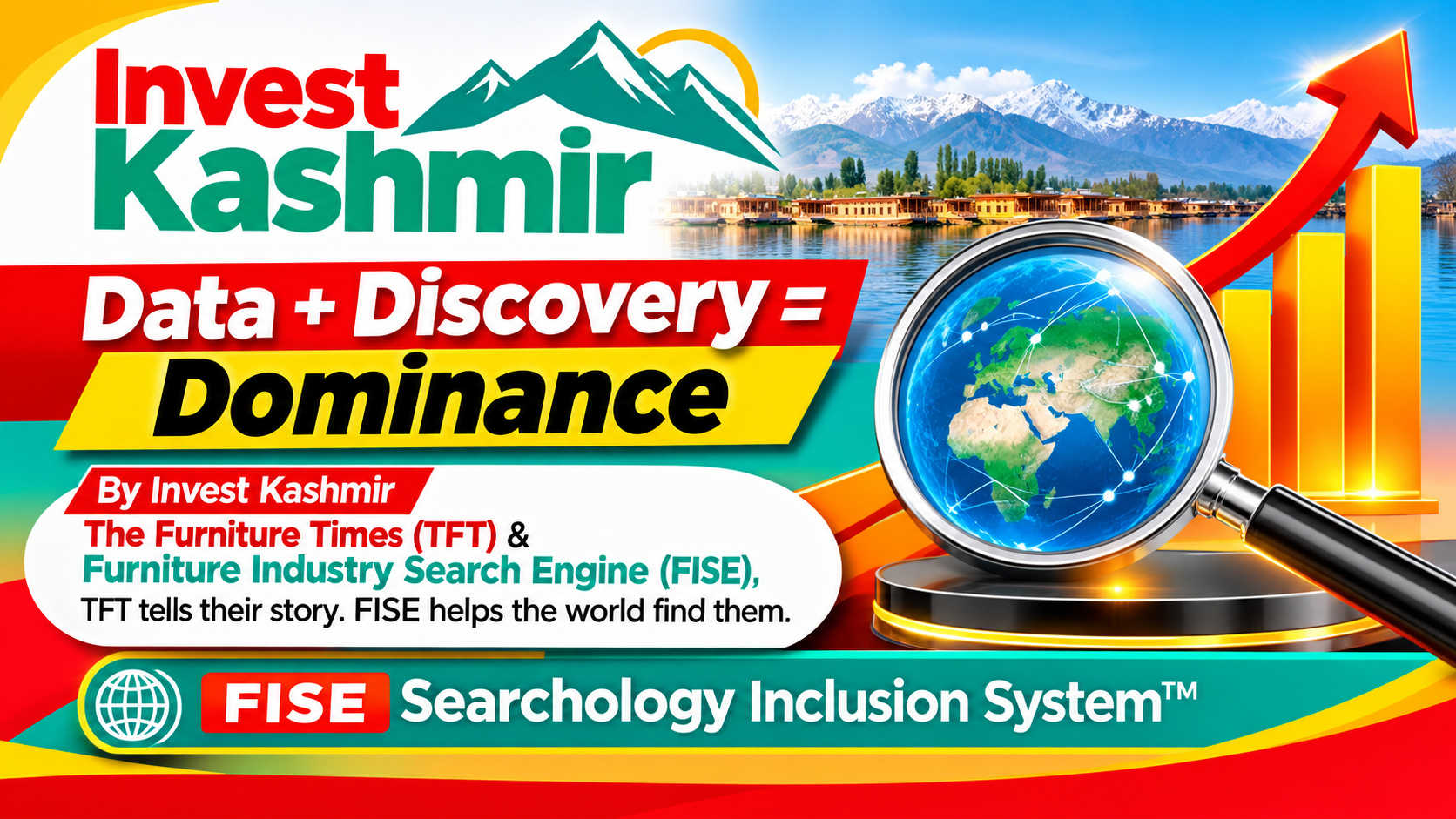

Featuring the vision of BAB Group of Companies | The Furniture Times (TFT) | Furniture Industry Search Engine (FISE) | FISE LIVE | FISE Searchology Inclusion System™
A business can have an excellent product, years of experience, talented people, competitive pricing, and the determination to grow. Yet it can still struggle to attract customers, secure partnerships, or reach international markets.
Why?
Because the world cannot choose a business it cannot discover.
This is one of the most overlooked challenges facing today’s entrepreneurs, small and medium-sized enterprises (SMEs), manufacturers, independent artisans, makers, and grassroots creators. They are building, producing, innovating, and serving customers, but a significant part of their potential audience may never know they exist.
This is The Invisible Business Problem.
It is not always a problem of product quality. It is not necessarily a lack of ambition, hard work, or business knowledge. Sometimes, the real problem is that the business is missing from the places where customers search, buyers explore, and opportunities emerge.
In an economy increasingly influenced by digital discovery, being good is important. Being discoverable is becoming essential.
Through the broader vision of BAB Group of Companies, The Furniture Times (TFT), Furniture Industry Search Engine (FISE), FISE LIVE, and the FISE Searchology Inclusion System™, a powerful question deserves attention:
How many valuable businesses are losing opportunities simply because the right people cannot find them?
1. The Biggest Business Problem Nobody Talks About: Being Invisible
Imagine two furniture manufacturers.
The first company produces excellent furniture. It has skilled workers, reliable production capabilities, and years of experience. However, its online presence is limited. Its business information is scattered, its products are difficult to discover, and international buyers rarely encounter its brand.
The second company offers comparable products but has a well-organized digital identity, accessible business information, professional product presentations, and a stronger presence across relevant discovery channels.
When a buyer searches online, which business has a better chance of being considered?
Often, it is the business that is easier to find and understand.
This does not mean the second company necessarily produces better furniture. It means that visibility influences the opportunity to compete.
The same situation exists across industries.
A talented artisan may create exceptional handmade products but struggle to reach customers beyond the local community. A small manufacturer may have the capacity to fulfil larger orders but lack exposure to international buyers. A grassroots entrepreneur may develop a valuable product but have no structured way to introduce it to the wider market.
Their problem is not necessarily a lack of value.
Their problem may be a lack of visibility.
A business that remains invisible cannot fully participate in the opportunities created by a connected digital economy.
This is why business owners must stop treating discoverability as an optional marketing activity. It deserves a place in the business growth strategy.
2. Your Competitors May Not Be Better. They May Simply Be Easier to Discover.
Competition has changed.
Businesses once depended heavily on physical locations, referrals, exhibitions, trade networks, newspapers, and traditional advertising. These channels remain relevant, but digital discovery has added another important layer to how buyers identify potential suppliers and service providers.
Today, a potential customer may search for a product before visiting a showroom. An international buyer may research manufacturers before arranging a meeting. A retailer may compare suppliers online before requesting a quotation.
In many cases, the first impression happens before a direct conversation.
This creates a significant difference between having a business and having a discoverable business.
Consider what happens when a customer searches for a specific product or service.
If your business information is incomplete, your website is difficult to navigate, your product descriptions are unclear, or your company has little presence in relevant industry environments, the customer may never reach you.
Meanwhile, another business may receive the enquiry simply because its information is easier to locate.
That is the invisible cost of weak discoverability.
It can mean missed enquiries, fewer qualified leads, limited brand recognition, and reduced opportunities to enter new markets.
The uncomfortable reality is that the market cannot evaluate the value of a business it never encounters.
Entrepreneurs must therefore think beyond producing excellent products. They must also build a digital presence that allows the right audiences to understand what they offer.
3. The Invisible Business Problem Is Bigger for SMEs, Artisans and Grassroots Creators
Large companies often have advantages that smaller businesses cannot easily match.
They may have dedicated marketing departments, established distribution networks, professional communication teams, significant advertising budgets, and extensive brand recognition.
Smaller businesses frequently operate with limited resources.
The owner may manage production, sales, customer service, accounts, marketing, and daily operations. Digital marketing becomes another responsibility competing for limited time and money.
An independent artisan may have exceptional craftsmanship but limited technical knowledge. A small manufacturer may understand production better than digital positioning. A grassroots creator may have a promising idea but no access to established commercial networks.
The result is an uneven digital environment.
Businesses with larger resources can often maintain a stronger presence, while smaller businesses struggle to communicate their value.
This is where digital inclusion becomes important.
The future of business discovery should not be designed only around companies that can afford expensive marketing campaigns. It should also recognize the needs of businesses that have valuable products, specialized knowledge, and meaningful contributions but limited access to visibility.
SMEs need opportunities to present their capabilities.
Artisans need opportunities to communicate their craftsmanship.
Makers need opportunities to introduce their creations.
Grassroots creators need opportunities to establish a recognizable digital identity.
These businesses should not have to remain invisible simply because they lack the marketing infrastructure of larger competitors.
4. Visibility Is Not Vanity. It Is a Business Growth Requirement.
Some entrepreneurs still associate visibility with social media followers, likes, website traffic, or online popularity.
But meaningful business visibility goes much further.
It means being discoverable by the people who are most likely to need what your business offers.
A furniture manufacturer does not simply need thousands of random visitors. It needs relevant buyers, retailers, distributors, interior designers, project developers, and business partners.
An artisan does not necessarily need millions of views. The artisan needs audiences that appreciate the product, understand its value, and have an interest in purchasing it.
A small enterprise does not need attention without purpose. It needs visibility that supports meaningful commercial conversations.
This distinction is critical.
The objective is not to be seen by everyone. The objective is to become easier to find by the right people.
Businesses should evaluate their visibility through practical questions:
- Can a potential customer find the company when searching for its products or services?
- Is the business information accurate and consistent?
- Can buyers understand what the company offers?
- Are its products and capabilities clearly presented?
- Is there a straightforward way to request information or contact the business?
- Does the business have a recognizable digital identity?
- Can its story reach audiences beyond its immediate geographical market?
If the answers are unclear, the business may have a discoverability problem that deserves immediate attention.
5. The Furniture Times (TFT): Every Business Has a Story Worth Discovering
Behind every business is a story.
A furniture manufacturer represents years of production experience, investment, design decisions, and the dedication of its workforce.
An artisan represents knowledge, creativity, craftsmanship, and often a tradition passed from one generation to another.
A startup represents an idea that someone decided was worth pursuing.
A small enterprise represents people who took risks, created opportunities, and continued building despite challenges.
Yet many of these stories remain untold.
The Furniture Times (TFT), within the wider BAB Group of Companies vision, places business storytelling at the centre of industry visibility.
Its guiding principle is simple:
TFT tells their story.
Business storytelling helps audiences understand more than what a company sells. It communicates who is behind the business, what the company creates, what makes its work distinctive, and why its contribution matters.
For smaller enterprises, this can be particularly valuable.
A professional business story can help communicate experience, introduce products, explain capabilities, highlight achievements, and establish a clearer identity.
For manufacturers, it can help buyers understand production strengths.
For artisans, it can bring attention to craftsmanship and creative identity.
For entrepreneurs, it can communicate the journey behind a business.
For industry participants, it can create opportunities to learn about companies, developments, and people they may not otherwise encounter.
A business should not underestimate the value of its story.
Your competitors are communicating their identities. Your customers are looking for information. Your potential partners are evaluating opportunities.
If your story remains hidden, you are missing an important opportunity to introduce your business to the world.
6. FISE: Helping the World Find Businesses That Deserve to Be Discovered
A powerful story is valuable, but storytelling alone does not solve the discovery problem.
People must also be able to find the business when they are searching for relevant products, suppliers, manufacturers, services, and industry opportunities.
This is where the Furniture Industry Search Engine (FISE) enters the wider vision.
FISE helps the world find them.
FISE represents an industry-focused discovery approach intended to make relevant business information easier to locate and explore.
Think about a buyer searching for a furniture manufacturer with particular production capabilities.
Think about a retailer looking for new suppliers, an interior designer searching for a specialized maker, or a hospitality company researching furniture partners.
A discovery-focused environment can help organize business information and make it easier for relevant audiences to identify potential companies.
For participating businesses, the opportunity is to establish a more structured digital presence and improve their potential for industry discovery.
For buyers, the objective is to make it easier to explore relevant businesses and identify possible connections.
The important distinction is that a business listing should not be viewed as the ultimate outcome.
The larger objective is meaningful discovery.
A business needs to communicate what it offers, provide accurate information, and make it possible for interested audiences to take the next step.
FISE’s broader vision addresses the need for a more connected discovery environment where businesses can become easier to identify and explore.
TFT tells the world who they are. FISE helps the world find them.
Together, these two ideas communicate a powerful approach to overcoming business invisibility: storytelling combined with discoverability.
7. FISE LIVE: Moving Beyond Static Business Visibility
Business discovery is changing.
Customers and buyers increasingly expect useful information, accessible communication, and more engaging ways to understand the businesses they encounter online.
A static business profile can introduce a company, but businesses also need ways to communicate, demonstrate value, and build meaningful connections.
FISE LIVE forms part of the broader FISE ecosystem, representing another dimension of digital visibility and engagement.
Its wider opportunity is connected to the idea that business discovery should not end with finding a name in a directory.
People want to understand what a business does, what it offers, and whether it can meet their requirements.
A more connected digital environment can help businesses communicate their identities, introduce their capabilities, and participate in industry conversations.
For an SME, this can support stronger engagement with prospective audiences.
For a manufacturer, it can provide another opportunity to communicate its business identity.
For an artisan or independent maker, it reinforces the importance of making creative work and business information accessible.
The real value of any live or interactive platform depends on the quality of its features, participation, accessibility, and the usefulness of the interactions it enables.
The direction is clear: businesses need more than an online address. They need meaningful ways to be discovered and understood.
8. FISE Searchology Inclusion System™: A Global Visibility Engine for Businesses That Are Often Overlooked
The invisible business problem requires more than another conventional listing approach.
It requires a wider understanding of who deserves access to digital discovery and why business visibility matters.
The FISE Searchology Inclusion System™ is built around a global visibility vision for SMEs, artisans, makers, and grassroots creators.
Its central philosophy is that businesses should have opportunities to establish a digital identity, improve discoverability, and participate in a more connected economy.
This is not just a business listing system.
It represents a broader vision built around five interconnected dimensions.
A Livelihood System
Behind every small business is a livelihood.
A furniture workshop may support several families. A local manufacturer may employ skilled workers. An artisan may depend on consistent orders to continue practising a traditional craft.
When a business gains access to relevant audiences, new commercial opportunities may emerge.
Those opportunities can potentially support income, employment, production, supplier relationships, and business continuity.
This is why discoverability has a human and economic dimension.
The objective is not simply to display business information. It is to improve the conditions under which valuable businesses can connect with potential customers.
Visibility alone cannot guarantee income, but it can help create another pathway toward commercial opportunity.
A Human Impact System
Technology is important, but people should remain at the centre of digital transformation.
Every business represents human effort, ambition, skills, and responsibility.
A successful discovery can mean more than a website visit. It may lead to an enquiry, a business relationship, a new customer, or an opportunity to expand operations.
A small creator who reaches a new market may gain recognition for years of work. A manufacturer who connects with a new buyer may have an opportunity to increase production. A grassroots business may gain the confidence and visibility needed to pursue further growth.
These possibilities illustrate why digital inclusion must be measured through meaningful human outcomes, not just platform activity.
The system’s human impact vision recognizes that businesses are built by people, and the opportunities created through technology should have the potential to benefit them.
A Search Revolution
Search should help people find what they actually need.
A buyer looking for a furniture supplier needs relevant information. A retailer searching for manufacturers needs businesses that match specific requirements. A customer exploring handmade products needs a way to identify relevant artisans and makers.
The challenge is to make business information easier to organize, understand, and discover.
The FISE Searchology Inclusion System™ places this challenge within a broader search innovation vision.
It recognizes that discovery should consider more than business names. Relevant information may include products, capabilities, industry categories, specializations, and other useful business details.
The objective is to make discovery more meaningful and inclusive.
A search revolution should not simply produce more information. It should help people navigate information more effectively.
A Digital Identity Movement
A business without a clear digital identity can be difficult to recognize and evaluate.
Imagine a buyer discovering a company but finding no reliable product descriptions, inconsistent contact details, limited photographs, or unclear information about its capabilities.
The buyer may decide to move on.
A stronger digital identity helps reduce this uncertainty.
It communicates who the business is, what it offers, what makes it distinctive, and how interested people can make contact.
For SMEs, this can be a valuable foundation for professional growth.
For artisans and makers, it can help communicate craftsmanship and product identity.
For grassroots creators, it can establish a recognizable presence that supports future discovery.
The FISE Searchology Inclusion System™ vision places digital identity at the heart of inclusion because businesses need to be identifiable before they can build recognition.
A Global Opportunity Engine
Geography should not be the only factor determining whether a business can reach potential customers.
A small manufacturer may have products suitable for international markets. An artisan may create work that appeals to customers outside the local community. An SME may have capabilities that match the requirements of a buyer in another country.
However, international discovery requires accurate information, market relevance, trust, competitive offerings, and effective communication.
The broader global opportunity vision is about helping businesses become more visible to audiences beyond their immediate networks.
It is about creating possibilities for connections that may otherwise never happen.
The objective is simple: give more businesses a meaningful opportunity to be discovered, considered, and connected.
9. Why Being Invisible Can Cost a Business More Than Advertising
Many businesses assume that their only route to visibility is paid advertising.
Advertising can be useful, but it is not the only component of a sustainable discovery strategy.
Businesses can build a stronger digital foundation through consistent and purposeful activities.
These include publishing useful information, maintaining an accurate business profile, creating professional product descriptions, sharing business stories, improving website structure, developing relevant industry connections, and participating in suitable discovery environments.
The challenge is that many businesses do not have a structured approach.
They publish occasionally without a clear strategy. They create social media accounts but leave business information incomplete. They develop websites without considering how customers search for their products.
The result is a scattered digital presence.
A stronger approach connects the different parts of business visibility.
Your website should explain your business. Your product pages should answer customer questions. Your business profiles should provide accurate information. Your stories should communicate your value. Your calls to action should make the next step obvious.
This is where a structured discovery ecosystem can become relevant.
The objective is not to replace every existing marketing channel. It is to make the business’s overall digital identity more coherent and discoverable.
Businesses with limited budgets should particularly focus on activities that create lasting value rather than spending money on visibility without a clear commercial objective.
10. The New Business Reality: If Customers Cannot Find You, They May Never Consider You
Consider how customers make decisions today.
A buyer may search online, compare companies, examine products, review available information, and shortlist potential suppliers before contacting anyone.
A company that is difficult to find may never enter that shortlist.
This is an important shift.
In the past, some businesses could depend heavily on local recognition and existing networks. Today, customers may discover alternatives from other locations, regions, and countries.
Your next competitor may not be located on the same street or in the same city.
It may be a business that appears when your potential customer searches online.
This creates an urgent responsibility for entrepreneurs.
They must understand how their target audiences discover products and services. They must ensure that the business appears in relevant environments and communicates its value clearly.
The question is not whether your company has a social media page.
The question is whether the right audience can discover your business when it matters.
If you cannot answer that question confidently, it is time to review your digital strategy.
11. Seven Actions Every Business Should Take to Become More Discoverable
Understanding the invisible business problem is only the beginning. Entrepreneurs need practical steps that can turn awareness into action.
First: Establish a clear digital identity.
Make sure your business name, location, contact details, website, products, and services are presented accurately. Consistency helps people recognize and understand your company.
Second: Explain what you actually offer.
Avoid vague descriptions. A potential customer should quickly understand your products, capabilities, target market, and value proposition.
Third: Invest in professional product presentation.
Use clear photographs, meaningful descriptions, accurate specifications, and useful information. Product presentation helps buyers assess whether your offering is relevant to their needs.
Fourth: Tell your business story.
Explain your experience, mission, craftsmanship, manufacturing capabilities, achievements, and the people behind the company. Authentic stories can help distinguish your business from competitors.
Fifth: Build a search-friendly website.
Create useful pages around the products and services your customers actually search for. Use descriptive headings, clear language, relevant keywords, structured information, and straightforward navigation.
Sixth: Explore relevant discovery platforms.
Identify industry-focused platforms, professional networks, business discovery environments, and opportunities that match your sector. Evaluate their relevance, transparency, reach, and participation requirements before investing.
Seventh: Convert discovery into action.
Make it easy for potential customers to request quotations, contact your team, explore your catalogue, or discuss a partnership. Respond professionally and track which activities generate qualified enquiries.
These actions do not require every business to have a large marketing department.
They require clarity, consistency, and a willingness to make discoverability part of everyday business development.
12. Invest Kashmir: Why Business Visibility Matters for Emerging Markets and Local Entrepreneurs
For emerging business communities, visibility can have an important role in connecting local capabilities with wider opportunities.
Regions with talented entrepreneurs, skilled workers, independent manufacturers, artisans, and creators may have significant economic potential. Yet their businesses can remain difficult to discover outside established networks.
This creates an opportunity to think differently about business development.
Local entrepreneurs need more than encouragement to start businesses. They also need access to information, networks, relevant audiences, and opportunities to communicate what they produce.
A small enterprise should be able to explain its capabilities to a prospective buyer.
An artisan should have opportunities to introduce handmade products to relevant audiences.
A manufacturer should be able to present its production strengths and explore potential commercial relationships.
A grassroots creator should have a pathway to establish a recognizable business identity.
From the perspective of Invest Kashmir, the invisible business problem deserves attention because business potential must be connected with market opportunity.
Entrepreneurship is not only about starting a company. It is also about building the conditions that allow businesses to become sustainable, competitive, and connected.
Regional business development can benefit from better digital discoverability, stronger business storytelling, and more structured access to relevant industry environments.
The broader BAB Group of Companies ecosystem offers a vision worth examining in this context.
Through TFT, FISE, FISE LIVE, and the FISE Searchology Inclusion System™, the ambition is to connect business identity and discovery with a wider conversation about inclusion and opportunity.
For local businesses, the message is practical: do not allow geographical boundaries or limited exposure to define the full potential of your business.
Build your capabilities. Communicate your value. Strengthen your digital identity. Make it easier for the world to discover what your community has to offer.
13. Why the Future of Business Belongs to Those Who Build Discoverability
The next generation of successful businesses will need more than quality products and competitive pricing.
They will need to communicate clearly, maintain credible information, understand how customers search, and build relationships across digital and physical markets.
Technology will continue to influence how people discover companies and evaluate their offerings.
Search systems, digital platforms, industry networks, business profiles, and AI-powered discovery experiences are changing how information is organized and accessed.
This makes structured, accurate, useful business information increasingly important.
Businesses should not assume that simply publishing content guarantees visibility in search engines or AI-generated answers. Discovery depends on relevance, technical accessibility, content quality, credibility, competition, and the systems being used.
However, the direction is unmistakable: businesses need to make their information easier for both people and digital systems to understand.
A company that clearly communicates its identity, capabilities, products, location, and contact information has a stronger foundation for discoverability than one whose information is incomplete or inconsistent.
This is why digital identity and business discovery should be considered long-term business assets.
The invisible business problem will not disappear by itself. Businesses must take deliberate action to address it.
14. The Real Cost of Waiting: Opportunities Do Not Always Wait for You
There is a danger in postponing digital visibility.
Entrepreneurs often say they will improve their websites later, create professional product descriptions later, publish their business stories later, or explore new discovery platforms when they have more time.
But business opportunities do not necessarily arrive according to an entrepreneur’s schedule.
A buyer may identify a supplier today. A retailer may shortlist manufacturers this week. A customer may make a purchasing decision before an invisible business even knows the opportunity existed.
That is why action matters.
You do not need to transform your entire digital presence overnight. You need to begin with the information and activities that make the greatest difference.
Review your website. Update your business information. Improve your product presentation. Tell your story. Identify where your customers search. Make it easier for them to contact you.
Then build consistently.
The most expensive business mistake may not always be investing in the wrong marketing channel. Sometimes, it is allowing your business to remain invisible while the market moves forward.
15. The Bigger Vision: A More Inclusive Digital Economy
The invisible business problem is not simply about marketing.
It is also about access, representation, opportunity, and participation.
A digital economy should create room for different types of businesses to establish identities and connect with relevant audiences.
It should recognize the contribution of small enterprises, independent makers, skilled artisans, emerging entrepreneurs, and grassroots creators.
It should encourage business information that is useful, accurate, and accessible.
It should create pathways through which local capabilities can become visible beyond local markets.
This is the larger philosophy behind the FISE Searchology Inclusion System™.
It is not just a business listing system.
It is a livelihood system because business discovery can create possibilities for income and employment.
It is a human impact system because behind every business is a person, a family, a team, or a community.
It is a search revolution because relevant business information should be easier to discover and understand.
It is a digital identity movement because every business needs a recognizable and credible presence.
It is a global opportunity engine because businesses should have opportunities to reach relevant audiences beyond their immediate geographical boundaries.
These are ambitious objectives, and their real impact will depend on how effectively the vision is implemented and how much value participating businesses and audiences receive.
But the underlying principle deserves attention:
A more inclusive digital economy must make room for businesses that have value but lack visibility.
Conclusion: Stop Building a Business the World Cannot Find
You can spend years improving your products, developing your skills, building your team, and serving customers.
But if your business remains difficult to discover, a significant part of its potential may remain untapped.
The invisible business problem is real enough to demand attention from every entrepreneur.
It affects small manufacturers, furniture businesses, SMEs, artisans, independent makers, and grassroots creators. It limits the opportunities of businesses that may have something valuable to offer but lack the visibility required to reach relevant audiences.
The answer is not simply to publish more posts or chase more followers.
The answer begins with building a recognizable digital identity, communicating business value, improving discoverability, and creating meaningful pathways between businesses and their potential customers.
Through the wider vision of BAB Group of Companies, The Furniture Times (TFT), Furniture Industry Search Engine (FISE), FISE LIVE, and the FISE Searchology Inclusion System™, storytelling and discovery are brought together as complementary dimensions of business visibility.
TFT tells their story. FISE helps the world find them.
And the larger message is one that every entrepreneur should take seriously:
Do not let your business become the best-kept secret in your industry.
Do not assume that customers will automatically discover you because your products are good.
Do not allow limited exposure to define the boundaries of your ambition.
Make your business easier to find. Make your value easier to understand. Make your identity stronger. Give your story the opportunity to reach the people who need to hear it.
Because the world is full of businesses worth discovering.
The next question is whether yours is one of them.
Invest Kashmir | Bringing attention to business visibility, entrepreneurship, inclusion, and global opportunity.
The Invisible Business Problem is not a reason to give up. It is a reason to become discoverable.
If you are an SME, furniture manufacturer, artisan, independent maker, supplier, or grassroots creator, start by examining your digital presence.
Ask yourself whether a potential customer can find your business, understand your products, recognize your value, and contact you without unnecessary difficulty.
Explore the wider vision of The Furniture Times (TFT), Furniture Industry Search Engine (FISE), FISE LIVE, and the FISE Searchology Inclusion System™ through the relevant official platforms.
Your business deserves the opportunity to be discovered. Start building that opportunity today.