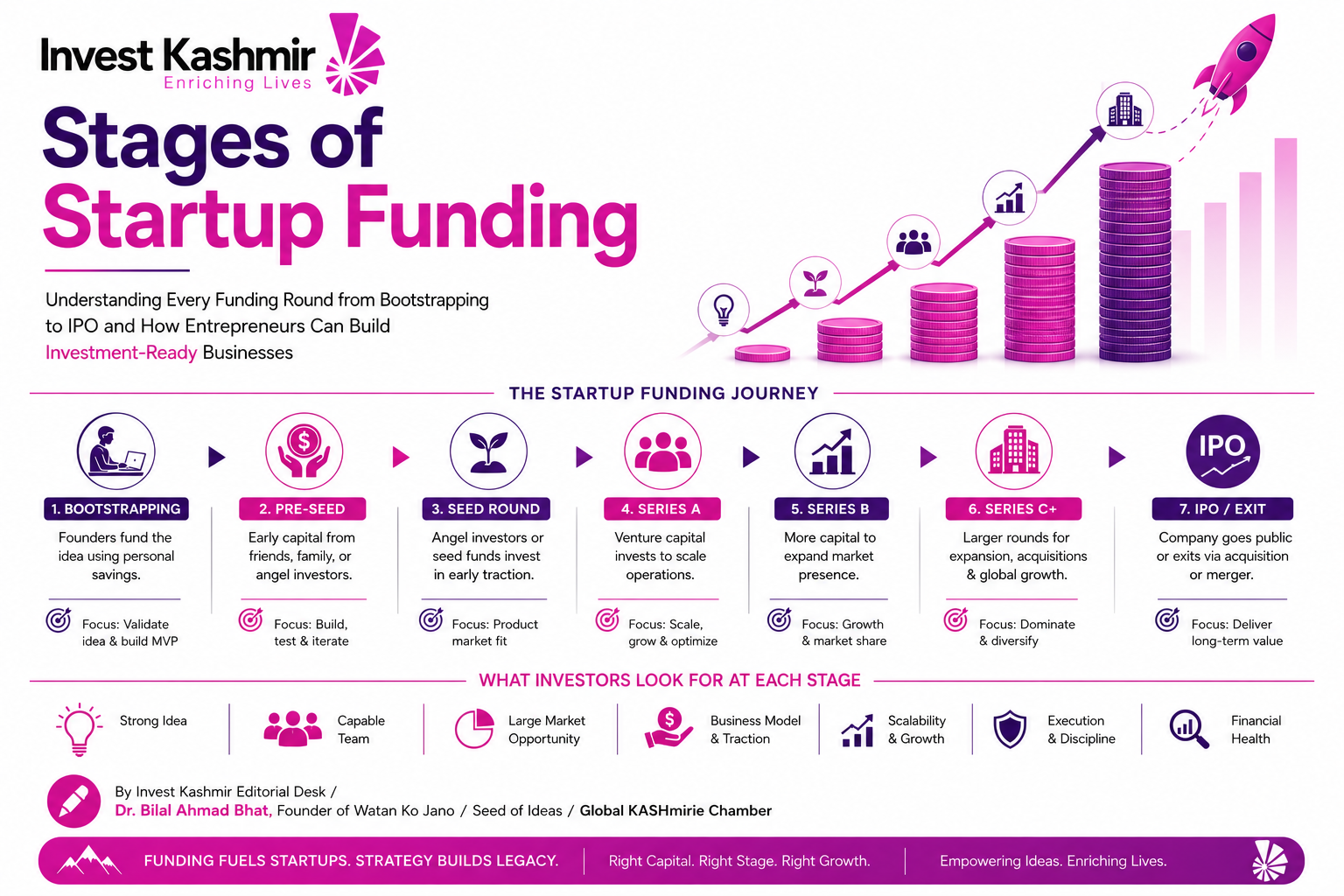
Understanding Every Funding Round from Bootstrapping to IPO and How Entrepreneurs Can Build Investment-Ready Businesses
By Invest Kashmir Editorial Desk / Dr. Bilal Ahmad Bhat, Founder of Watan Ko Jano / Seed of Ideas / Global KASHmirie Chamber
Every successful startup begins with a vision.
Some ideas emerge from everyday problems.
Others originate in research laboratories, universities, manufacturing facilities, farms, hospitals, or technology companies.
Regardless of where the idea begins, every entrepreneur eventually faces one unavoidable challenge:
How do I finance the journey from an idea to a globally successful company?
Funding is one of the most important aspects of entrepreneurship.
Without sufficient capital, even outstanding innovations may struggle to reach customers.
However, raising money is not the true objective.
The true objective is building a valuable, sustainable business.
Funding should accelerate that journey—not replace it.
Modern startup ecosystems have developed a structured funding lifecycle that supports entrepreneurs through different stages of business development. Each funding round reflects increasing business maturity, customer validation, operational capability, and investor confidence.
For Jammu & Kashmir, where entrepreneurship is rapidly expanding across Tourism Technology, AgriTech, HealthTech, Artificial Intelligence, Renewable Energy, Manufacturing, Food Processing, Education Technology, Handicrafts, and Digital Commerce, understanding these funding stages can help founders make smarter financial decisions while preparing for long-term growth.
Why Startup Funding Exists
Capital allows entrepreneurs to transform ideas into businesses.
Funding enables startups to:
- Build products.
- Hire talented people.
- Conduct research.
- Reach customers.
- Expand operations.
- Improve technology.
- Protect intellectual property.
- Scale internationally.
Each funding stage supports different business objectives.
Understanding those objectives helps founders raise the right amount of capital at the right time.
Stage One: Bootstrapping
Every entrepreneurial journey often begins with bootstrapping.
At this stage, founders rely primarily on:
- Personal savings.
- Family support.
- Early customer revenue.
- Personal resources.
The objective is not rapid expansion.
The objective is learning.
Bootstrapping teaches:
- Financial discipline.
- Customer focus.
- Operational efficiency.
- Responsible decision-making.
Many successful companies began without outside investment.
Stage Two: Pre-Seed Funding
Pre-seed funding supports businesses that are transforming ideas into viable opportunities.
Typical activities include:
- Market research.
- Customer interviews.
- Product design.
- Prototype development.
- Business validation.
- Team formation.
Funding often comes from:
- Founders.
- Friends and family.
- Angel investors.
- Startup grants.
- Incubators.
The emphasis at this stage is validating whether the problem is worth solving before significant resources are committed.
Stage Three: Seed Funding
Seed funding represents the transition from concept to business.
By this stage, founders typically possess:
- A Minimum Viable Product (MVP).
- Early users.
- Customer feedback.
- Initial traction.
- Product validation.
Investment is generally used for:
- Product improvement.
- Hiring.
- Customer acquisition.
- Marketing.
- Technology development.
Professional angel investors and early-stage venture capital firms often participate at this stage.
Recent funding trends show that investors are writing larger seed cheques while becoming increasingly selective, favouring startups with stronger products, clearer business models, and measurable traction.
Stage Four: Series A Funding
Series A marks the transition from startup to scalable business.
Investors expect evidence that:
- Customers value the product.
- Revenue is growing.
- Product-market fit exists.
- Leadership is capable.
- The business model works.
Series A funding is commonly used to:
- Expand teams.
- Scale marketing.
- Improve technology.
- Strengthen operations.
- Enter new markets.
Institutional venture capital firms typically become major investors during this stage.
Stage Five: Series B Funding
Series B focuses on accelerating growth.
Companies generally possess:
- Established customer bases.
- Growing revenues.
- Proven business models.
- Strong operational systems.
Capital supports:
- Geographic expansion.
- Product diversification.
- Senior hiring.
- Infrastructure development.
- International growth.
Growth becomes increasingly systematic rather than experimental.
Stage Six: Series C Funding
Series C supports companies preparing for market leadership.
Funding may be used for:
- International expansion.
- Strategic acquisitions.
- Research and development.
- Large-scale recruitment.
- Market dominance.
By this stage, businesses often resemble mature organisations.
Investment increasingly comes from:
- Growth equity firms.
- Private equity investors.
- Large venture capital funds.
- Institutional investors.
Stage Seven: Series D and Beyond
Not every company requires additional funding beyond Series C.
Those that continue raising capital may use it for:
- New product categories.
- Global acquisitions.
- Advanced technology.
- Delayed IPO preparation.
- Large-scale expansion.
Later funding rounds generally involve lower operational risk because businesses possess stronger financial histories and larger customer bases.
Stage Eight: IPO or Strategic Exit
The final stage for many startups involves:
- Initial Public Offering (IPO).
- Strategic acquisition.
- Merger.
- Private equity acquisition.
An IPO allows public investors to purchase company shares.
Acquisitions allow founders and investors to realise returns while integrating businesses into larger organisations.
Not every successful company pursues an IPO.
Many remain privately owned for decades.
Funding Is About Progress, Not Prestige
Many entrepreneurs mistakenly celebrate fundraising as success.
Investment is not the finish line.
It is a responsibility.
Every funding round increases expectations.
Investors expect:
- Strong governance.
- Responsible financial management.
- Customer growth.
- Revenue expansion.
- Strategic execution.
Capital should create value rather than simply increase valuation.
Investors Evaluate More Than Financials
Professional investors examine:
- Founder capability.
- Leadership.
- Customer traction.
- Market opportunity.
- Product quality.
- Financial discipline.
- Governance.
- Innovation.
- Scalability.
The quality of execution often matters more than the size of the funding request.
Artificial Intelligence Is Changing Startup Funding
Artificial Intelligence has transformed investor priorities.
Today’s investors increasingly support companies developing:
- AI applications.
- DeepTech.
- Healthcare innovation.
- Climate Technology.
- Enterprise Software.
- Robotics.
- Smart Manufacturing.
However, AI alone is not sufficient.
Founders must demonstrate sustainable commercial value alongside technological innovation.
Common Mistakes During Fundraising
Many startups encounter difficulties because they:
- Raise money too early.
- Raise excessive capital.
- Ignore customer validation.
- Focus on valuation instead of value.
- Lack financial discipline.
- Expand before achieving product-market fit.
Successful fundraising begins with building a healthy business.
Opportunities for Jammu & Kashmir
Jammu & Kashmir possesses remarkable entrepreneurial opportunities across:
- Tourism Technology.
- AgriTech.
- HealthTech.
- Artificial Intelligence.
- Renewable Energy.
- Food Processing.
- Horticulture.
- Manufacturing.
- Handicrafts.
- Education Technology.
Founders in these sectors can benefit significantly by understanding how funding aligns with business maturity rather than pursuing investment prematurely.
Universities as Startup Catalysts
Educational institutions can strengthen entrepreneurial success by teaching:
- Startup finance.
- Business valuation.
- Investor readiness.
- Financial modelling.
- Leadership.
- Innovation management.
- Corporate governance.
Entrepreneurship education should prepare founders for both innovation and investment.
Building a Strong Funding Ecosystem
A successful startup ecosystem depends upon collaboration among:
- Entrepreneurs.
- Investors.
- Universities.
- Incubators.
- Accelerators.
- Government agencies.
- Financial institutions.
- Industry associations.
Each stakeholder contributes to transforming ideas into scalable enterprises.
Looking Ahead
Startup funding is not a ladder climbed as quickly as possible.
It is a journey of preparation.
Each stage represents increasing responsibility.
Increasing capability.
Increasing trust.
The entrepreneurs who succeed are not those who raise the most money.
They are those who create the greatest value before asking for investment.
For Jammu & Kashmir, building globally competitive startups requires founders who understand that funding should support customer success, innovation, and sustainable growth—not simply headline valuations.
The future belongs to disciplined entrepreneurs.
Founders who validate before scaling.
Who learn before expanding.
Who build before fundraising.
Because investment follows preparation.
Preparation creates confidence.
Confidence attracts capital.
And capital, when combined with vision, integrity, innovation, and execution, transforms ideas into companies that shape industries, strengthen economies, and inspire future generations.