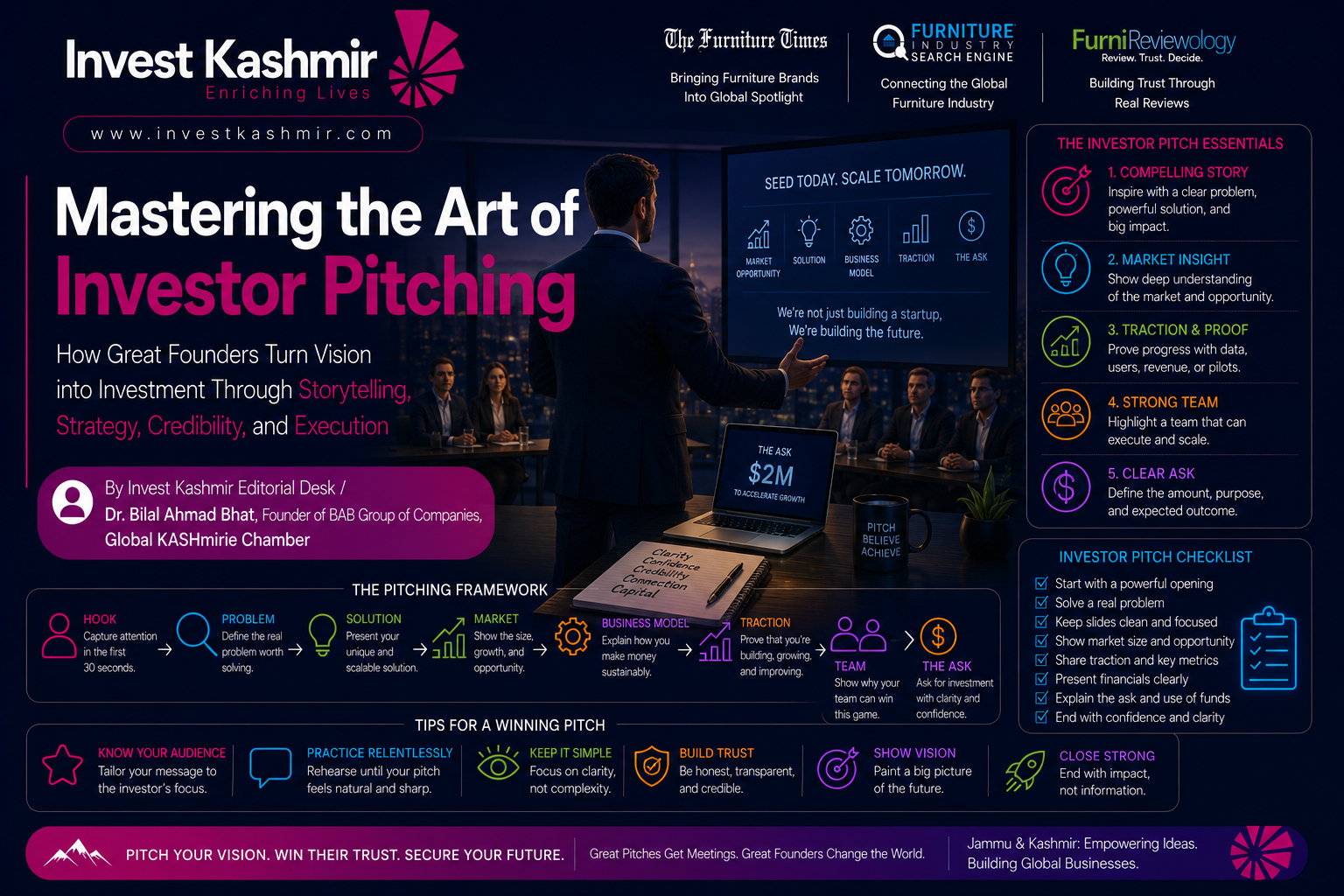
How Great Founders Turn Vision into Investment Through Storytelling, Strategy, Credibility, and Execution
By Invest Kashmir Editorial Desk / Dr. Bilal Ahmad Bhat, Founder of BAB Group of Companies, Global KASHmirie Chamber
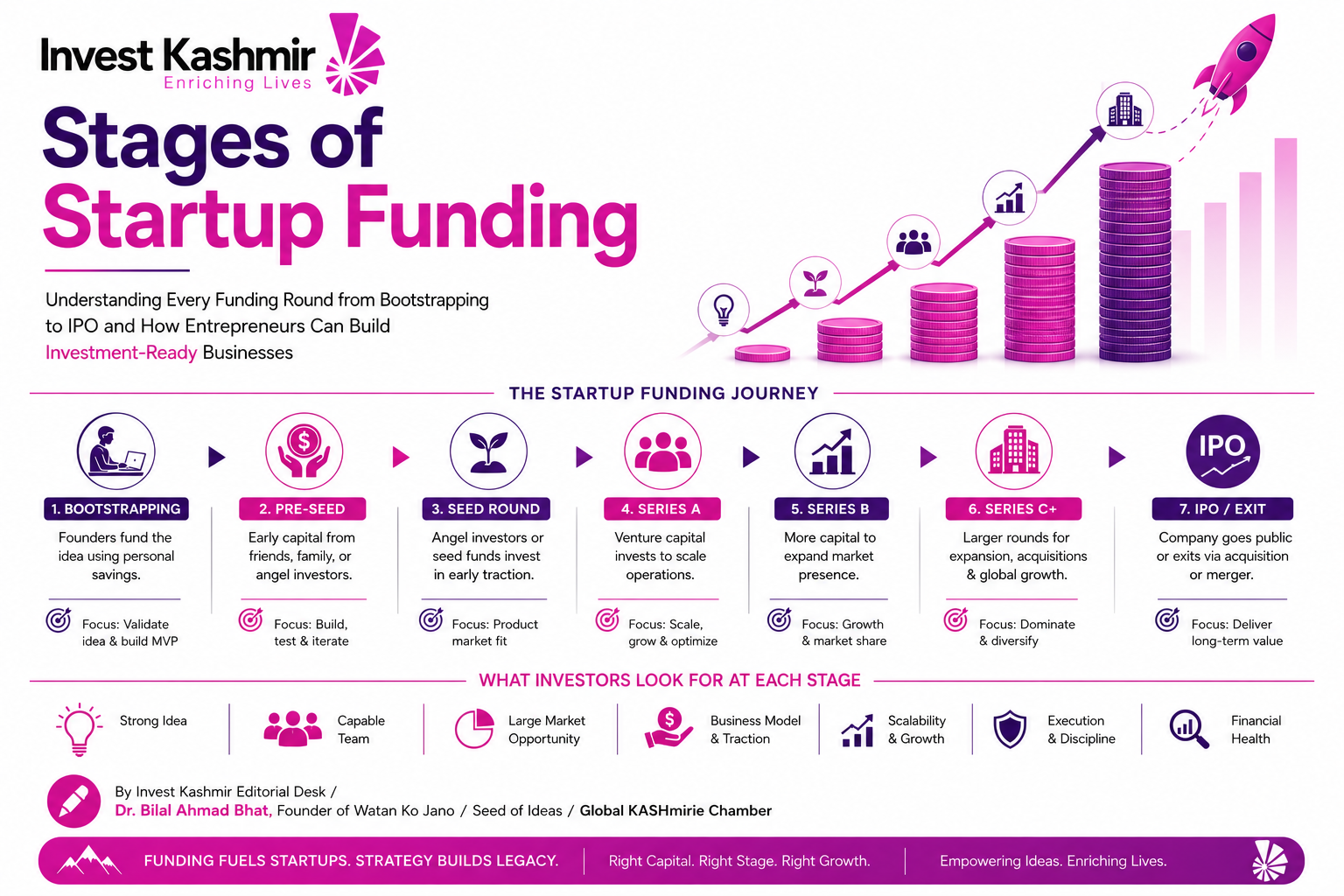
Every startup begins with an idea.
Some ideas solve everyday problems.
Others introduce breakthrough technologies.
Some improve healthcare.
Others transform agriculture, tourism, manufacturing, education, financial services, or renewable energy.
However, regardless of how innovative an idea may be, one challenge eventually confronts every entrepreneur:
How do I convince investors to believe in my vision?
This is where investor pitching becomes one of the most important skills an entrepreneur can develop.
An investor pitch is far more than a presentation.
It is a conversation built on trust.
It is the founder’s opportunity to communicate not only what the company does, but why it matters, why the team can execute successfully, and why the business deserves investment.
The strongest investor pitches do not rely on dramatic promises or exaggerated forecasts.
They combine clarity, evidence, customer understanding, financial discipline, and authentic leadership.
In today’s investment environment, investors increasingly expect founders to demonstrate customer validation, realistic financial planning, capital efficiency, and measurable business progress rather than relying solely on ambitious ideas.
For Jammu & Kashmir, where entrepreneurship is expanding across Tourism Technology, AgriTech, HealthTech, Artificial Intelligence, Renewable Energy, Manufacturing, Food Processing, Education Technology, Handicrafts, and Digital Services, mastering investor pitching will become increasingly important as startups seek regional, national, and international investment.
What Is an Investor Pitch?
An investor pitch is a structured presentation explaining:
- The problem.
- The solution.
- The market opportunity.
- The business model.
- The competitive advantage.
- The leadership team.
- Financial requirements.
- Long-term vision.
Its purpose is not merely to request funding.
Its purpose is to establish confidence.
Investors invest in businesses they understand and founders they trust.
Investors Invest in People First
Products evolve.
Markets change.
Technology advances.
Business models adapt.
Leadership remains constant.
Professional investors frequently evaluate founders before evaluating products.
They ask questions such as:
- Can this team execute?
- Can they adapt?
- Can they solve unexpected challenges?
- Can they lead responsibly?
- Can they build long-term value?
Confidence in leadership often determines investment outcomes.
Begin with the Problem
Every successful startup solves a meaningful problem.
The strongest pitches begin by clearly explaining:
- What challenge exists?
- Who experiences it?
- Why is it important?
- Why has it remained unsolved?
When investors understand the problem, they better appreciate the value of the proposed solution.
Present a Clear Solution
Once the problem is understood, founders should explain:
- How the product works.
- Why it is different.
- What benefits customers receive.
- Why customers choose it.
Complex technical explanations should never overshadow customer value.
Investors ultimately invest in businesses that solve real problems.
Demonstrate Market Opportunity
A brilliant product addressing a very small market may struggle to generate significant returns.
Investors therefore examine:
- Total addressable market.
- Industry growth.
- Customer demand.
- Market trends.
- Competitive landscape.
Founders should present realistic market analysis supported by credible research rather than unrealistic projections.
Explain Your Business Model
Investors need to understand:
- How revenue is generated.
- Who pays.
- Pricing strategy.
- Customer acquisition.
- Profitability potential.
A strong business model demonstrates that innovation can become a sustainable enterprise.
Product-Market Fit Builds Confidence
One of the strongest indicators of startup quality is product-market fit.
Evidence may include:
- Paying customers.
- User growth.
- Customer retention.
- Testimonials.
- Pilot programmes.
- Strategic partnerships.
Customer validation often speaks more convincingly than theoretical projections.
Show the Numbers
Entrepreneurs should understand their financial metrics.
Investors expect founders to discuss:
- Revenue.
- Growth rate.
- Customer acquisition cost.
- Customer lifetime value.
- Gross margin.
- Cash runway.
- Financial projections.
Modern investors increasingly prioritise capital efficiency and evidence-based financial planning over aggressive growth assumptions.
Build a Strong Pitch Deck
Your presentation should support your story—not replace it.
A well-structured pitch deck typically includes:
- Company overview.
- Problem.
- Solution.
- Market.
- Business model.
- Competitive advantage.
- Traction.
- Financials.
- Team.
- Investment request.
Current fundraising guidance generally recommends concise presentations focused on one clear message per slide and a logical narrative that moves from problem to proof.
Tell a Story Investors Remember
Data informs.
Stories persuade.
Every startup has a story.
Why was the company created?
What inspired the founders?
What customer challenge motivated the innovation?
Authentic storytelling helps investors remember businesses long after meetings conclude.
Confidence Without Overstatement
Investors appreciate confidence.
They do not appreciate exaggeration.
Avoid:
- Unrealistic revenue forecasts.
- Unsupported market claims.
- Overpromising timelines.
- Ignoring risks.
Credibility is built through honesty.
Prepare for Difficult Questions
Every investor meeting includes questions.
Common topics include:
- Competition.
- Revenue assumptions.
- Customer acquisition.
- Financial planning.
- Regulatory issues.
- Product development.
- Team capability.
Founders should welcome challenging questions because they demonstrate investor engagement.
Know Exactly What You Need
Many entrepreneurs conclude presentations by asking for “investment.”
Professional investors expect greater precision.
Founders should clearly explain:
- Capital required.
- Intended use of funds.
- Business milestones.
- Expected outcomes.
A specific funding request demonstrates preparation and strategic planning.
Practice Matters
Outstanding pitches are rarely spontaneous.
Successful founders:
- Rehearse regularly.
- Refine presentations.
- Seek feedback.
- Improve communication.
- Adapt to different audiences.
Preparation increases confidence while improving clarity.
Artificial Intelligence and Investor Expectations
Artificial Intelligence is changing entrepreneurship.
However, investors increasingly distinguish between startups using AI as a marketing term and those creating genuine customer value.
Founders should focus on:
- Real customer outcomes.
- Sustainable business models.
- Responsible technology.
- Measurable impact.
Technology should strengthen the business—not become the entire story.
Opportunities for Jammu & Kashmir
Jammu & Kashmir possesses tremendous entrepreneurial opportunities across:
- Tourism Technology.
- AgriTech.
- HealthTech.
- Artificial Intelligence.
- Renewable Energy.
- Food Processing.
- Horticulture.
- Handicrafts.
- Manufacturing.
- Education Technology.
Entrepreneurs within these sectors can attract investment by combining local strengths with globally scalable solutions.
Universities and Investor Readiness
Educational institutions can strengthen entrepreneurship by teaching:
- Business communication.
- Financial modelling.
- Investor relations.
- Startup valuation.
- Business strategy.
- Leadership.
Investor readiness should become an integral part of entrepreneurship education.
Building an Investment Ecosystem
A thriving startup ecosystem depends upon collaboration among:
- Entrepreneurs.
- Investors.
- Universities.
- Incubators.
- Accelerators.
- Government agencies.
- Financial institutions.
- Industry associations.
Together, these stakeholders create environments where innovative businesses can secure funding responsibly and sustainably.
Looking Ahead
Investor pitching is not about delivering the perfect presentation.
It is about communicating genuine value with confidence, preparation, and integrity.
Great founders do not simply sell products.
They present solutions.
They communicate vision.
They demonstrate execution.
They build trust.
For Jammu & Kashmir, developing founders who can confidently engage investors will strengthen the region’s innovation ecosystem, attract new sources of capital, create employment, and encourage sustainable economic growth.
Investment follows confidence.
Confidence follows preparation.
Preparation follows discipline.
And disciplined entrepreneurs build companies that outlast funding cycles and economic uncertainty.
The most successful investor pitch is never the one with the most impressive slides.
It is the one that convinces investors that the founders possess the vision, capability, resilience, and integrity to transform an idea into a business that creates lasting value for customers, communities, and the economy.