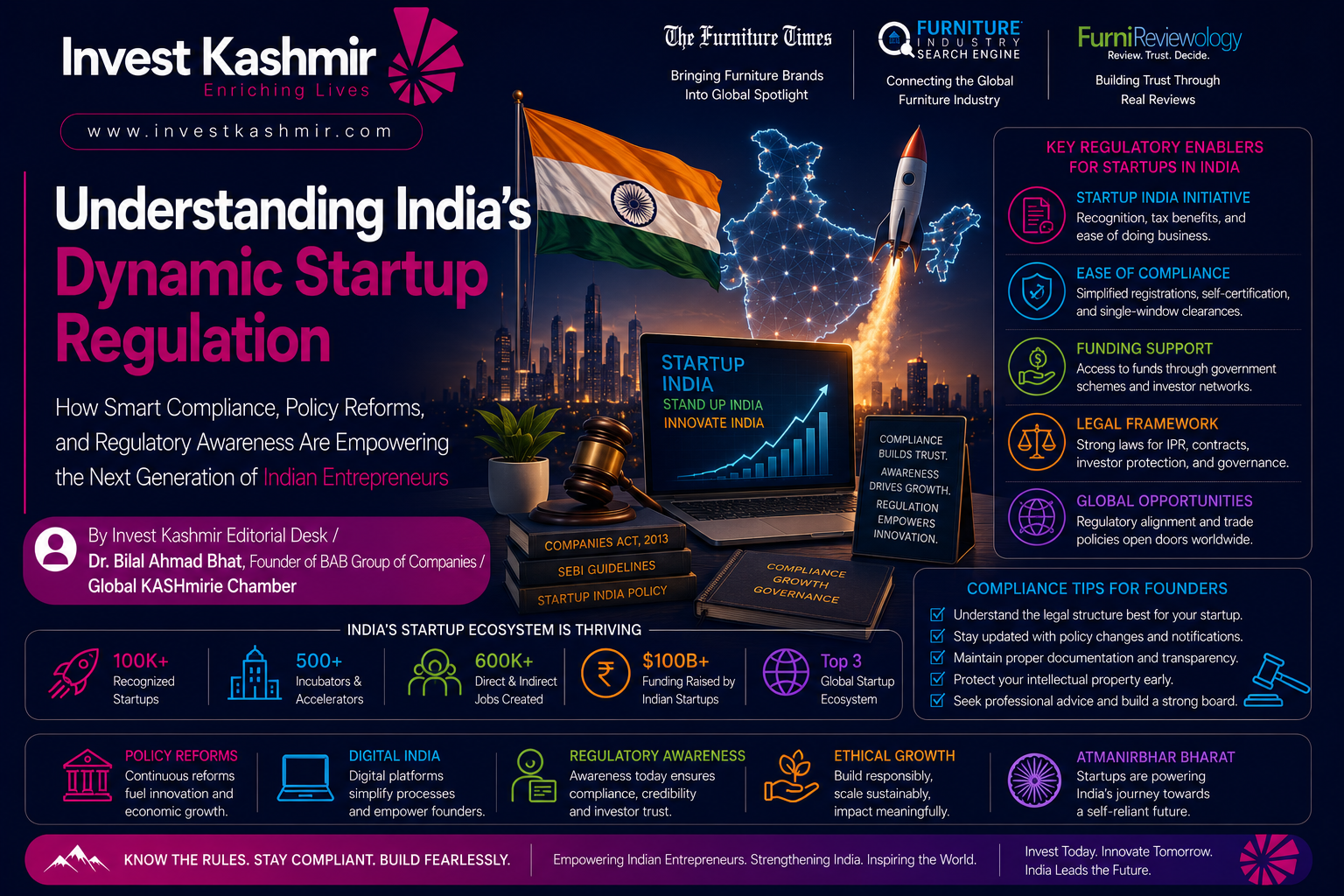
How Smart Compliance, Policy Reforms, and Regulatory Awareness Are Empowering the Next Generation of Indian Entrepreneurs
By Invest Kashmir Editorial Desk / Dr. Bilal Ahmad Bhat, Founder of BAB Group of Companies
India has emerged as one of the world’s most vibrant startup destinations.
From financial technology and Artificial Intelligence to AgriTech, HealthTech, renewable energy, biotechnology, deep technology, logistics, manufacturing, and digital commerce, Indian entrepreneurs are creating innovative businesses that are transforming industries and attracting global investment.
Behind this entrepreneurial momentum lies an equally important foundation—a rapidly evolving regulatory ecosystem.
Modern startups operate in an environment where innovation moves faster than legislation. Governments therefore face an ongoing challenge: encouraging entrepreneurship while maintaining transparency, protecting consumers, ensuring fair competition, and creating sustainable economic growth.
India has responded by continuously modernizing its startup policies through initiatives such as Startup India, DPIIT recognition, regulatory simplification, digital governance, intellectual property support, startup funding initiatives, and easier compliance frameworks. Over the past decade, these reforms have helped establish India as one of the world’s largest startup ecosystems, with more than 200,000 DPIIT-recognised startups and growing participation from Tier-II and Tier-III cities.
For Jammu & Kashmir, where entrepreneurship is expanding across tourism, AgriTech, HealthTech, Artificial Intelligence, food processing, handicrafts, renewable energy, education, and manufacturing, understanding India’s evolving startup regulations is essential for building sustainable, investment-ready businesses.
Why Startup Regulations Matter
Many entrepreneurs view regulations as administrative requirements.
In reality, regulations create the legal framework within which businesses operate.
Strong regulatory systems help:
- Protect entrepreneurs.
- Build investor confidence.
- Improve transparency.
- Encourage innovation.
- Strengthen customer trust.
- Facilitate responsible growth.
Rather than slowing entrepreneurship, well-designed regulations create stable environments where businesses can expand confidently.
India’s Startup Transformation
Since the launch of the Startup India initiative, India has steadily strengthened its entrepreneurial ecosystem.
Policy reforms have focused on:
- Simplifying business registration.
- Supporting innovation.
- Encouraging investment.
- Strengthening intellectual property protection.
- Improving access to funding.
- Promoting entrepreneurship education.
- Expanding incubation support.
These initiatives have helped position India among the world’s leading startup economies. Startup India continues to provide recognised startups with access to tax incentives, simplified compliance, intellectual property support, procurement benefits, mentorship programmes, and investor networks.
Understanding DPIIT Recognition
One of the most important milestones for Indian startups is obtaining recognition from the Department for Promotion of Industry and Internal Trade (DPIIT).
Recognition provides eligible startups access to various government support mechanisms, including:
- Startup recognition.
- Intellectual property support.
- Easier compliance.
- Certain tax-related benefits where eligible.
- Government programmes.
- Investor networking opportunities.
Recognition also signals credibility to investors, partners, and financial institutions.
Compliance Builds Credibility
Compliance should never be viewed merely as paperwork.
It demonstrates that entrepreneurs operate responsibly.
Important compliance areas generally include:
- Business registration.
- Financial reporting.
- Tax obligations.
- Labour compliance.
- Corporate governance.
- Data protection.
- Intellectual property management.
Businesses with strong compliance systems often attract greater investor confidence.
Intellectual Property Protection
Innovation creates competitive advantage.
Protecting innovation is equally important.
Indian startups increasingly rely upon:
- Patents.
- Trademarks.
- Copyright.
- Design registration.
- Trade secrets.
India’s regulatory framework continues to support faster intellectual property processing and reduced costs for eligible startups.
Digital Governance Is Simplifying Entrepreneurship
Technology has transformed regulatory processes.
Entrepreneurs increasingly complete:
- Company registration.
- Startup recognition.
- Tax filings.
- Compliance reporting.
- Intellectual property applications.
through digital platforms.
Digital governance reduces administrative complexity while improving transparency.
Regulatory Reforms Continue to Evolve
India’s startup regulations continue adapting to changing technologies and business models.
Recent policy developments have expanded eligibility thresholds, strengthened support for innovation-driven businesses, and introduced a dedicated framework for deep technology startups. These reforms reflect the government’s recognition that sectors such as Artificial Intelligence, biotechnology, robotics, quantum technologies, and advanced engineering often require longer research and commercialization timelines.
Deep Technology and the Future
Deep technology startups often require:
- Long research cycles.
- High research and development investment.
- Advanced scientific expertise.
- Significant intellectual property protection.
Recognising these realities, India’s evolving regulatory framework increasingly differentiates deep technology ventures from traditional startup models.
Taxation and Financial Governance
Responsible financial management remains essential for startup success.
Founders should develop systems for:
- Accurate bookkeeping.
- Financial reporting.
- Tax compliance.
- Cash-flow management.
- Audit readiness.
Strong financial governance supports both regulatory compliance and investment readiness.
Startup Funding and Regulation
Entrepreneurs often associate regulation solely with legal compliance.
However, regulatory readiness also influences fundraising.
Investors evaluate:
- Governance.
- Legal structure.
- Financial records.
- Compliance history.
- Intellectual property.
- Corporate documentation.
Well-prepared businesses generally complete due diligence more efficiently.
Artificial Intelligence and Emerging Regulation
Artificial Intelligence is creating entirely new regulatory considerations.
Founders developing AI products should pay increasing attention to:
- Responsible AI.
- Data governance.
- Transparency.
- Privacy.
- Cybersecurity.
- Ethical deployment.
As AI adoption accelerates globally, regulatory frameworks will continue evolving alongside technological innovation.
Opportunities for Jammu & Kashmir
Jammu & Kashmir possesses remarkable entrepreneurial potential across:
- Tourism Technology.
- AgriTech.
- HealthTech.
- Artificial Intelligence.
- Renewable Energy.
- Food Processing.
- Horticulture.
- Handicrafts.
- Manufacturing.
- Education Technology.
Understanding regulatory frameworks enables founders to:
- Build investor confidence.
- Protect innovation.
- Expand responsibly.
- Access government support.
- Compete nationally and internationally.
Universities and Regulatory Awareness
Educational institutions can strengthen entrepreneurship by teaching:
- Business law.
- Startup regulation.
- Intellectual property.
- Financial governance.
- Compliance management.
- Entrepreneurial ethics.
Legal awareness should become an integral part of entrepreneurship education.
Building a Strong Startup Ecosystem
A thriving innovation ecosystem depends upon collaboration among:
- Entrepreneurs.
- Investors.
- Universities.
- Government agencies.
- Incubators.
- Accelerators.
- Financial institutions.
- Industry associations.
When regulatory systems remain transparent and supportive, entrepreneurship flourishes.
Looking Ahead
India’s startup regulations will continue evolving alongside innovation.
Artificial Intelligence.
Deep technology.
Climate technology.
Digital healthcare.
Advanced manufacturing.
These emerging industries require policies that encourage experimentation while protecting public interest.
For Jammu & Kashmir, understanding India’s regulatory landscape is not merely about legal compliance.
It is about building businesses that inspire trust.
Businesses that attract investment.
Businesses that create employment.
Businesses that compete globally.
The future belongs to entrepreneurs who combine innovation with integrity, ambition with accountability, and creativity with compliance.
Regulation should never be viewed as a barrier to entrepreneurship.
When understood and applied effectively, it becomes a powerful foundation for sustainable innovation, responsible growth, and long-term economic prosperity.
As India continues strengthening one of the world’s largest startup ecosystems, founders who understand the regulatory environment will be better prepared to transform ideas into enduring enterprises that contribute to the nation’s innovation economy and the future of Jammu & Kashmir.