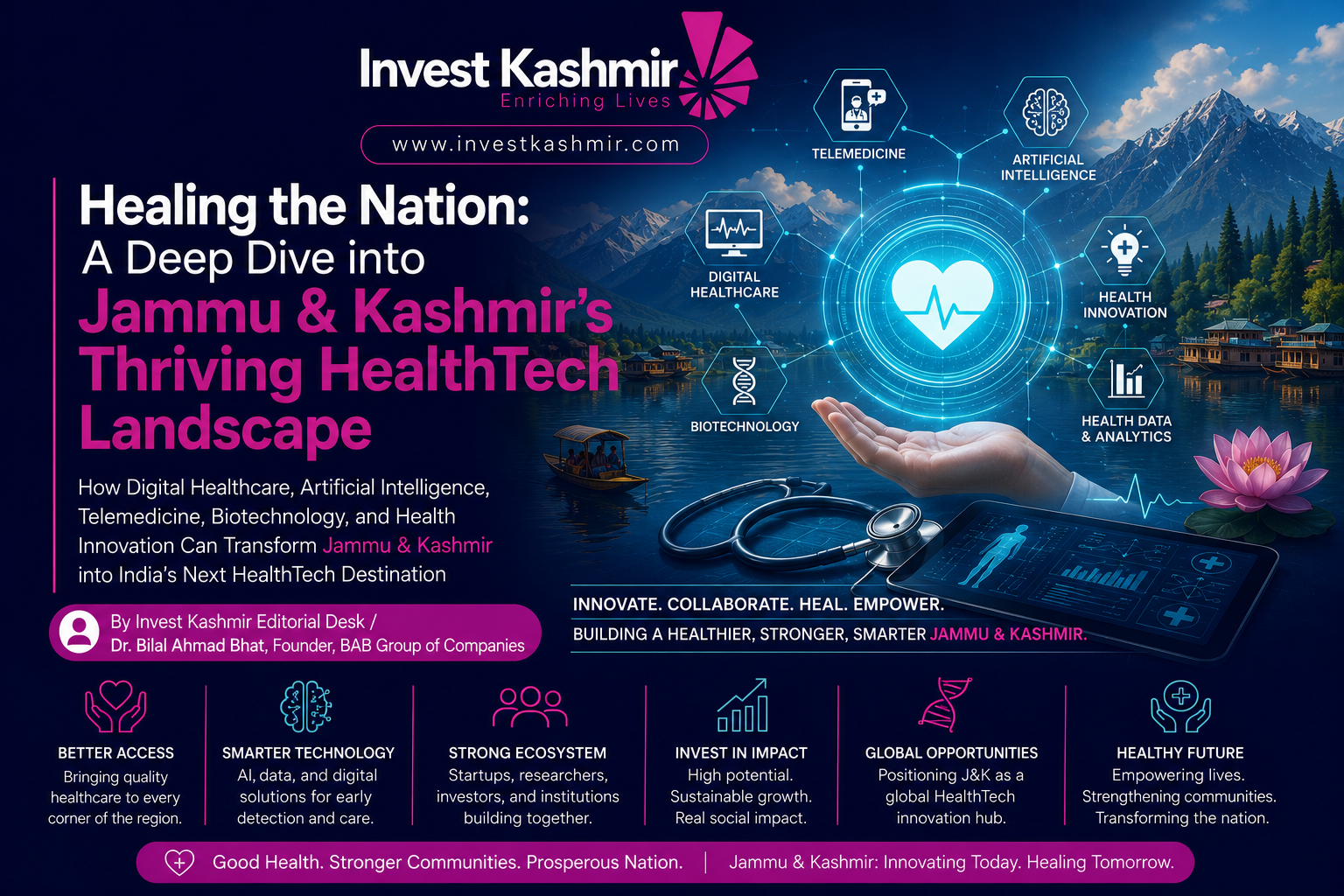
How Digital Healthcare, Artificial Intelligence, Telemedicine, Biotechnology, and Health Innovation Can Transform Jammu & Kashmir into India’s Next HealthTech Destination
By Dr. Bilal Ahmad Bhat
Founder, BAB Group of Companies
Healthcare has always been one of the strongest foundations of human development. A healthy population contributes to stronger economies, higher productivity, greater innovation, improved education, and sustainable social progress. Today, however, healthcare is undergoing one of the most significant transformations in modern history.
The convergence of Artificial Intelligence (AI), telemedicine, digital health platforms, wearable technologies, biotechnology, robotics, cloud computing, big data analytics, precision medicine, and mobile health applications is redefining how healthcare is delivered, monitored, and managed across the world.
HealthTech has evolved beyond being a support function for hospitals. It is becoming an economic sector that attracts investment, creates high-skilled employment, drives research and development, supports startups, and improves access to quality healthcare.
India’s digital health ecosystem continues to expand rapidly through telemedicine, digital health records, AI-enabled diagnostics, and public digital health initiatives, creating significant opportunities for entrepreneurs and investors. Telemedicine, in particular, is improving access to healthcare in underserved regions where specialist availability remains limited.
For Jammu & Kashmir, this transformation presents a historic opportunity—not only to improve healthcare delivery but also to establish itself as an emerging destination for HealthTech innovation, entrepreneurship, research, and investment.
A New Era of Healthcare
Healthcare is no longer confined within hospital walls.
Today’s healthcare ecosystem extends into:
- Homes
- Smartphones
- Wearable devices
- Remote monitoring systems
- AI-powered diagnostics
- Virtual consultations
- Digital pharmacies
- Smart laboratories
- Cloud-based patient records
Patients increasingly expect healthcare that is:
- Accessible
- Affordable
- Personalized
- Preventive
- Connected
- Data-driven
Meeting these expectations requires both technological innovation and strong collaboration between healthcare providers, governments, universities, entrepreneurs, and investors.
The Rise of HealthTech
HealthTech encompasses the technologies that improve healthcare delivery, patient outcomes, operational efficiency, and medical research.
Major HealthTech segments include:
- Telemedicine
- Artificial Intelligence
- Digital Diagnostics
- Medical Devices
- Biotechnology
- Health Information Systems
- Electronic Health Records
- Mobile Health Applications
- Wearable Technologies
- Precision Medicine
- Robotics
- Remote Patient Monitoring
Across Asia, digital health adoption is accelerating because of aging populations, rising chronic diseases, expanding smartphone penetration, AI innovation, and supportive government initiatives. Analysts project sustained long-term growth for digital health and telemedicine across the region.
Why Jammu & Kashmir Has Significant HealthTech Potential
Jammu & Kashmir possesses several strategic advantages that position it for HealthTech growth.
These include:
A Young and Educated Population
Young entrepreneurs, engineers, medical professionals, researchers, and technology graduates represent an important foundation for future innovation.
Growing Digital Infrastructure
Expanding internet connectivity and digital services are enabling greater adoption of online healthcare solutions.
Expanding Healthcare Demand
Both urban and rural populations increasingly require accessible specialist care, preventive healthcare, chronic disease management, and diagnostic services.
Strong Academic Institutions
Medical colleges, universities, engineering institutions, and research centers can collaborate with startups to develop innovative healthcare technologies.
Government Support
National and regional initiatives promoting digital healthcare, innovation, telemedicine, startup development, and entrepreneurship create favorable conditions for HealthTech investment.
Telemedicine: Bringing Healthcare Closer
One of the most promising HealthTech opportunities is telemedicine.
Virtual healthcare consultations reduce geographical barriers while connecting patients with specialists regardless of physical location.
Benefits include:
- Improved rural healthcare access
- Faster specialist consultations
- Reduced travel costs
- Continuous patient monitoring
- Better chronic disease management
- Greater healthcare accessibility
Recent national initiatives continue to emphasize mobile health and telemedicine as strategic priorities for strengthening healthcare delivery and innovation ecosystems.
Artificial Intelligence in Healthcare
Artificial Intelligence is becoming one of the most transformative technologies in modern medicine.
AI applications include:
- Medical imaging analysis
- Disease prediction
- Clinical decision support
- Drug discovery
- Personalized treatment planning
- Administrative automation
- Healthcare analytics
Importantly, AI should be viewed as a tool that augments healthcare professionals rather than replacing them.
Human expertise combined with intelligent technologies can improve both efficiency and patient outcomes.
Startups Driving Healthcare Innovation
HealthTech startups are redefining healthcare through innovation.
Emerging opportunities include:
- Remote diagnostics
- AI-powered medical assistants
- Digital mental health platforms
- Elderly care technologies
- Wearable monitoring devices
- Healthcare logistics
- Digital pharmacy solutions
- Hospital management software
- Medical education platforms
These businesses create employment while attracting investment and strengthening regional innovation ecosystems.
Biotechnology and Medical Research
Biotechnology represents another important growth opportunity.
Research areas include:
- Diagnostics
- Vaccines
- Precision medicine
- Genomics
- Drug development
- Agricultural biotechnology
- Medical devices
Closer collaboration between universities, research institutions, hospitals, and private industry can accelerate commercialization of scientific discoveries.
Digital Health Records
Healthcare increasingly depends upon secure and interoperable digital information.
Electronic Health Records can improve:
- Clinical coordination
- Patient safety
- Treatment continuity
- Healthcare efficiency
- Data-driven decision making
Responsible implementation requires robust cybersecurity, privacy protection, and governance frameworks.
HealthTech Investment Opportunities
Global investors are increasingly attracted to digital health because of its long-term growth potential.
Investment opportunities include:
- AI healthcare platforms
- Telemedicine
- Medical devices
- Healthcare software
- Biotechnology
- Preventive health
- Digital diagnostics
- Hospital technologies
- Remote monitoring
For Jammu & Kashmir, building an investor-friendly HealthTech ecosystem can attract both domestic and international capital.
Building a Health Innovation Ecosystem
Successful HealthTech ecosystems depend upon collaboration.
Key stakeholders include:
- Government
- Universities
- Hospitals
- Research institutions
- Startups
- Investors
- Incubators
- Accelerators
- Technology companies
- Pharmaceutical organizations
When these partners collaborate, innovation accelerates while improving healthcare accessibility and quality.
Challenges That Must Be Addressed
Building a world-class HealthTech ecosystem also requires addressing important challenges.
These include:
- Digital literacy
- Rural connectivity
- Regulatory compliance
- Cybersecurity
- Healthcare workforce training
- Data privacy
- Funding access
- Technology adoption
Overcoming these barriers requires coordinated long-term planning involving both public and private sectors.
A Vision for Jammu & Kashmir
Imagine a future where:
- Rural patients access specialists through telemedicine.
- AI assists doctors in early disease detection.
- Startups develop healthcare solutions exported worldwide.
- Universities commercialize medical research.
- Investors establish HealthTech innovation centers.
- Hospitals operate with intelligent digital systems.
- Entrepreneurs create globally competitive healthcare companies.
This future is achievable.
It requires vision, collaboration, investment, and sustained commitment.
Conclusion
Healthcare is no longer solely a social service.
It has become a strategic economic sector capable of driving innovation, entrepreneurship, employment, research, and sustainable development.
For Jammu & Kashmir, HealthTech represents far more than digital transformation.
It represents an opportunity to build an innovation-driven healthcare economy that improves lives while creating new industries.
The future of healthcare will belong to regions that combine medical excellence with technological innovation.
By investing in digital infrastructure, supporting startups, strengthening research, encouraging Artificial Intelligence, promoting telemedicine, protecting patient trust, and fostering collaboration between government, academia, healthcare providers, and investors, Jammu & Kashmir can emerge as one of India’s most promising HealthTech destinations.
Healing the nation is no longer the responsibility of hospitals alone.
It is the shared mission of innovators, entrepreneurs, policymakers, investors, educators, researchers, and every citizen committed to building a healthier, more prosperous future.