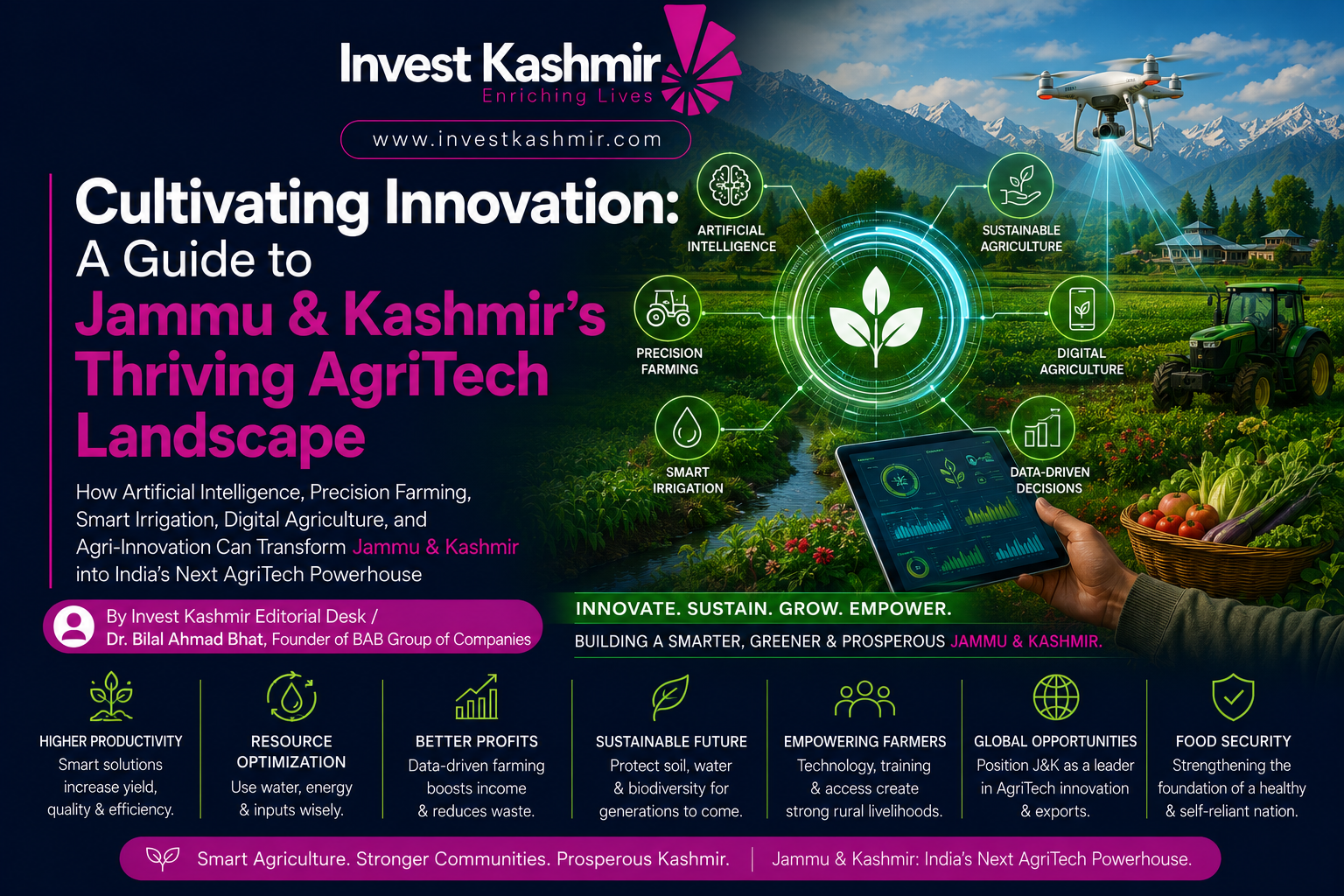
How Artificial Intelligence, Precision Farming, Smart Irrigation, Digital Agriculture, and Agri-Innovation Can Transform Jammu & Kashmir into India’s Next AgriTech Powerhouse
By Invest Kashmir Editorial Desk / Dr. Bilal Ahmad Bhat, Founder of BAB Group of Companies
Agriculture has always been the backbone of Jammu & Kashmir’s economy, supporting livelihoods, preserving cultural traditions, and contributing significantly to the region’s prosperity. From the world-renowned saffron fields of Pampore to the apple orchards of Kashmir, walnut plantations, cherry farms, and diverse horticultural produce, the Union Territory possesses natural advantages that few regions can match.
Yet agriculture in the twenty-first century is no longer defined solely by fertile land and favorable weather. It is increasingly driven by data, digital technologies, artificial intelligence, precision farming, biotechnology, remote sensing, drones, climate intelligence, and connected supply chains. The convergence of these technologies has given rise to Agricultural Technology (AgriTech)—one of the fastest-growing innovation sectors in the global economy.
For Jammu & Kashmir, AgriTech represents more than technological progress. It offers a pathway to improve farmer incomes, strengthen food security, reduce post-harvest losses, enhance export competitiveness, create high-skilled employment, attract investment, and build a resilient rural economy.
Recent research on digital agriculture in the Himalayan region highlights that technologies such as AI, IoT, remote sensing, and digital public infrastructure can significantly improve productivity and climate resilience, provided they are supported by infrastructure, capacity building, and region-specific implementation strategies.
Agriculture Is Entering a Digital Revolution
For generations, farming depended primarily on experience, seasonal patterns, and manual observation.
Today, farmers increasingly make decisions using:
- Artificial Intelligence
- Internet of Things (IoT)
- Drone Technology
- Satellite Imaging
- Geographic Information Systems (GIS)
- Weather Analytics
- Soil Sensors
- Mobile Applications
- Cloud Computing
- Predictive Analytics
These technologies enable data-driven farming that improves productivity while reducing waste and environmental impact.
Across India, national initiatives such as the Digital Agriculture Mission are accelerating the development of farmer-centric digital services through technologies including AI, remote sensing, data analytics, AgriStack, and digital crop surveys.
What Is AgriTech?
AgriTech refers to the application of modern technology throughout the agricultural value chain.
It encompasses innovations that improve:
- Crop production
- Irrigation
- Soil health
- Pest management
- Supply chains
- Farm machinery
- Market access
- Food processing
- Agricultural finance
- Farm advisory services
AgriTech combines agriculture with engineering, information technology, biotechnology, environmental science, and business innovation.
Why Jammu & Kashmir Is Positioned for AgriTech Growth
Jammu & Kashmir possesses unique strengths that create exceptional opportunities for AgriTech development.
World-Class Horticulture
The region is internationally recognized for:
- Apples
- Saffron
- Walnuts
- Almonds
- Cherries
- Pears
- Apricots
Adding digital technologies throughout cultivation, grading, storage, logistics, and exports can significantly increase value creation.
Diverse Agro-Climatic Zones
The Union Territory supports multiple crops across varying climatic conditions, providing ideal environments for precision agriculture and climate-smart farming.
Young Entrepreneurial Talent
Thousands of educated young professionals possess the potential to build startups focused on agricultural innovation, digital services, food technology, and rural entrepreneurship.
Expanding Digital Infrastructure
Growing connectivity creates opportunities for mobile advisory platforms, smart farm management, digital marketplaces, and remote agricultural services.
Precision Agriculture: Farming with Intelligence
Precision agriculture enables farmers to apply the right input at the right time and in the right quantity.
Instead of treating entire fields uniformly, digital technologies allow field-level decision making through:
- Soil monitoring
- Moisture sensing
- Nutrient analysis
- Crop health monitoring
- Yield prediction
- Variable-rate application
This improves productivity while reducing unnecessary costs.
Artificial Intelligence in Agriculture
Artificial Intelligence is rapidly transforming farming practices.
AI applications include:
- Disease detection
- Pest prediction
- Yield forecasting
- Weather intelligence
- Crop recommendation
- Market analysis
- Farm planning
- Supply chain optimization
AI-powered advisory systems help farmers make faster and more informed decisions while improving resilience against climate variability.
Smart Irrigation and Water Management
Water remains one of agriculture’s most valuable resources.
Smart irrigation technologies use sensors, weather forecasts, and automation to optimize water usage.
Benefits include:
- Reduced water consumption
- Improved crop quality
- Lower production costs
- Enhanced sustainability
Digital AgTech initiatives in several countries demonstrate how IoT-enabled smart irrigation, soil monitoring, and automated farm systems can increase productivity while lowering operational costs.
Drones Are Changing Farm Management
Drone technology provides farmers with real-time aerial information about crop conditions.
Applications include:
- Crop monitoring
- Pest surveillance
- Precision spraying
- Land mapping
- Yield estimation
- Irrigation assessment
These capabilities improve decision-making while reducing labor-intensive field inspections.
Building Strong Agricultural Supply Chains
Innovation should extend beyond the farm.
Technology can improve:
- Cold chain logistics
- Warehouse management
- Digital marketplaces
- Food traceability
- Export documentation
- Inventory management
Reducing post-harvest losses is particularly important for high-value horticultural products such as apples, cherries, walnuts, and saffron.
AgriTech Startups: The Next Generation of Rural Entrepreneurship
The AgriTech sector is creating new opportunities for entrepreneurs developing solutions such as:
- Farm management software
- AI advisory platforms
- Smart irrigation systems
- Drone services
- Precision farming technologies
- Digital marketplaces
- Supply chain platforms
- Agri-financing solutions
- Crop insurance technologies
India’s AgriTech ecosystem has expanded rapidly over the past decade, supported by government initiatives, digital infrastructure, and increasing entrepreneurial activity.
Universities and Research Institutions
Agricultural universities and research institutions have an important role in driving innovation.
Collaboration between researchers, startups, industry, and government can accelerate:
- Technology transfer
- Precision farming
- Climate-resilient agriculture
- Biotechnology
- Food innovation
- Commercialization of research
These partnerships strengthen regional competitiveness while supporting local farmers.
Opportunities for Investors
Global investors increasingly recognize agriculture as a technology-driven growth sector.
Investment opportunities include:
- AgriTech startups
- Cold chain infrastructure
- Food processing
- Farm automation
- Digital marketplaces
- Agricultural AI
- Smart irrigation
- Drone technology
- Controlled-environment agriculture
As digital agriculture expands globally, investment in AI, IoT, remote sensing, and automation continues to accelerate across both developed and emerging markets.
Building an Integrated AgriTech Ecosystem
A thriving AgriTech ecosystem depends on collaboration among:
- Farmers
- Startups
- Universities
- Research institutions
- Investors
- Government agencies
- Financial institutions
- Technology companies
- Food processors
- Exporters
Together, these stakeholders create an environment where innovation moves efficiently from laboratories to farms and from farms to global markets.
Challenges That Must Be Addressed
To unlock AgriTech’s full potential, several priorities require continued attention:
- Digital literacy among farmers
- Rural broadband connectivity
- Affordable technology adoption
- Access to finance
- Climate resilience
- Data governance
- Agricultural extension services
- Startup support
Addressing these challenges will require coordinated public-private partnerships and long-term policy commitment.
A Vision for Jammu & Kashmir
Imagine a future where:
- Farmers receive AI-powered weather forecasts before sowing.
- Drones identify crop diseases before they spread.
- Smart irrigation conserves precious water resources.
- Mobile platforms connect growers directly with international buyers.
- Startups export agricultural technologies developed in Jammu & Kashmir.
- Universities commercialize agricultural research.
- Young entrepreneurs build globally competitive AgriTech companies.
This vision is achievable.
It requires leadership, investment, innovation, collaboration, and the confidence to embrace digital transformation.
Conclusion
Agriculture is no longer solely about cultivation.
It is about intelligence.
Connectivity.
Data.
Innovation.
Entrepreneurship.
Sustainability.
For Jammu & Kashmir, AgriTech offers a historic opportunity to modernize agriculture while preserving the region’s rich farming heritage.
By embracing Artificial Intelligence, precision agriculture, digital platforms, biotechnology, smart irrigation, climate-smart farming, research, and entrepreneurship, the Union Territory can position itself as one of India’s leading AgriTech destinations.
The future of agriculture will not be determined only by fertile soil.
It will be determined by how effectively knowledge, technology, and human ingenuity work together.
The seeds of tomorrow’s prosperity are being planted today.
With visionary leadership, collaborative innovation, and sustained investment, Jammu & Kashmir can cultivate not only healthier crops—but stronger businesses, resilient rural communities, globally competitive exports, and a new era of sustainable economic growth.