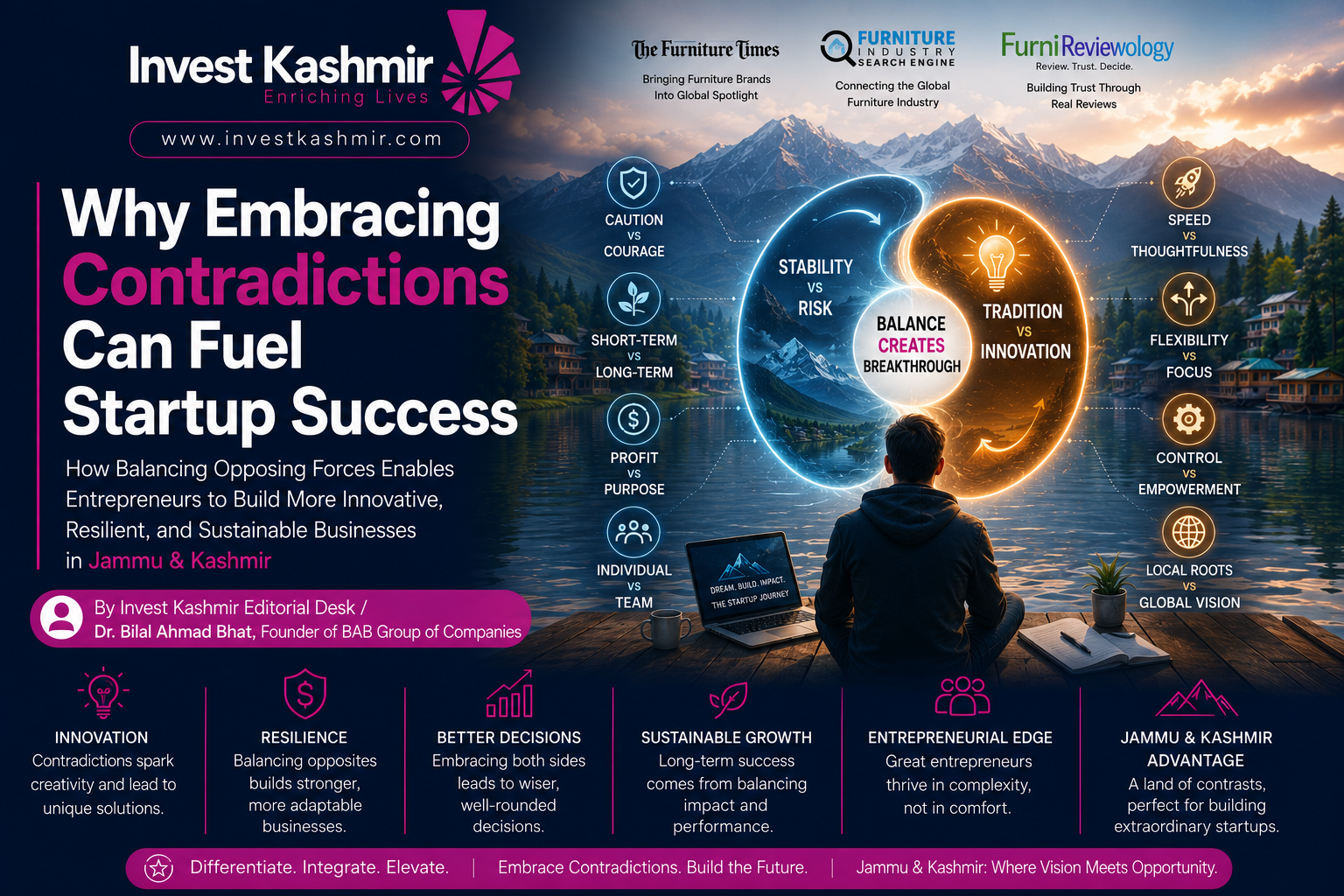
How Balancing Opposing Forces Enables Entrepreneurs to Build More Innovative, Resilient, and Sustainable Businesses in Jammu & Kashmir
By Invest Kashmir Editorial Desk / Dr. Bilal Ahmad Bhat, Founder of BAB Group of Companies
Startups are often portrayed as businesses driven by certainty, confidence, and bold vision.
In reality, successful entrepreneurship is built on navigating uncertainty and managing contradictions.
Every founder faces competing demands. They must move quickly while making thoughtful decisions. They must innovate while maintaining operational discipline. They must dream big while managing limited resources. They must embrace risk while protecting the future of their business.
These apparent contradictions are not weaknesses—they are defining characteristics of entrepreneurship.
Leadership and innovation research increasingly describes these tensions as strategic paradoxes. Rather than choosing one side over the other, successful organizations often adopt a “both-and” mindset, balancing exploration with execution, creativity with discipline, and flexibility with consistency. Research in organizational paradox theory suggests that leaders who embrace these tensions are often better positioned to drive innovation and long-term organizational performance.
For Jammu & Kashmir, where startups are emerging across tourism, agriculture, horticulture, information technology, healthcare, education, manufacturing, renewable energy, and creative industries, understanding how to navigate these contradictions can help entrepreneurs build stronger companies capable of competing nationally and globally.
The Startup Journey Is Full of Contradictions
Every entrepreneur begins with an ambitious vision.
However, transforming an idea into a sustainable business requires balancing multiple priorities simultaneously.
Successful founders frequently need to:
- Think globally while solving local problems.
- Grow rapidly while managing cash carefully.
- Experiment continuously while maintaining customer trust.
- Lead confidently while remaining open to feedback.
- Build innovative products while delivering reliable services.
These tensions never disappear.
As companies grow, they simply evolve into more sophisticated forms.
Innovation Requires Both Creativity and Discipline
Many people associate innovation exclusively with creativity.
Creativity is essential.
However, ideas alone rarely build successful businesses.
Innovation requires structured execution.
The most successful startups combine:
- Creative thinking
- Customer research
- Product development
- Financial planning
- Market validation
- Continuous improvement
Innovation leadership research describes this as balancing exploration with implementation rather than focusing exclusively on one approach.
Move Fast—But Build Carefully
Startup culture often celebrates speed.
Launching products quickly allows founders to gather customer feedback and adapt rapidly.
Yet speed without quality creates risk.
Entrepreneurs should strive to:
- Validate ideas early.
- Test assumptions.
- Improve continuously.
- Maintain quality standards.
- Protect customer trust.
The goal is not simply to move faster than competitors.
The goal is to learn faster.
Confidence and Humility Must Coexist
Entrepreneurs need confidence.
Without confidence, few businesses would ever be launched.
However, excessive confidence can become dangerous.
History shows that many successful organizations encounter difficulties because they become overconfident, relying too heavily on the strategies that originally made them successful instead of adapting to changing markets.
The strongest founders balance:
- Confidence in vision
- Humility in learning
- Conviction in purpose
- Openness to change
This combination encourages continuous growth.
Compete While Collaborating
Many entrepreneurs view competitors solely as threats.
Modern startup ecosystems demonstrate something different.
Collaboration often accelerates innovation.
Businesses benefit from partnerships with:
- Universities
- Research institutions
- Industry associations
- Technology providers
- Government agencies
- Investors
- Customers
Innovation ecosystems flourish when organizations compete in the marketplace while collaborating to strengthen knowledge, research, and infrastructure.
Think Long-Term While Delivering Short-Term Results
Investors expect measurable progress.
Customers expect reliable products.
Employees expect stability.
At the same time, founders must continue investing in future growth.
This requires balancing:
- Immediate execution
- Long-term innovation
- Current profitability
- Future expansion
Successful startups understand that sustainable growth depends on managing both horizons simultaneously.
Risk and Responsibility
Entrepreneurship requires calculated risk.
Without experimentation, innovation slows.
However, responsible entrepreneurs distinguish between informed risk and unnecessary risk.
Responsible innovation includes:
- Financial discipline
- Ethical leadership
- Customer protection
- Regulatory compliance
- Data security
- Environmental responsibility
Calculated risks supported by sound planning create stronger businesses.
Technology and Human Judgment
Artificial Intelligence, automation, analytics, and digital platforms are transforming every industry.
Technology provides remarkable capabilities.
Human judgment remains essential.
Successful businesses combine:
- AI-driven insights
- Human creativity
- Ethical decision-making
- Emotional intelligence
- Customer relationships
The future belongs to organizations where technology amplifies human capability rather than replacing it.
Growth and Culture
Rapid expansion often creates pressure.
Hiring increases.
Operations become more complex.
New markets emerge.
During growth, many organizations unintentionally weaken their culture.
Strong founders recognize that:
- Culture drives performance.
- Values guide decisions.
- Trust strengthens teams.
- Purpose inspires innovation.
Growth should strengthen organizational culture—not replace it.
Learning from Failure Without Becoming Defined by It
Failure remains one of entrepreneurship’s greatest teachers.
Not every product succeeds.
Not every strategy delivers expected results.
Not every market responds immediately.
Resilient founders:
- Analyze outcomes.
- Adapt quickly.
- Preserve confidence.
- Continue learning.
Failure becomes valuable when it generates knowledge that improves future decisions.
Opportunities for Jammu & Kashmir
Jammu & Kashmir possesses enormous entrepreneurial potential across:
- Tourism Technology
- Artificial Intelligence
- AgriTech
- HealthTech
- Renewable Energy
- Food Processing
- Horticulture
- Handicrafts
- Education Technology
- Manufacturing
- Creative Industries
Entrepreneurs in these sectors will frequently encounter competing priorities.
Balancing innovation with sustainability, technology with tradition, and growth with financial discipline will determine long-term success.
Universities as Partners in Innovation
Academic institutions can help entrepreneurs manage complexity by supporting:
- Entrepreneurship education
- Research commercialization
- Startup incubation
- Industry collaboration
- Innovation laboratories
- Technology transfer
These partnerships strengthen both startups and regional innovation ecosystems.
Investors Value Balanced Leadership
Modern investors increasingly evaluate founders beyond technical expertise.
They seek entrepreneurs capable of managing uncertainty through:
- Strategic thinking
- Adaptability
- Financial discipline
- Leadership
- Governance
- Continuous learning
Businesses that successfully balance competing priorities often demonstrate stronger resilience during changing economic conditions.
Building a Resilient Startup Ecosystem
A thriving startup ecosystem depends on collaboration between:
- Entrepreneurs
- Investors
- Universities
- Government
- Accelerators
- Incubators
- Financial institutions
- Technology companies
- Research organizations
Together, these stakeholders help startups navigate challenges while encouraging sustainable innovation.
Conclusion
Entrepreneurship has never been about finding perfect certainty.
It has always been about making thoughtful decisions amid uncertainty.
The world’s most successful startups rarely eliminate contradictions.
They learn to manage them.
They innovate while remaining disciplined.
They embrace technology while valuing people.
They pursue ambitious visions while staying grounded in customer needs.
For Jammu & Kashmir, the future of entrepreneurship will depend not only on great ideas but also on leaders capable of balancing complexity with clarity.
Innovation is born from curiosity.
Growth is sustained through discipline.
Success emerges when entrepreneurs embrace both.
By cultivating a mindset that welcomes constructive contradictions rather than fearing them, the next generation of founders can build businesses that are more innovative, more resilient, and better prepared to contribute to the economic transformation of Jammu & Kashmir and beyond.