Understanding the Science, Strategy, and Significance of Valuing Startups in the Modern Innovation Economy
By Invest Kashmir Editorial Desk / Dr. Bilal Ahmad Bhat, Founder of BAB Group of Companies, Global KASHmirie Chamber
Every entrepreneur dreams of building a company that creates lasting impact.
Some founders envision transforming industries through Artificial Intelligence.
Others seek to modernize agriculture, improve healthcare, revolutionize education, strengthen manufacturing, or create sustainable energy solutions.
However, sooner or later, every founder encounters one of the most important—and often misunderstood—questions in entrepreneurship:
“What is my startup worth?”
The answer is known as startup valuation.
Startup valuation is far more than a number used during fundraising.
It represents the market’s assessment of a company’s current value based on its future potential, innovation, leadership, customer traction, intellectual property, financial performance, market opportunity, and ability to generate sustainable growth.
Unlike mature businesses that can often be valued using historical earnings alone, startups are frequently valued based on what they can become rather than only what they are today.
That is why valuation combines finance, strategy, market analysis, risk assessment, and investor confidence into a single conversation.
For entrepreneurs in Jammu & Kashmir, understanding valuation is essential—not only for raising capital but also for building businesses that inspire long-term trust, attract strategic investors, and contribute to the region’s economic transformation.
What Is Startup Valuation?
Startup valuation is the process of estimating the economic value of a startup.
It determines how much the company is worth before or after receiving investment.
Valuation influences:
- Equity ownership
- Investment negotiations
- Fundraising
- Employee stock options
- Mergers and acquisitions
- Strategic partnerships
- Long-term business planning
For founders, valuation directly affects how much ownership they retain while raising capital.
For investors, it influences expected returns and investment decisions.
Why Valuation Matters
Many entrepreneurs mistakenly believe that a higher valuation automatically means a better company.
In reality, valuation should reflect sustainable business fundamentals.
An appropriate valuation helps:
- Attract quality investors.
- Build founder credibility.
- Support future fundraising.
- Maintain balanced ownership.
- Strengthen strategic planning.
An unrealistic valuation may discourage investors or create difficulties in future funding rounds.
Valuation Is Not Just About Revenue
One of the most common misconceptions is that startups are valued solely based on sales.
Early-stage companies often have little or no revenue.
Instead, investors evaluate multiple factors including:
- Strength of the founding team.
- Market opportunity.
- Innovation.
- Product development.
- Customer traction.
- Competitive advantage.
- Intellectual property.
- Scalability.
- Business model.
- Execution capability.
For pre-revenue startups, qualitative factors frequently play a larger role than historical financial performance.
The Different Stages of Startup Valuation
Valuation changes as businesses grow.
Idea Stage
At this stage, investors primarily evaluate:
- Founder capability.
- Market opportunity.
- Problem significance.
- Innovation.
- Business vision.
Pre-Revenue Stage
Investors consider:
- Prototype development.
- Product readiness.
- Customer validation.
- Team quality.
- Intellectual property.
Early Revenue Stage
Attention shifts toward:
- Revenue growth.
- Customer acquisition.
- Retention.
- Unit economics.
- Market expansion.
Growth Stage
Investors increasingly evaluate:
- Profitability potential.
- Market leadership.
- Operational efficiency.
- International scalability.
- Corporate governance.
Each stage requires different valuation approaches because the available business information evolves over time.
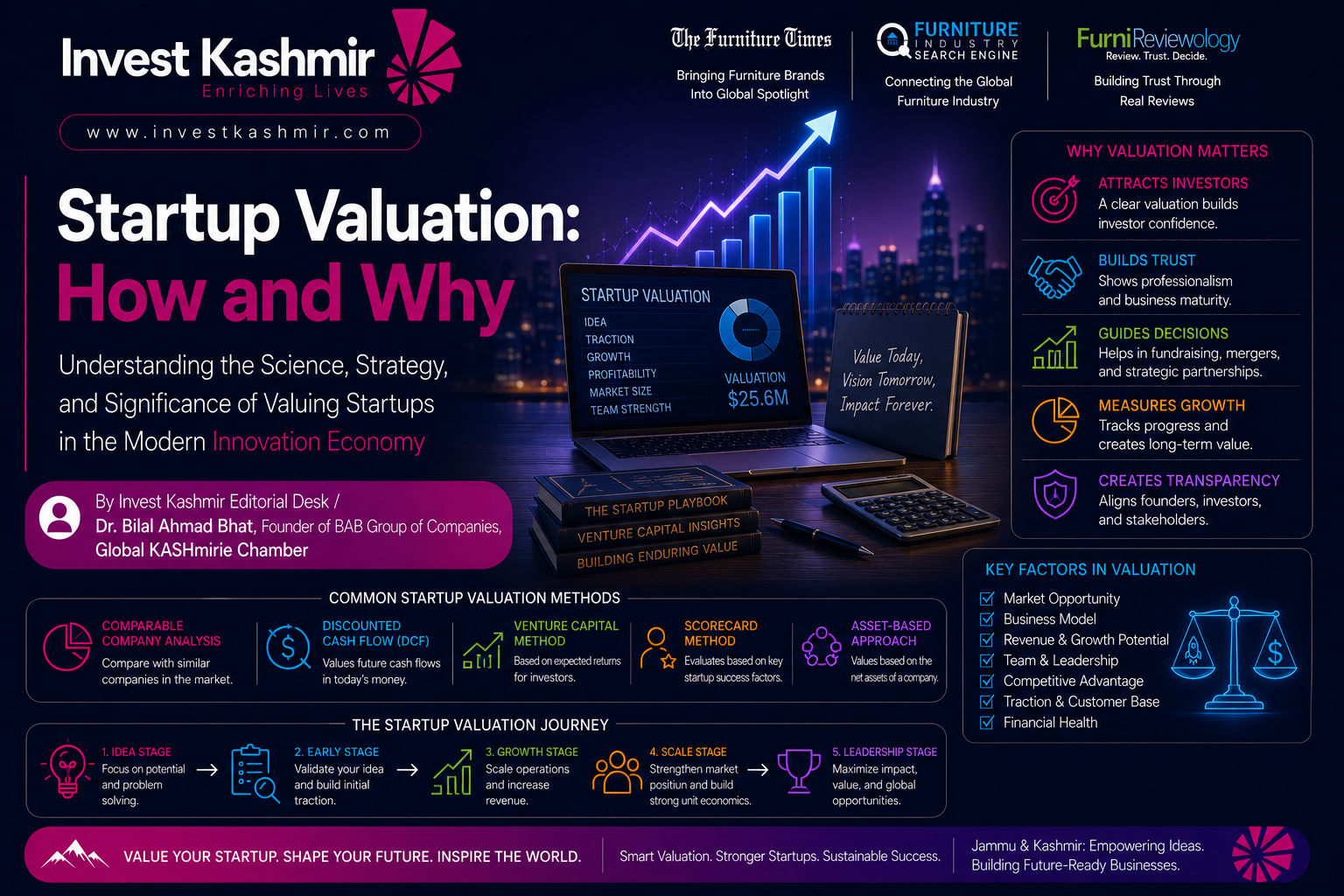
Common Startup Valuation Methods
Professional investors rarely rely upon a single valuation model.
Instead, they often compare multiple approaches before reaching a conclusion.
Some of the most widely used methods include:
The Berkus Method
Designed for pre-revenue startups, this method assigns value to key milestones such as:
- Business idea.
- Prototype.
- Management team.
- Strategic relationships.
- Early market traction.
Scorecard Method
This approach compares a startup with similar companies operating in the same region and industry while adjusting for factors such as leadership, product quality, competition, and market opportunity.
Venture Capital Method
Frequently used by venture capital investors, this method estimates a company’s future exit value before working backward to determine an appropriate present valuation based on expected returns.
Comparable Company Analysis
This method compares startups with similar businesses that have recently raised investment or completed acquisitions.
Discounted Cash Flow (DCF)
For later-stage businesses with predictable financial projections, future cash flows are estimated and discounted back to present value.
Different valuation methods are appropriate at different stages of growth, and investors often combine several approaches to develop a balanced assessment.
What Investors Really Look For
While valuation models provide structure, investment decisions often depend on broader business quality.
Investors frequently evaluate:
- Founder integrity.
- Leadership capability.
- Market size.
- Customer demand.
- Innovation.
- Competitive differentiation.
- Financial discipline.
- Scalability.
- Governance.
- Long-term vision.
Numbers matter.
People matter equally.
Product-Market Fit Increases Value
One of the strongest drivers of valuation is product-market fit.
Businesses that consistently solve meaningful customer problems demonstrate:
- Revenue potential.
- Customer loyalty.
- Market demand.
- Lower business risk.
Strong customer validation often strengthens investor confidence more than ambitious projections alone.
Intellectual Property Creates Competitive Advantage
Patents.
Trademarks.
Copyrights.
Trade secrets.
Proprietary technology.
These assets strengthen defensibility while increasing long-term commercial value.
Innovative companies with protected intellectual property often enjoy stronger competitive positioning.
Artificial Intelligence and Startup Valuation
Artificial Intelligence has become one of the fastest-growing investment sectors globally.
However, investors increasingly distinguish between companies that merely use AI and those that create durable business value through AI.
Modern investors examine:
- Quality of technology.
- Customer adoption.
- Unit economics.
- Gross margins.
- Data advantages.
- Responsible AI governance.
The emphasis has shifted from excitement alone toward sustainable commercial performance.
Common Valuation Mistakes
Founders sometimes unintentionally reduce investor confidence by:
- Overestimating market size.
- Ignoring competition.
- Using unrealistic financial projections.
- Neglecting governance.
- Lacking customer validation.
- Focusing on valuation before creating value.
The strongest valuations emerge naturally from strong businesses.
Valuation and Fundraising
Fundraising is ultimately a negotiation between founders and investors.
Valuation influences:
- Equity dilution.
- Ownership structure.
- Future fundraising.
- Employee incentives.
- Long-term founder control.
Successful negotiations focus on building partnerships rather than simply maximizing headline valuations.
Opportunities for Jammu & Kashmir
Jammu & Kashmir possesses exceptional entrepreneurial opportunities across:
- Tourism Technology.
- AgriTech.
- HealthTech.
- Artificial Intelligence.
- Renewable Energy.
- Food Processing.
- Horticulture.
- Handicrafts.
- Manufacturing.
- Education Technology.
Businesses within these sectors can significantly improve valuation by demonstrating:
- Real customer demand.
- Strong execution.
- Intellectual property.
- Digital readiness.
- Financial discipline.
- Scalable business models.
Universities and Entrepreneurial Value Creation
Educational institutions can strengthen startup ecosystems by teaching:
- Entrepreneurial finance.
- Business valuation.
- Financial modelling.
- Corporate governance.
- Investor communication.
- Intellectual property management.
Financial literacy is becoming as important as technical innovation.
Building a Strong Investment Ecosystem
Healthy startup ecosystems depend upon collaboration among:
- Entrepreneurs.
- Investors.
- Universities.
- Incubators.
- Accelerators.
- Government agencies.
- Financial institutions.
- Industry associations.
Together, these stakeholders create environments where innovation receives fair, transparent, and sustainable valuation.
Looking Ahead
The future of startup valuation will continue evolving.
Artificial Intelligence.
Deep technology.
Climate innovation.
Digital healthcare.
Advanced manufacturing.
These industries will require increasingly sophisticated approaches to evaluating business potential.
Yet one principle will remain unchanged.
Great valuations are earned.
They are not created through optimistic presentations alone.
They emerge from solving meaningful problems, building exceptional teams, serving customers consistently, protecting innovation, managing finances responsibly, and executing with discipline.
For Jammu & Kashmir, developing entrepreneurs who understand valuation will strengthen investment readiness, improve fundraising outcomes, and encourage more sustainable businesses.
The true value of a startup is never measured only by the capital it raises.
It is measured by the trust it earns.
The lives it improves.
The employment it creates.
The innovation it delivers.
And the lasting contribution it makes to society.
In the end, valuation is not simply about assigning a price to a company.
It is about recognizing the potential of people, ideas, and innovation to shape the future of economies and communities.