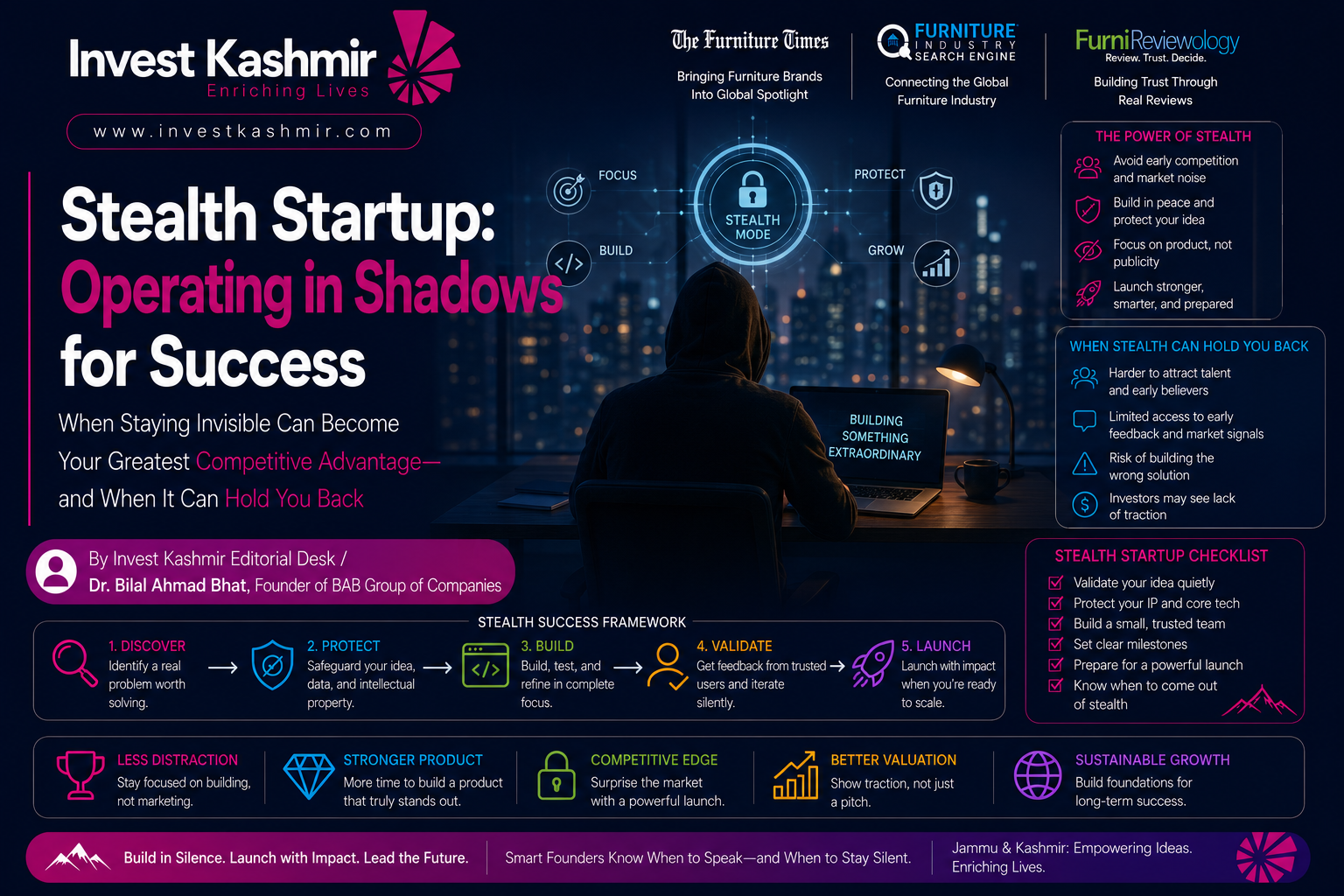
When Staying Invisible Can Become Your Greatest Competitive Advantage—and When It Can Hold You Back
By Invest Kashmir Editorial Desk / Dr. Bilal Ahmad Bhat, Founder of BAB Group of Companies
In today’s entrepreneurial world, visibility is often celebrated as the fastest path to success.
Founders are encouraged to build personal brands, launch products publicly, engage with customers on social media, speak at conferences, and attract investor attention as early as possible. Startup ecosystems reward openness, networking, and continuous visibility.
Yet some of the world’s most innovative companies choose an entirely different strategy.
Instead of announcing their ideas to the world, they remain deliberately quiet.
They build in silence.
They develop products behind closed doors.
They limit public information.
They avoid unnecessary publicity until they are confident their innovation is ready for the market.
This approach is known as stealth mode.
A stealth startup temporarily operates with limited public visibility to protect intellectual property, reduce competitive pressure, refine products, and carefully control the timing of its market entry. While this strategy has been used successfully in sectors such as artificial intelligence, biotechnology, cybersecurity, defence technology, and advanced software, it is not suitable for every business. Founders must carefully balance the benefits of secrecy with the need for customer feedback, fundraising, hiring, and market validation.
For Jammu & Kashmir, where startups are emerging across tourism, AgriTech, HealthTech, Artificial Intelligence, renewable energy, handicrafts, food processing, manufacturing, education, and digital services, understanding when to remain quiet—and when to become visible—can become an important strategic decision.
What Is a Stealth Startup?
A stealth startup is a business that intentionally limits public information about its products, technology, strategy, or even its existence during the early stages of development.
Unlike traditional startups that actively seek publicity from the beginning, stealth startups generally avoid:
- Public product announcements
- Media interviews
- Marketing campaigns
- Detailed websites
- Public demonstrations
- Extensive social media activity
Instead, they focus their resources on product development, research, testing, and strategic planning before making a public launch.
Why Founders Choose Stealth Mode
Every startup faces competition.
For companies developing highly innovative technologies, revealing too much too early may expose valuable ideas before they are fully protected or ready for market.
Founders often choose stealth mode to:
- Protect intellectual property.
- Reduce competitive imitation.
- Refine products privately.
- Avoid unrealistic public expectations.
- Control launch timing.
- Focus entirely on execution.
The objective is not secrecy for its own sake.
The objective is strategic preparation.
Protecting Innovation
One of the strongest reasons for operating in stealth mode is protecting innovation.
This is particularly valuable for startups developing:
- Artificial Intelligence platforms
- Biotechnology solutions
- Advanced manufacturing technologies
- Cybersecurity products
- Deep technology innovations
- Proprietary software
While patents, trademarks, and copyrights provide legal protection, these processes often require time. Temporary confidentiality can help reduce the risk of competitors copying ideas before founders are ready to launch.
Building Without External Pressure
Launching publicly creates expectations.
Customers expect progress.
Investors expect milestones.
Media expect announcements.
These pressures can distract founders during the earliest stages of product development.
Operating quietly allows entrepreneurs to:
- Experiment freely.
- Improve product quality.
- Test internal assumptions.
- Correct mistakes privately.
- Focus on long-term execution.
This environment often encourages deeper innovation.
Controlling the Launch
Timing matters.
A carefully planned product launch often creates greater impact than announcing an unfinished concept.
Stealth startups maintain greater control over:
- Product positioning.
- Brand messaging.
- Media engagement.
- Customer communication.
- Market entry.
Rather than responding continuously to public attention, founders choose when the world first experiences their innovation.
The Challenges of Stealth Mode
Stealth mode offers important advantages.
However, it also creates meaningful challenges.
Without public visibility, startups may experience:
- Limited customer feedback.
- Reduced brand awareness.
- More difficult recruitment.
- Slower community building.
- More challenging fundraising.
- Delayed market validation.
Many successful products improve significantly through early customer engagement. Remaining completely hidden may reduce opportunities to learn from real users before launch.
Customer Feedback Still Matters
One of the greatest risks of prolonged secrecy is building a product customers do not actually need.
Successful entrepreneurs understand that:
Innovation should solve real problems.
Customer validation remains essential.
Many stealth startups therefore conduct confidential testing with carefully selected users under non-disclosure agreements rather than launching immediately to the public.
This approach combines privacy with practical learning.
Raising Capital While in Stealth
Many founders wonder whether investors support stealth startups.
The answer depends on the business.
Professional investors may invest in stealth companies when founders demonstrate:
- Strong leadership.
- Technical expertise.
- Clear market understanding.
- Credible execution plans.
- Defensible technology.
Fundraising generally occurs through trusted private relationships rather than public promotion.
Hiring in a Confidential Environment
Recruiting talented employees becomes more complex when projects remain confidential.
Many stealth startups:
- Share limited project information during early recruitment.
- Use confidentiality agreements where appropriate.
- Reveal additional details after candidates join the organization.
This approach protects sensitive information while allowing businesses to attract skilled professionals.
Is Stealth Right for Every Startup?
The answer is no.
Stealth mode is most suitable when:
- Technology is highly innovative.
- Intellectual property requires protection.
- Competition can rapidly replicate ideas.
- Products require extensive research and development.
- Public expectations could become counterproductive.
Conversely, startups that depend heavily on:
- Community engagement.
- Consumer awareness.
- User-generated feedback.
- Brand recognition.
- Marketplace growth.
may benefit from earlier public visibility.
The correct strategy depends on the business model rather than following trends.
Artificial Intelligence and Stealth Innovation
Artificial Intelligence has increased interest in stealth startups.
Companies developing:
- Foundation models.
- Enterprise AI.
- Robotics.
- Autonomous systems.
- Advanced analytics.
often choose confidentiality while refining technologies and protecting competitive advantages.
At the same time, AI businesses must still validate customer needs before scaling.
Technology alone does not guarantee commercial success.
Lessons for Jammu & Kashmir
Jammu & Kashmir’s emerging innovation ecosystem includes opportunities across:
- Tourism Technology.
- AgriTech.
- HealthTech.
- Artificial Intelligence.
- Renewable Energy.
- Food Processing.
- Manufacturing.
- Handicrafts.
- Education Technology.
- Digital Services.
Not every startup should launch immediately.
Some innovations may benefit from a carefully planned period of focused development before public introduction.
Others may grow faster through early community engagement.
Strategic judgment matters more than imitation.
Universities and Research Commercialization
Research institutions frequently develop innovations requiring confidentiality before commercialization.
Universities can strengthen startup ecosystems by supporting:
- Intellectual property protection.
- Technology transfer.
- Startup incubation.
- Research commercialization.
- Entrepreneurial mentoring.
These systems help innovators decide when confidentiality creates value and when public collaboration accelerates progress.
Building Trust While Remaining Private
Operating quietly should never mean operating without integrity.
Even in stealth mode, founders should maintain:
- Strong governance.
- Ethical leadership.
- Responsible financial management.
- Transparent relationships with investors and partners.
- Respect for legal and regulatory requirements.
Trust remains essential regardless of public visibility.
Building an Innovation Ecosystem
A thriving entrepreneurial ecosystem depends upon collaboration among:
- Entrepreneurs.
- Universities.
- Investors.
- Incubators.
- Accelerators.
- Government agencies.
- Technology companies.
- Research institutions.
Some businesses will innovate openly.
Others will innovate quietly.
Both approaches contribute to economic development when executed thoughtfully.
Looking Ahead
Entrepreneurship is not about choosing between visibility and secrecy.
It is about choosing the strategy that best supports innovation, customers, and long-term growth.
Stealth mode is not a shortcut to success.
Nor is public visibility a guarantee of it.
The strongest founders understand when to listen quietly, when to build patiently, when to protect innovation, and when to confidently introduce their ideas to the world.
For Jammu & Kashmir, building globally competitive startups requires more than creativity.
It requires strategic thinking.
Some ideas need collaboration from the beginning.
Others require time, discipline, and careful preparation before they are revealed.
The future belongs to entrepreneurs who know the difference.
Because success is not determined by how early the world notices your startup.
It is determined by the value your startup creates when the world finally does.