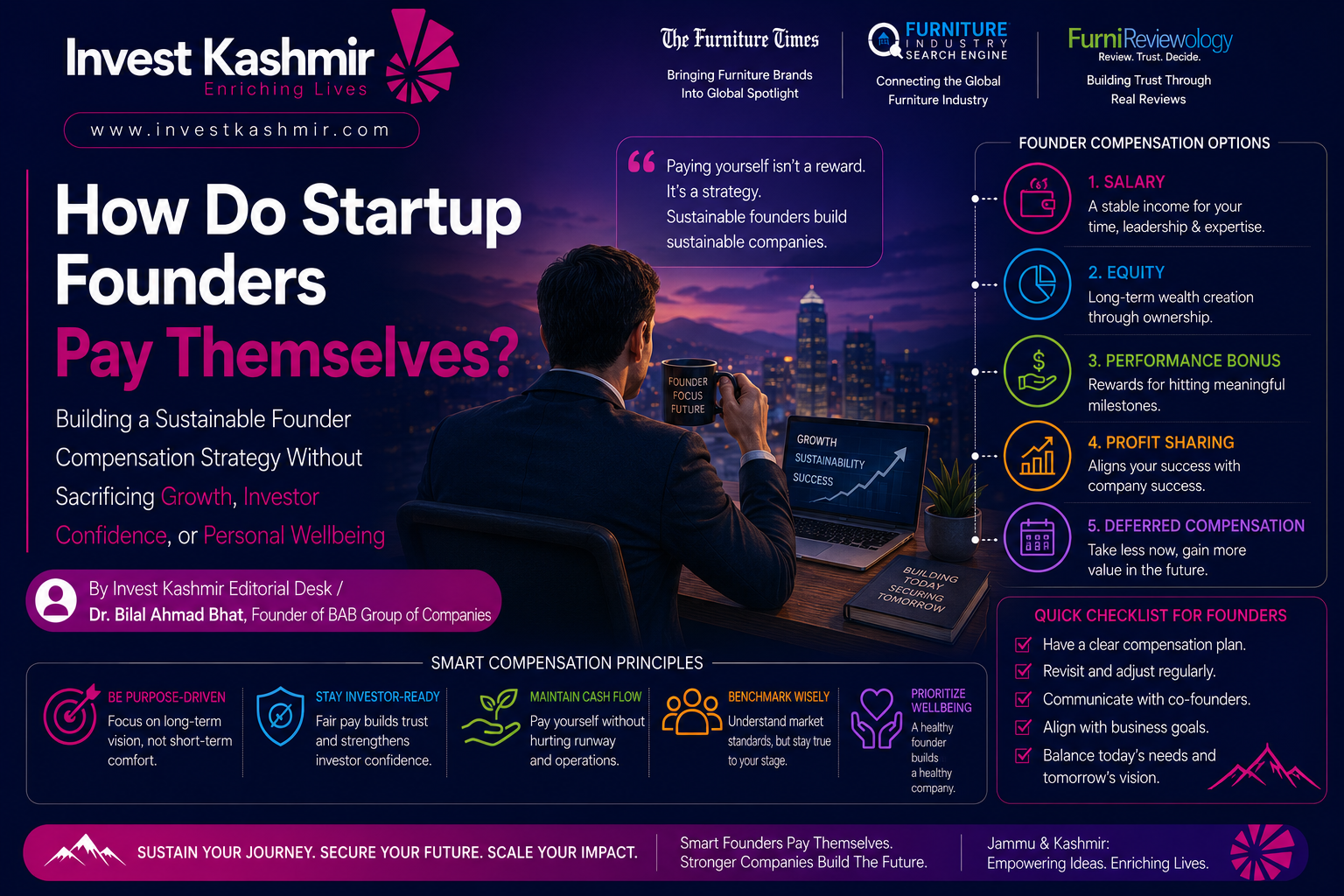
Building a Sustainable Founder Compensation Strategy Without Sacrificing Growth, Investor Confidence, or Personal Wellbeing
By Invest Kashmir Editorial Desk / Dr. Bilal Ahmad Bhat, Founder of BAB Group of Companies
How should I pay myself?
Startup founders spend countless hours developing products, meeting customers, raising investment, hiring teams, and building businesses. Yet many overlook one of the most fundamental aspects of entrepreneurship: creating a sustainable personal financial plan.
Some founders believe they should take no salary at all.
Others assume they should immediately pay themselves a market-rate executive salary.
Neither extreme is universally correct.
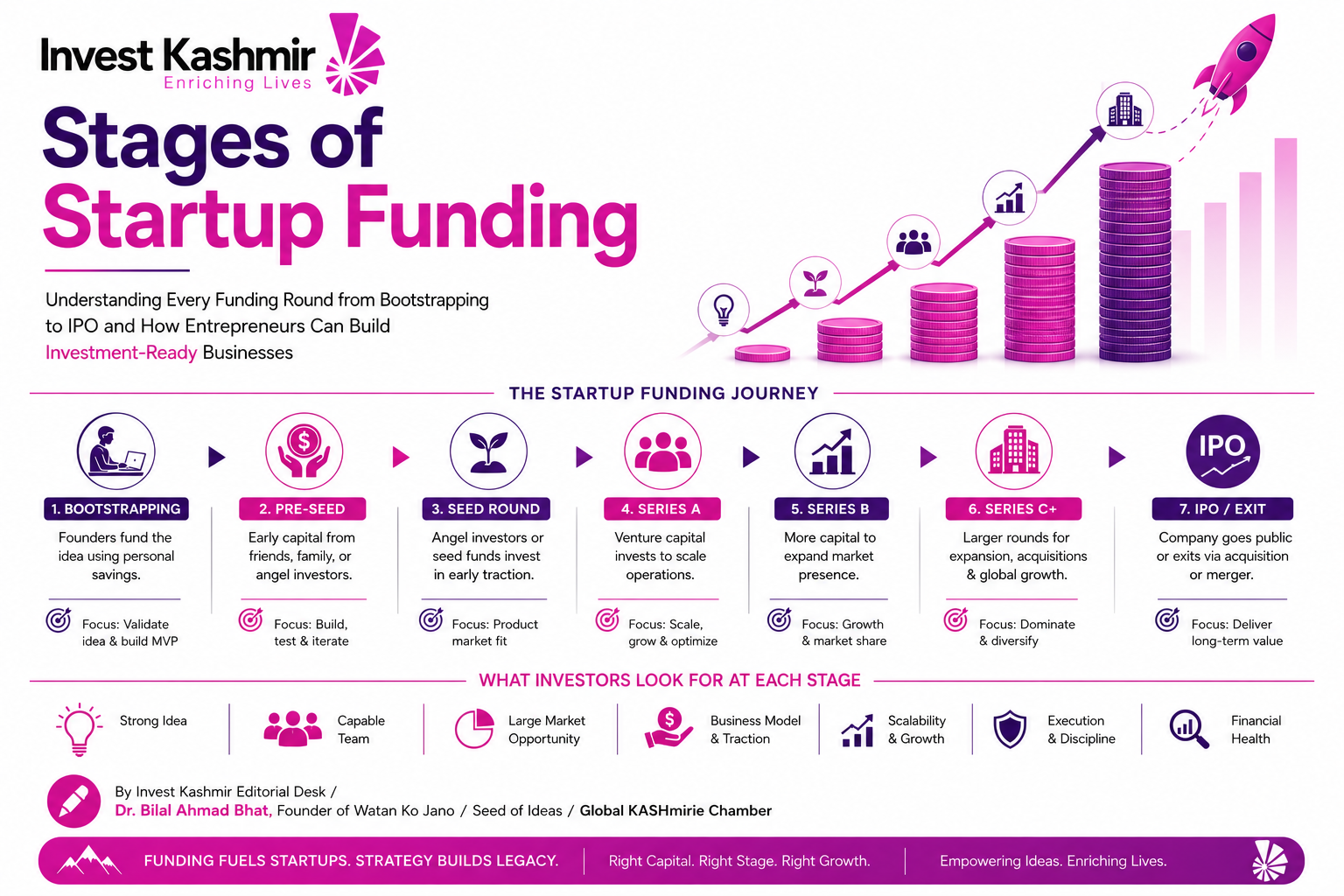
Founder compensation is one of the most strategic financial decisions a startup will make because it influences cash flow, investor confidence, employee morale, company culture, and the founder’s own wellbeing. The most successful founders typically aim for compensation that covers reasonable living expenses while preserving sufficient capital to grow the business. Founder salary decisions generally evolve as companies progress from bootstrapping to revenue generation and external investment.
For Jammu & Kashmir, where entrepreneurship is expanding across tourism, AgriTech, HealthTech, Artificial Intelligence, renewable energy, manufacturing, handicrafts, food processing, education, and digital services, understanding founder compensation is essential for building financially responsible and investment-ready businesses.
Founders Are Employees Too
Many entrepreneurs mistakenly believe they should ignore their own financial needs.
While startups require discipline and careful spending, founders also need financial stability.
Entrepreneurs still have:
- Families.
- Housing expenses.
- Food.
- Healthcare.
- Transportation.
- Education costs.
- Personal responsibilities.
If founders experience constant financial stress, decision-making, creativity, and long-term leadership can suffer.
Healthy companies are often led by healthy founders.
There Is No Universal Founder Salary
One of the biggest misconceptions in entrepreneurship is that every founder should earn the same amount.
In reality, founder compensation depends on factors such as:
- Stage of the company.
- Available cash.
- Revenue.
- Investment raised.
- Cost of living.
- Number of founders.
- Business growth plans.
There is no single “correct” salary.
The appropriate amount should reflect both the founder’s essential needs and the company’s financial capacity.
The Bootstrapping Stage
Many startups begin without outside investment.
During this stage, founders often rely on:
- Personal savings.
- Previous income.
- Consulting work.
- Early customer revenue.
Some founders choose minimal salaries while others postpone compensation until revenue becomes more stable.
Bootstrapping requires careful financial planning because every expenditure directly affects business survival.
Paying Yourself Through Revenue
As startups begin generating consistent income, founders can gradually introduce regular salaries.
This approach offers several advantages:
- Predictable personal income.
- Better financial planning.
- Clear accounting.
- Improved cash-flow management.
Rather than taking irregular withdrawals, structured compensation helps create stronger financial discipline.
Venture-Backed Startups
When startups raise external investment, founder salaries often become part of financial planning discussions.
Professional investors generally understand that founders need reasonable compensation.
However, they also expect founders to:
- Protect company runway.
- Spend responsibly.
- Align personal incentives with long-term growth.
- Demonstrate financial discipline.
Many investors support modest, predictable founder salaries that cover living expenses without unnecessarily increasing the company’s burn rate.
Salary Versus Equity
Startup founders are typically compensated through two mechanisms:
Salary
Salary provides regular income that supports day-to-day living expenses.
It creates financial stability and allows founders to focus fully on building the business.
Equity
Equity represents ownership in the company.
Its value may increase substantially if the business grows successfully, attracts investment, or experiences an acquisition or public listing.
Many founders accept lower salaries during early stages because they believe in the long-term value of their ownership. Equity aligns founders’ financial interests with the future success of the company, while salaries address present-day financial needs.
Balancing Cash Flow and Compensation
Every salary paid by a startup affects available capital.
Founders should ask:
- Can the company afford this salary?
- Will compensation reduce our operating runway?
- Does it affect hiring plans?
- Does it limit product development?
Compensation decisions should strengthen—not weaken—the company’s financial position.
Founder Compensation and Company Culture
Employees carefully observe founder behaviour.
If founders pay themselves excessively while asking employees to make sacrifices, trust may decline.
Conversely, founders who underpay themselves to an unhealthy extent may experience burnout.
The objective is balance.
Responsible leadership demonstrates fairness, transparency, and long-term thinking.
Avoiding Founder Burnout
Financial stress is one of the leading contributors to entrepreneurial burnout.
Founders perform better when they can focus on:
- Customers.
- Innovation.
- Leadership.
- Strategy.
Reasonable compensation allows entrepreneurs to devote energy to building sustainable businesses rather than constantly worrying about personal financial survival.
When Should Founder Salaries Increase?
Founder compensation should evolve as businesses grow.
Salary adjustments may become appropriate when:
- Revenue becomes stable.
- Profitability improves.
- Additional investment is secured.
- Cash reserves strengthen.
- Business operations become more predictable.
Compensation should increase alongside company performance rather than ahead of it.
Common Mistakes Founders Make
Many entrepreneurs unintentionally create financial challenges by:
- Paying themselves nothing for extended periods.
- Taking excessive salaries too early.
- Mixing personal and business finances.
- Making irregular withdrawals.
- Ignoring tax obligations.
- Failing to create financial forecasts.
Professional financial management helps avoid these mistakes.
The Importance of Financial Governance
Good governance strengthens both startups and investor confidence.
Every company should establish:
- Clear payroll policies.
- Transparent accounting.
- Proper financial reporting.
- Board oversight where applicable.
- Responsible budgeting.
Strong governance demonstrates maturity and professionalism.
Investors Appreciate Financial Discipline
Professional investors rarely expect founders to become wealthy through salary alone.
Instead, they seek entrepreneurs who demonstrate:
- Financial responsibility.
- Capital efficiency.
- Long-term commitment.
- Responsible leadership.
- Sustainable planning.
Disciplined compensation decisions often strengthen investor confidence rather than weaken it.
Opportunities for Jammu & Kashmir
As entrepreneurship expands across Jammu & Kashmir, founder education should include:
- Financial literacy.
- Startup accounting.
- Cash-flow management.
- Compensation planning.
- Investor readiness.
- Corporate governance.
These capabilities are as important as technology or product development.
Universities and Entrepreneurship Education
Educational institutions can strengthen startup ecosystems by teaching:
- Entrepreneurial finance.
- Business planning.
- Financial forecasting.
- Governance.
- Investment readiness.
- Leadership.
Preparing founders before they launch businesses increases the probability of long-term success.
Building Sustainable Startup Ecosystems
Healthy startup ecosystems require collaboration among:
- Entrepreneurs.
- Investors.
- Universities.
- Incubators.
- Accelerators.
- Government agencies.
- Financial institutions.
- Industry associations.
Together, these stakeholders help founders make informed financial decisions that support sustainable growth.
Looking Ahead
The question is not whether founders deserve to be paid.
They do.
The real question is how to create compensation structures that protect both the entrepreneur and the enterprise.
Successful founders understand that every financial decision reflects leadership.
Paying yourself responsibly demonstrates confidence without excess.
It protects personal wellbeing without compromising company growth.
It aligns incentives with long-term success.
For Jammu & Kashmir, building globally competitive startups requires founders who understand not only innovation and technology but also financial stewardship.
The strongest businesses are built by entrepreneurs who balance ambition with discipline, growth with responsibility, and vision with sound financial management.
A founder’s salary should never be viewed simply as a personal reward.
It is a strategic business decision.
When managed wisely, it strengthens leadership, protects company stability, builds investor confidence, and creates the foundation for sustainable entrepreneurial success.