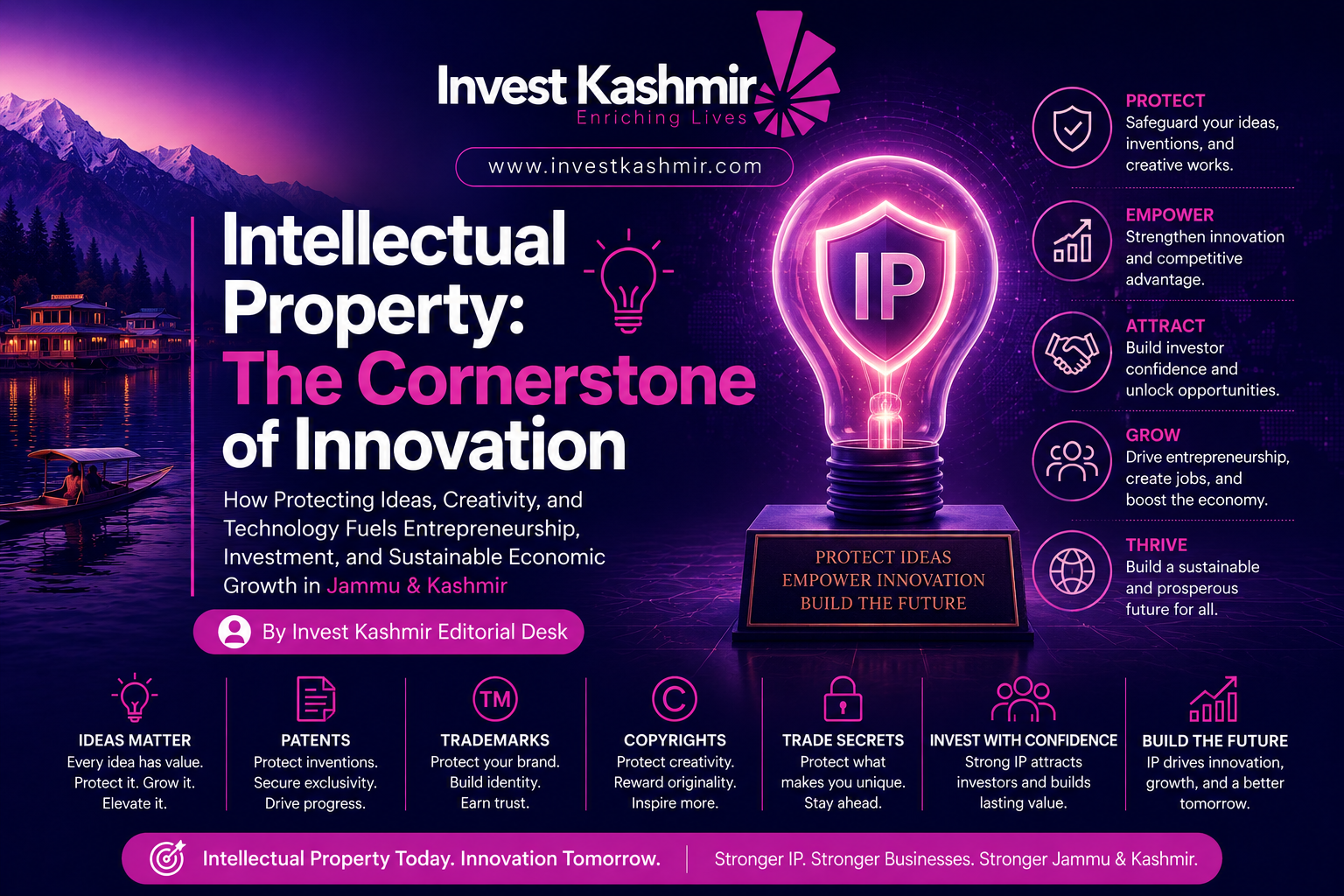
How Protecting Ideas, Creativity, and Technology Fuels Entrepreneurship, Investment, and Sustainable Economic Growth in Jammu & Kashmir
By Invest Kashmir Editorial Desk
Innovation has become the defining force of the twenty-first century economy. Nations that innovate create industries, attract investment, generate employment, and build resilient economies. Businesses that innovate establish competitive advantages, expand globally, and create long-term value. At the center of this innovation ecosystem lies one of the world’s most important strategic assets—Intellectual Property (IP).
Intellectual Property is far more than a legal safeguard. It is the bridge between creativity and commerce, between research and real-world impact, and between ideas and economic prosperity. Whether it is a revolutionary technology, a distinctive brand, an original design, advanced software, a manufacturing process, or a traditional craft, intellectual property enables innovators to protect, commercialize, and maximize the value of their creations.
Across the globe, governments, investors, universities, and businesses increasingly recognize that innovation cannot flourish without a strong intellectual property ecosystem. The World Intellectual Property Organization (WIPO) emphasizes that effective IP strategies help startups and SMEs transform innovation into commercial success, attract investment, and build long-term competitive advantage.
For Jammu & Kashmir, a region rich in entrepreneurial talent, cultural heritage, natural resources, technology potential, and creative industries, intellectual property represents a strategic opportunity to build a knowledge-driven economy capable of competing on the global stage.
Innovation Is More Than an Idea
Every successful innovation begins with curiosity.
A student develops a new mobile application.
An engineer invents a smarter manufacturing process.
A startup creates an Artificial Intelligence platform.
An artisan develops a distinctive handcrafted design.
A farmer introduces a sustainable agricultural technique.
These innovations have economic value.
However, without proper protection, they can be copied, reproduced, or commercially exploited by others.
Intellectual property transforms innovation into a protected business asset, encouraging entrepreneurs to invest time, capital, and expertise into creating solutions that improve industries and society.
Understanding Intellectual Property
Intellectual Property refers to legally protected creations of the human mind.
The primary forms include:
Patents
Protect new inventions, technologies, manufacturing processes, engineering solutions, and scientific innovations.
Trademarks
Protect business names, logos, slogans, symbols, and brand identities that distinguish products and services in the marketplace.
Copyright
Protect original literary, artistic, musical, software, educational, digital, and creative works.
Industrial Designs
Protect the visual appearance and aesthetic characteristics of products.
Trade Secrets
Protect confidential business information such as manufacturing methods, algorithms, formulas, customer databases, and proprietary processes.
Geographical Indications
Protect products whose quality or reputation is linked to a specific geographical origin, helping preserve regional identity and market value.
Together, these rights encourage innovation while enabling businesses to compete fairly and responsibly.
Intellectual Property Drives Economic Growth
Modern economies increasingly derive their value from intangible assets rather than physical infrastructure alone.
Technology.
Knowledge.
Research.
Brands.
Software.
Creative content.
Industrial design.
These assets now represent significant sources of corporate value.
International studies consistently show a positive relationship between intellectual property ownership and stronger business performance, particularly among small and medium-sized enterprises. SMEs that actively manage patents, trademarks, and designs often achieve higher productivity and stronger revenue per employee than businesses without protected IP portfolios.
Why Startups Must Prioritize IP
Many entrepreneurs focus primarily on product development while delaying intellectual property planning.
This can become one of the most expensive mistakes during business growth.
Early IP planning helps startups:
- Protect innovation before market launch
- Build investor confidence
- Strengthen business valuation
- Reduce competitive risks
- Create licensing opportunities
- Support international expansion
- Improve acquisition potential
Investors increasingly evaluate a company’s intellectual property portfolio when assessing long-term growth potential.
Strong intellectual property demonstrates that founders understand strategic asset management and sustainable business development.
Intellectual Property Attracts Investment
Investment decisions extend beyond financial statements.
Professional investors frequently examine:
- Patent ownership
- Trademark registration
- Software ownership
- Technology protection
- Brand strength
- Research capabilities
- IP commercialization strategy
Protected intellectual property reduces uncertainty and strengthens investor confidence because it provides legal protection for the company’s competitive advantages.
For startups seeking venture capital, angel investment, strategic partnerships, or international collaboration, intellectual property often becomes a decisive factor.
Commercializing Innovation
Protecting innovation is only the first step.
The true value of intellectual property emerges through commercialization.
Businesses can generate revenue by:
- Licensing patented technologies
- Franchising brands
- Licensing software
- Selling intellectual property rights
- Creating strategic alliances
- Entering international markets
- Developing new products
- Collaborating with research institutions
Successful commercialization transforms research into economic value, creating employment, attracting investment, and supporting industrial growth.
WIPO emphasizes that businesses should align IP management with their commercialization strategy rather than treating registration as the final objective.
Innovation Opportunities in Jammu & Kashmir
Jammu & Kashmir possesses tremendous intellectual capital across diverse sectors.
Agriculture and Horticulture
Innovative farming technologies, food processing techniques, organic products, cold-chain solutions, and value-added agricultural innovations can benefit from intellectual property protection.
Tourism
Digital tourism platforms, destination branding, hospitality innovations, sustainable tourism services, and cultural experiences can build long-term competitive advantages through trademarks, copyrights, and proprietary technologies.
Handicrafts and Creative Industries
Traditional craftsmanship—including wood carving, papier-mâché, handwoven textiles, carpets, and artisan products—can gain greater global recognition through strategic branding, design protection, and geographical indications.
Information Technology
Software development, Artificial Intelligence applications, cybersecurity solutions, educational technology, and digital platforms rely heavily upon intellectual property for long-term growth.
Manufacturing
Industrial innovation, engineering improvements, automation technologies, product designs, and production processes create significant opportunities for patent protection.
Universities and Research Institutions
Universities play an increasingly important role in national innovation ecosystems.
Research generated within academic institutions can evolve into commercially successful businesses through:
- Technology transfer
- Startup incubation
- Patent commercialization
- Industry partnerships
- Innovation hubs
- Entrepreneurship programs
Closer collaboration between academia and industry enables research to move from laboratories into markets, creating economic and societal impact.
Building an Innovation Culture
An innovation economy requires more than inventors.
It requires collaboration among:
- Entrepreneurs
- Universities
- Investors
- Government agencies
- Research organizations
- Industry associations
- Technology companies
- Financial institutions
When these stakeholders work together, they create an ecosystem where ideas can be developed, protected, financed, commercialized, and scaled.
Common Intellectual Property Mistakes
Many businesses unintentionally reduce the value of their innovations by:
- Delaying IP protection
- Publicly disclosing inventions too early
- Failing to register trademarks
- Neglecting confidentiality agreements
- Ignoring employee IP ownership policies
- Overlooking valuable trade secrets
WIPO advises SMEs to identify valuable intangible assets early and develop an IP strategy that evolves alongside their business objectives.
Intellectual Property and Sustainable Development
Intellectual property contributes to broader economic objectives by encouraging:
- Entrepreneurship
- Scientific research
- Technology transfer
- Industrial competitiveness
- Export growth
- Job creation
- Foreign investment
- Sustainable innovation
A robust IP ecosystem encourages businesses to invest confidently in research and development because successful innovations can be legally protected and commercially rewarded.
The Road Ahead
The future economy will increasingly reward those who create rather than imitate.
Ideas will become currencies.
Knowledge will become capital.
Innovation will become infrastructure.
Intellectual property provides the legal and commercial foundation that allows these assets to generate lasting value.
For Jammu & Kashmir, strengthening intellectual property awareness among entrepreneurs, startups, MSMEs, universities, artisans, researchers, and investors can accelerate the region’s transformation into a globally competitive innovation hub.
The businesses that lead tomorrow will not simply manufacture products.
They will create ideas.
Protect ideas.
Commercialize ideas.
And build industries around ideas.
Innovation begins with imagination.
Intellectual property ensures that imagination becomes opportunity, opportunity becomes enterprise, and enterprise becomes sustainable economic growth.
When innovation is protected, confidence grows.
When confidence grows, investment follows.
When investment follows, regions prosper, industries evolve, and societies move forward together.