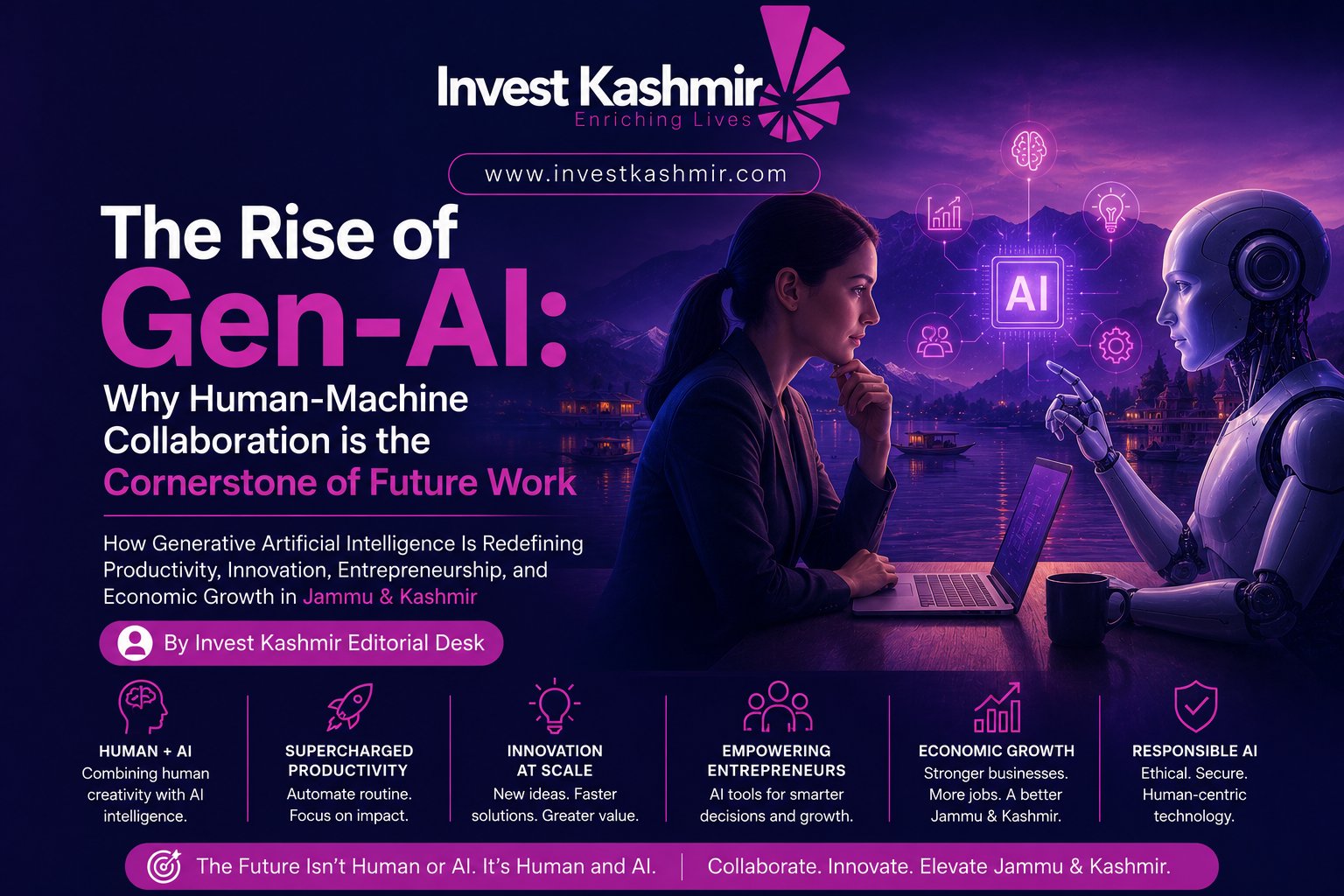
How Generative Artificial Intelligence Is Redefining Productivity, Innovation, Entrepreneurship, and Economic Growth in Jammu & Kashmir
By Invest Kashmir Editorial Desk
The workplace is entering one of the most profound transformations since the Industrial Revolution. From factories and financial institutions to hospitals, classrooms, government offices, creative industries, and startups, Generative Artificial Intelligence (Gen-AI) is rapidly becoming an essential business capability rather than an experimental technology.
Yet the future of work is not a story of humans versus machines.
It is a story of humans working with intelligent machines to unlock new levels of creativity, productivity, innovation, and economic value.
Around the world, businesses are discovering that the greatest returns from Gen-AI come not from replacing people but from augmenting human capabilities. Organizations that combine human judgment, creativity, empathy, and strategic thinking with AI-powered speed, automation, and data analysis are emerging as the leaders of the digital economy. Recent global workforce research similarly suggests that AI adoption is reshaping jobs toward collaboration, with human skills such as leadership, judgment, creativity, and communication becoming even more valuable alongside technological proficiency.
For Jammu & Kashmir, where entrepreneurship, tourism, agriculture, handicrafts, manufacturing, healthcare, education, renewable energy, and technology are expanding rapidly, embracing human-machine collaboration presents an opportunity to build a globally competitive innovation ecosystem.
Understanding Generative Artificial Intelligence
Generative Artificial Intelligence refers to AI systems capable of creating new content rather than simply analyzing existing information.
Unlike earlier automation tools that followed predefined instructions, Gen-AI can:
- Generate written content
- Create software code
- Analyze complex data
- Produce images and designs
- Summarize documents
- Translate languages
- Develop business strategies
- Assist research
- Automate customer interactions
- Support decision-making
Instead of replacing human intelligence, these systems function as digital collaborators capable of accelerating knowledge work across industries.
The Shift from Automation to Collaboration
Earlier generations of automation primarily focused on repetitive manual tasks.
Today’s AI systems operate differently.
They assist professionals in solving complex problems, identifying patterns, generating ideas, and accelerating decision-making.
This represents a significant evolution.
Rather than asking:
“Which jobs will AI replace?”
Business leaders are increasingly asking:
“How can AI help our people perform at their highest potential?”
This shift from automation to augmentation defines the future of work.
Why Human Skills Matter More Than Ever
As AI becomes more capable, uniquely human qualities become increasingly valuable.
Machines excel at:
- Processing massive datasets
- Pattern recognition
- Repetitive workflows
- Information retrieval
- Speed
- Consistency
Humans contribute:
- Creativity
- Emotional intelligence
- Ethical judgment
- Leadership
- Critical thinking
- Innovation
- Negotiation
- Cultural understanding
- Relationship building
- Strategic vision
The organizations that thrive will combine these complementary strengths rather than viewing them as competing forces.
AI as a Productivity Multiplier
Across industries, Gen-AI is helping professionals complete routine tasks more efficiently.
Examples include:
Entrepreneurs
- Developing business plans
- Conducting market research
- Preparing investor presentations
- Creating marketing content
- Analyzing competitors
Manufacturers
- Predictive maintenance
- Supply chain optimization
- Quality monitoring
- Inventory forecasting
- Production planning
Healthcare
- Clinical documentation
- Medical research assistance
- Administrative efficiency
- Patient communication
Education
- Personalized learning
- Content development
- Lesson planning
- Student support
Tourism
- Multilingual customer service
- Travel planning
- Marketing campaigns
- Visitor engagement
Rather than eliminating professionals, AI enables them to dedicate more time to innovation, customer relationships, strategic planning, and creative problem-solving.
The Future Workforce Will Be AI-Augmented
The next generation of professionals will not compete against AI.
They will compete alongside AI.
Future employers will increasingly seek individuals who can:
- Work effectively with AI tools
- Verify AI-generated outputs
- Ask better questions
- Interpret AI insights
- Make ethical decisions
- Solve complex business problems
- Lead multidisciplinary teams
AI literacy is rapidly becoming a core workplace skill, much like digital literacy became essential over the past two decades.
New Opportunities for Entrepreneurs
Gen-AI significantly lowers barriers for starting and scaling businesses.
Entrepreneurs can now:
- Build prototypes faster
- Create branding materials
- Develop digital products
- Automate customer support
- Improve operational efficiency
- Expand internationally
- Analyze markets
- Generate multilingual content
This democratization of advanced technology enables startups with limited resources to compete more effectively in domestic and international markets.
For aspiring entrepreneurs in Jammu & Kashmir, AI provides access to capabilities that were once available only to large corporations.
Transforming Traditional Industries
Human-machine collaboration is not limited to technology companies.
Traditional sectors can also benefit enormously.
Agriculture
AI-powered analytics can support crop planning, weather forecasting, irrigation management, and market intelligence.
Horticulture
Predictive models can improve production planning while reducing waste.
Handicrafts
Artisans can use AI-assisted marketing, e-commerce optimization, multilingual product descriptions, and global customer engagement while preserving traditional craftsmanship.
Manufacturing
AI can improve quality control, operational efficiency, predictive maintenance, and supply chain resilience.
Tourism
Businesses can enhance visitor experiences through personalized recommendations, multilingual communication, and intelligent booking systems.
Technology strengthens these industries without replacing the human expertise that makes them unique.
Responsible AI Adoption
Successful AI implementation requires more than software deployment.
Organizations must establish responsible governance around:
- Data privacy
- Cybersecurity
- Transparency
- Accountability
- Bias mitigation
- Intellectual property
- Human oversight
Responsible AI ensures that technology supports people while maintaining public trust and organizational integrity.
Continuous Learning Will Define Success
The pace of technological change demands continuous upskilling.
Professionals should invest in:
- AI literacy
- Data interpretation
- Critical thinking
- Digital communication
- Leadership
- Creativity
- Project management
- Ethical decision-making
Organizations that encourage lifelong learning will adapt more successfully to technological transformation.
Building an AI-Ready Ecosystem in Jammu & Kashmir
As Jammu & Kashmir continues strengthening its entrepreneurial ecosystem, integrating Gen-AI into education, startups, MSMEs, manufacturing, tourism, healthcare, and public services can accelerate economic development.
An AI-ready ecosystem requires collaboration among:
- Government institutions
- Universities
- Startup accelerators
- Research organizations
- Industry associations
- Technology companies
- Investors
- Educational institutions
Such collaboration can help entrepreneurs adopt emerging technologies while preparing the workforce for future opportunities.
Human Leadership in the Age of AI
Technology alone cannot define organizational success.
Leaders remain responsible for:
- Setting vision
- Building trust
- Inspiring teams
- Managing change
- Making ethical decisions
- Serving communities
- Creating inclusive workplaces
As AI assumes more operational tasks, human leadership becomes even more important.
The future belongs to leaders who combine technological understanding with empathy, integrity, adaptability, and strategic thinking.
A New Era of Opportunity
The rise of Generative AI should not be viewed as the end of human work.
It represents the beginning of a new partnership between human intelligence and machine capability.
Businesses that embrace this partnership will innovate faster, serve customers better, make smarter decisions, and compete more effectively in the global marketplace.
For Jammu & Kashmir, this transformation presents a historic opportunity to cultivate a digitally empowered workforce, strengthen entrepreneurship, modernize traditional industries, attract investment, and create sustainable, knowledge-driven economic growth.
The future of work will not be built by humans alone.
Nor will it be built by machines alone.
It will be built by people who understand how to collaborate with intelligent technologies to create solutions, generate value, and shape a more prosperous future for all.