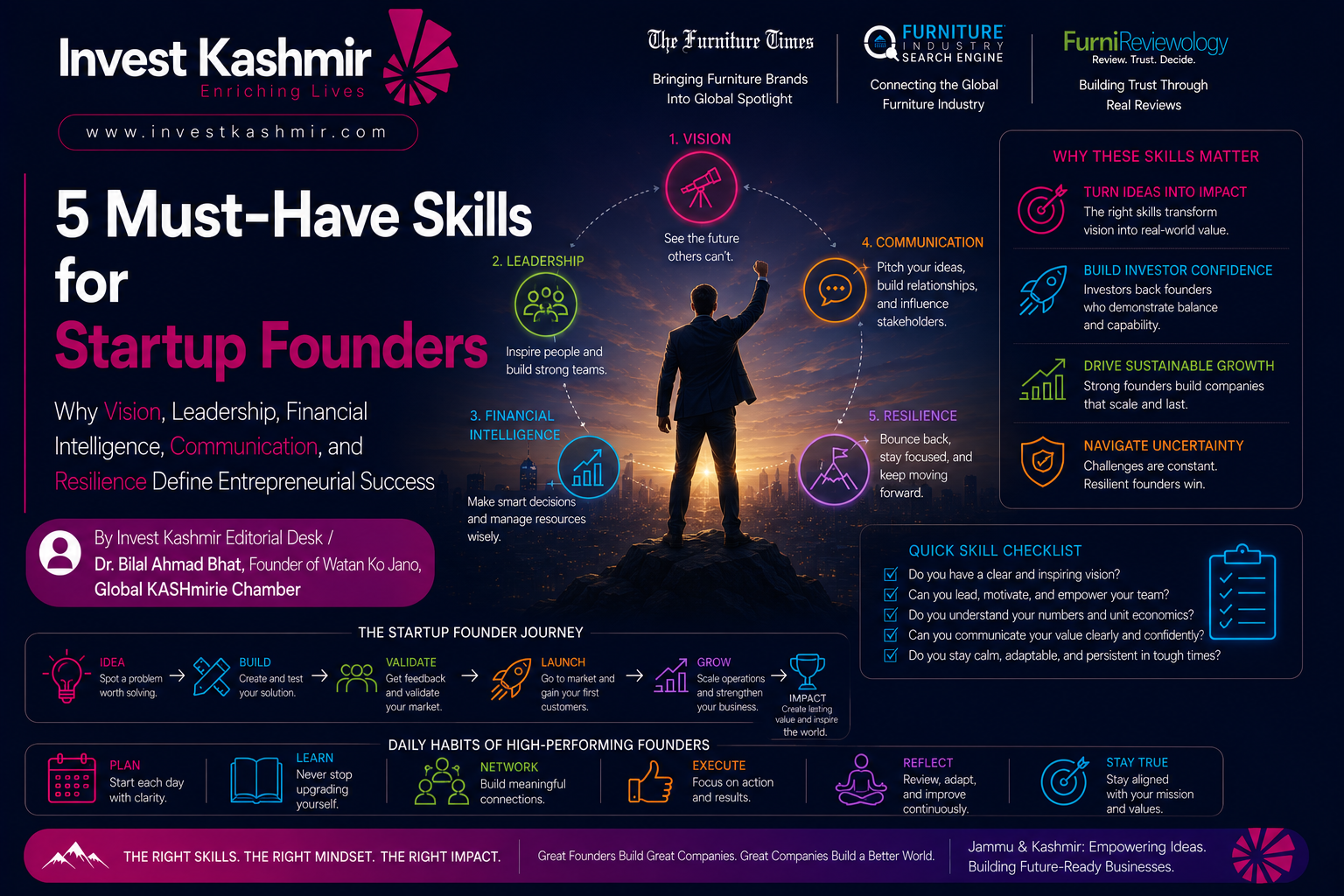
Why Vision, Leadership, Financial Intelligence, Communication, and Resilience Define Entrepreneurial Success
By Invest Kashmir Editorial Desk / Dr. Bilal Ahmad Bhat, Founder of Watan Ko Jano, Global KASHmirie Chamber
Every successful startup begins with an idea.
But ideas alone have never built great companies.
History has repeatedly shown that countless entrepreneurs have launched businesses with brilliant concepts, innovative technologies, and ambitious dreams. Yet only a small percentage transform those ideas into sustainable enterprises that create employment, attract investment, improve communities, and contribute to economic development.
The difference rarely lies in the idea itself.
It lies in the founder.
A startup founder is required to perform multiple roles simultaneously. One day they negotiate with investors. The next day they meet customers, solve operational problems, motivate employees, review financial statements, refine products, and make strategic decisions that determine the future of the company.
Entrepreneurship therefore demands far more than technical knowledge.
It requires leadership.
It requires discipline.
It requires continuous learning.
It requires emotional strength.
Most importantly, it requires a combination of practical skills that evolve as the business grows.
For Jammu & Kashmir, where entrepreneurship is expanding rapidly across Tourism Technology, AgriTech, HealthTech, Artificial Intelligence, Renewable Energy, Manufacturing, Food Processing, Handicrafts, Education Technology, and Digital Commerce, developing these entrepreneurial capabilities will determine whether innovative ideas become globally competitive businesses.
Skill One: Visionary Leadership
Every successful company begins with a clear vision.
Vision gives entrepreneurs direction.
It answers important questions:
- Why does this business exist?
- What problem are we solving?
- What future are we trying to create?
- How will we improve people’s lives?
Vision is not merely about dreaming.
It is about translating long-term ambition into practical action.
Strong founders inspire employees, investors, customers, and partners because they communicate purpose with clarity.
Leadership also requires making difficult decisions during uncertainty.
Markets change.
Technology evolves.
Competition increases.
A visionary founder maintains strategic direction while remaining flexible enough to adapt when circumstances demand change. Leadership, strategic thinking, and decisive execution consistently rank among the most valuable founder capabilities in modern startup ecosystems.
Skill Two: Financial Intelligence
Many startups fail because they run out of money—not because they run out of ideas.
Financial intelligence allows founders to understand:
- Cash flow.
- Revenue.
- Profitability.
- Operating expenses.
- Customer acquisition costs.
- Financial runway.
- Investment requirements.
Entrepreneurs do not need to become accountants.
However, they must understand how financial decisions affect business sustainability.
Financial discipline includes:
- Responsible budgeting.
- Prioritising investments.
- Managing resources efficiently.
- Monitoring performance.
- Planning for uncertainty.
Investors increasingly evaluate capital efficiency alongside innovation, expecting founders to demonstrate thoughtful financial management and disciplined execution.
Skill Three: Communication and Storytelling
Great ideas create opportunities.
Great communication creates belief.
Every founder communicates continuously.
They speak with:
- Customers.
- Investors.
- Employees.
- Government agencies.
- Suppliers.
- Strategic partners.
- Media.
Clear communication strengthens trust.
Storytelling helps entrepreneurs explain:
- The problem.
- The solution.
- Customer impact.
- Business vision.
- Long-term opportunity.
Strong communication also improves negotiations, fundraising, recruitment, leadership, and customer relationships.
Founders who communicate clearly reduce confusion while strengthening organizational alignment.
Skill Four: Adaptability and Resilience
Entrepreneurship is unpredictable.
Business plans evolve.
Customer preferences change.
Technology advances.
Unexpected challenges emerge.
Successful founders rarely avoid adversity.
Instead, they respond constructively.
Resilience enables entrepreneurs to:
- Learn from setbacks.
- Adjust business models.
- Improve products.
- Recover from failure.
- Continue building.
Adaptability has become increasingly important in today’s AI-driven and rapidly changing business environment. Investors consistently identify resilience, authenticity, and the ability to execute under changing conditions as defining founder qualities.
Skill Five: Customer-Centric Problem Solving
The purpose of every startup is to solve meaningful problems.
Successful founders constantly ask:
- What problem are customers experiencing?
- Does our solution create measurable value?
- What feedback are customers providing?
- How can we improve continuously?
Customer-focused founders spend less time defending assumptions and more time validating ideas.
Problem-solving also requires:
- Critical thinking.
- Data analysis.
- Creativity.
- Continuous experimentation.
Businesses that remain close to customers often innovate faster while reducing unnecessary risk.
Why Technical Skills Alone Are Not Enough
Many entrepreneurs possess exceptional technical knowledge.
However, technology alone rarely builds successful companies.
Founders must combine technical expertise with:
- Leadership.
- Business understanding.
- Emotional intelligence.
- Strategic thinking.
- Decision-making.
Modern entrepreneurship requires balanced capability across multiple disciplines.
Artificial Intelligence Is Changing Founder Responsibilities
Artificial Intelligence enables startups to:
- Analyse markets.
- Automate repetitive work.
- Improve productivity.
- Enhance customer service.
- Generate business insights.
Yet AI cannot replace:
- Human judgment.
- Ethical leadership.
- Vision.
- Relationship building.
- Entrepreneurial courage.
Technology supports founders.
It does not replace them.
Universities Must Develop Entrepreneurial Skills
Higher education should prepare future founders through:
- Leadership development.
- Business communication.
- Financial literacy.
- Innovation management.
- Entrepreneurial ethics.
- Practical problem-solving.
Entrepreneurship education should combine classroom learning with real-world experience.
Opportunities for Jammu & Kashmir
Jammu & Kashmir possesses extraordinary entrepreneurial opportunities across:
- Tourism Technology.
- AgriTech.
- HealthTech.
- Artificial Intelligence.
- Renewable Energy.
- Food Processing.
- Manufacturing.
- Handicrafts.
- Digital Commerce.
- Education Technology.
Young entrepreneurs entering these industries will benefit enormously by strengthening foundational leadership skills before focusing solely on technology or funding.
Building a Strong Entrepreneurial Ecosystem
A thriving startup ecosystem requires collaboration among:
- Entrepreneurs.
- Universities.
- Investors.
- Incubators.
- Accelerators.
- Government agencies.
- Financial institutions.
- Industry associations.
When these institutions work together, founders receive not only funding but also mentorship, education, strategic guidance, and market access.
Looking Ahead
The next generation of successful founders will not necessarily possess the largest budgets.
They will possess the strongest capabilities.
They will communicate clearly.
Lead responsibly.
Manage resources wisely.
Solve meaningful problems.
Adapt continuously.
Build trusted relationships.
For Jammu & Kashmir, entrepreneurship represents more than business creation.
It represents economic transformation.
Employment generation.
Innovation.
Global competitiveness.
The future belongs to founders who continuously invest in themselves before expecting others to invest in their companies.
Because businesses grow only as far as their founders grow.
Ideas create possibilities.
Skills create execution.
Execution creates businesses.
And great founders create lasting economic change.
The greatest startup advantage is never technology alone.
It is a founder who possesses the vision to imagine the future, the courage to pursue it, and the skills to make it a reality.