Why Smart Entrepreneurs Are Building Diverse Capital Strategies Beyond Venture Capital
By Invest Kashmir Editorial Desk
For decades, venture capital (VC) has been portrayed as the ultimate destination for ambitious entrepreneurs. Countless startup success stories—from Silicon Valley to Bengaluru—have highlighted founders pitching investors, securing multi-million-dollar funding rounds, and rapidly scaling their businesses. While venture capital remains a critical engine of innovation, it is no longer the only pathway to business growth.
Today’s entrepreneurs operate in a far more diverse financial landscape. Businesses can now access capital through government grants, angel investors, revenue-based financing, crowdfunding, venture debt, peer-to-peer lending, strategic corporate partnerships, export financing, family offices, incubator programs, and blended finance structures. Rather than relying solely on one funding source, successful companies increasingly combine multiple financing options that align with their growth stage, industry, cash flow, and long-term vision. Recent analyses highlight the growing use of non-dilutive funding, revenue-based financing, and crowdfunding as founders seek greater flexibility and ownership preservation.
For emerging entrepreneurial ecosystems such as Jammu & Kashmir, understanding these alternative funding models is not merely advantageous—it is essential for building resilient businesses, attracting investment, creating employment, and fostering sustainable economic development.
The Changing Nature of Entrepreneurial Finance
The global startup ecosystem has undergone a significant transformation over the past decade. Investors have become more selective, founders are increasingly conscious of equity dilution, and governments are expanding support for innovation through grants, incentives, and entrepreneurship programs.
As a result, capital has become more diverse.
Rather than asking, “How do I get venture capital?” modern entrepreneurs are asking a more strategic question:
“What is the right capital for my business at the right time?”
This shift reflects a growing understanding that funding should serve the business strategy—not define it.
Why Venture Capital Is Not Always the Right Fit
Venture capital remains one of the most powerful tools for financing high-growth businesses, particularly those developing disruptive technologies or targeting global markets.
However, VC funding comes with expectations.
Investors typically seek:
- Rapid business growth
- High return potential
- Large addressable markets
- Equity ownership
- Defined exit opportunities
- Strong governance
Not every business is designed for exponential growth.
Many successful enterprises—including manufacturing companies, tourism businesses, food processors, handicraft exporters, healthcare providers, education ventures, and family-owned businesses—can achieve long-term success without pursuing venture capital.
For these businesses, alternative financing may provide greater flexibility while allowing founders to retain ownership and strategic control.
Government Grants and Innovation Incentives
Government grants are among the most attractive forms of startup financing because they are generally non-dilutive.
Unlike loans, grants usually do not require repayment.
Unlike venture capital, they do not require founders to surrender ownership.
Governments across the world increasingly support innovation through funding for:
- Research and development
- Technology adoption
- Digital transformation
- Manufacturing modernization
- Women entrepreneurship
- Rural enterprises
- Green businesses
- Export development
- Skill development
- Youth entrepreneurship
For Jammu & Kashmir, government-backed entrepreneurship initiatives can play an important role in supporting startups operating in sectors such as tourism, horticulture, handicrafts, renewable energy, information technology, healthcare, food processing, and sustainable manufacturing.
Angel Investors: More Than Just Capital
Angel investors are experienced entrepreneurs, professionals, or business leaders who invest their personal funds into promising early-stage companies.
Beyond financial investment, angels often provide:
- Industry expertise
- Mentorship
- Strategic advice
- Business networks
- Customer introductions
- Partnership opportunities
Many successful companies receive their first external investment from angel investors long before attracting venture capital.
For first-time founders, the right angel investor can be as valuable as the capital they provide.
Revenue-Based Financing
Revenue-based financing has emerged as one of the fastest-growing alternative funding models for businesses with predictable recurring revenue.
Instead of giving away equity, businesses receive capital upfront and repay a percentage of future revenue until a predetermined repayment amount is reached.
This model offers several advantages:
- No equity dilution
- Flexible repayments linked to business performance
- No loss of management control
- Faster access to growth capital
Revenue-based financing has become particularly attractive for software companies, subscription businesses, digital services, and growing SMEs with stable income streams.
Venture Debt
Many startups assume they must raise another equity round whenever they need capital.
In reality, venture debt provides an additional financing option.
Rather than selling shares, companies borrow capital that supports expansion while minimizing ownership dilution.
Businesses commonly use venture debt to:
- Extend financial runway
- Purchase equipment
- Expand operations
- Hire talent
- Finance acquisitions
- Bridge funding between investment rounds
Used strategically, venture debt complements venture capital rather than replacing it.
Crowdfunding: Funding Through Communities
Crowdfunding has transformed entrepreneurial finance by allowing businesses to raise capital directly from communities, supporters, and customers.
Several crowdfunding models now exist:
- Reward-based crowdfunding
- Equity crowdfunding
- Donation-based crowdfunding
- Debt crowdfunding
Beyond raising money, crowdfunding helps businesses:
- Validate products
- Build customer communities
- Generate media attention
- Test market demand
- Strengthen brand awareness
Successful crowdfunding campaigns often become powerful marketing campaigns as well.
Peer-to-Peer Lending
Digital financial platforms have made business lending more accessible through peer-to-peer (P2P) financing.
Rather than borrowing from a traditional bank, businesses can secure loans funded by multiple individual or institutional investors through regulated online platforms.
P2P lending can offer:
- Faster approvals
- Simplified applications
- Competitive financing
- Flexible repayment structures
For SMEs that may struggle to meet conventional banking requirements, P2P lending provides an important alternative.
Strategic Corporate Partnerships
Large corporations increasingly invest in startups that complement their business strategies.
Corporate partnerships may include:
- Equity investment
- Joint product development
- Technology collaboration
- Market access
- Distribution agreements
- Procurement contracts
Such partnerships can accelerate growth by providing both funding and commercial opportunities.
Family Offices and Private Investors
Across the world, family offices are becoming significant sources of patient capital.
Unlike traditional venture capital funds, many family offices adopt longer investment horizons and prioritize sustainable value creation.
Their investments frequently support:
- Manufacturing
- Agriculture
- Tourism
- Healthcare
- Infrastructure
- Education
- Export businesses
For regional enterprises in Jammu & Kashmir, this form of capital may align more closely with long-term development objectives.
Incubators and Accelerators
Many entrepreneurs underestimate the value of incubator and accelerator programs.
While the financial investment may be modest, these programs often provide:
- Mentorship
- Investor access
- Business validation
- Product refinement
- Networking
- Market expansion
- Training
The knowledge, relationships, and credibility gained through these programs often prove more valuable than the initial funding itself.
Export Finance and Trade Support
Businesses engaged in international trade require specialized financing solutions.
Export-oriented enterprises can benefit from:
- Export credit
- Trade finance
- Working capital facilities
- Invoice financing
- Supply chain finance
- Letters of credit
These instruments improve liquidity while enabling businesses to expand into global markets with greater confidence.
Blended Finance: The Future of Entrepreneurial Funding
Modern businesses increasingly combine multiple financing sources rather than depending on one.
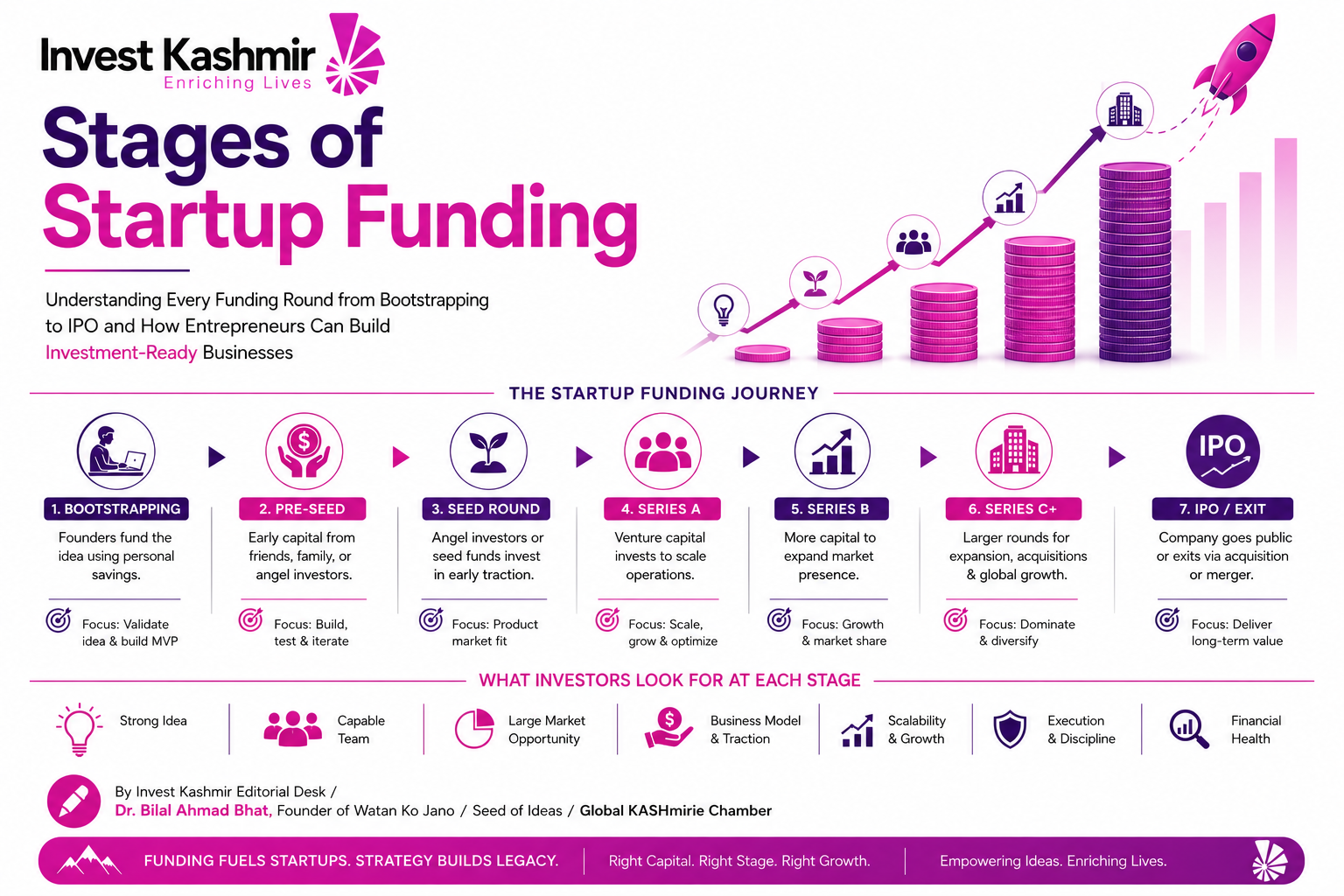
A typical funding journey may include:
- Founder capital during the idea stage
- Government grants for product development
- Angel investment for validation
- Crowdfunding for market testing
- Revenue-based financing for growth
- Venture debt for expansion
- Venture capital for international scaling
This diversified approach reduces financial risk while improving long-term sustainability.
Building a Stronger Funding Ecosystem in Jammu & Kashmir
As Jammu & Kashmir continues to position itself as an emerging destination for entrepreneurship, innovation, manufacturing, tourism, and technology-driven enterprise, expanding awareness of diverse financing options will be critical.
A vibrant entrepreneurial ecosystem requires more than investors alone. It depends on collaboration among government agencies, financial institutions, incubators, universities, industry associations, corporate partners, development organizations, and entrepreneurs.
By strengthening access to multiple forms of capital, the region can encourage innovation, empower MSMEs, create employment opportunities, and attract both domestic and international investment.
Looking Beyond the Pitch
The future of entrepreneurship is no longer defined by a single investor presentation or one funding source.
Successful founders understand that capital is strategic.
Every financing decision should align with the company’s vision, business model, growth stage, and long-term objectives.
Venture capital will continue to play an essential role in supporting transformative innovation. Yet it represents only one part of a much broader financial ecosystem.
Businesses that understand and leverage alternative funding options are better positioned to grow sustainably, preserve ownership where appropriate, manage financial risk, and seize new opportunities.
For the entrepreneurs of Jammu & Kashmir, the message is clear: the future belongs not only to those who can pitch investors—but to those who can build resilient businesses supported by the right mix of capital, partnerships, and long-term vision.