The world cannot support what it cannot discover
Every day, talented artisans create extraordinary products. Small furniture manufacturers build businesses with years of experience. Local entrepreneurs develop solutions that deserve international recognition. Grassroots creators preserve traditional skills, and small and medium-sized enterprises work tirelessly to turn their ideas into sustainable livelihoods.
Yet one critical challenge continues to hold many of them back: visibility.
A business can have an exceptional product, competitive pricing, outstanding craftsmanship and a powerful story, but if potential customers cannot find it, its opportunities remain limited. In today’s digital economy, being good at what you do is important. Being discoverable by the right people, in the right places, at the right time, is what can help you grow.
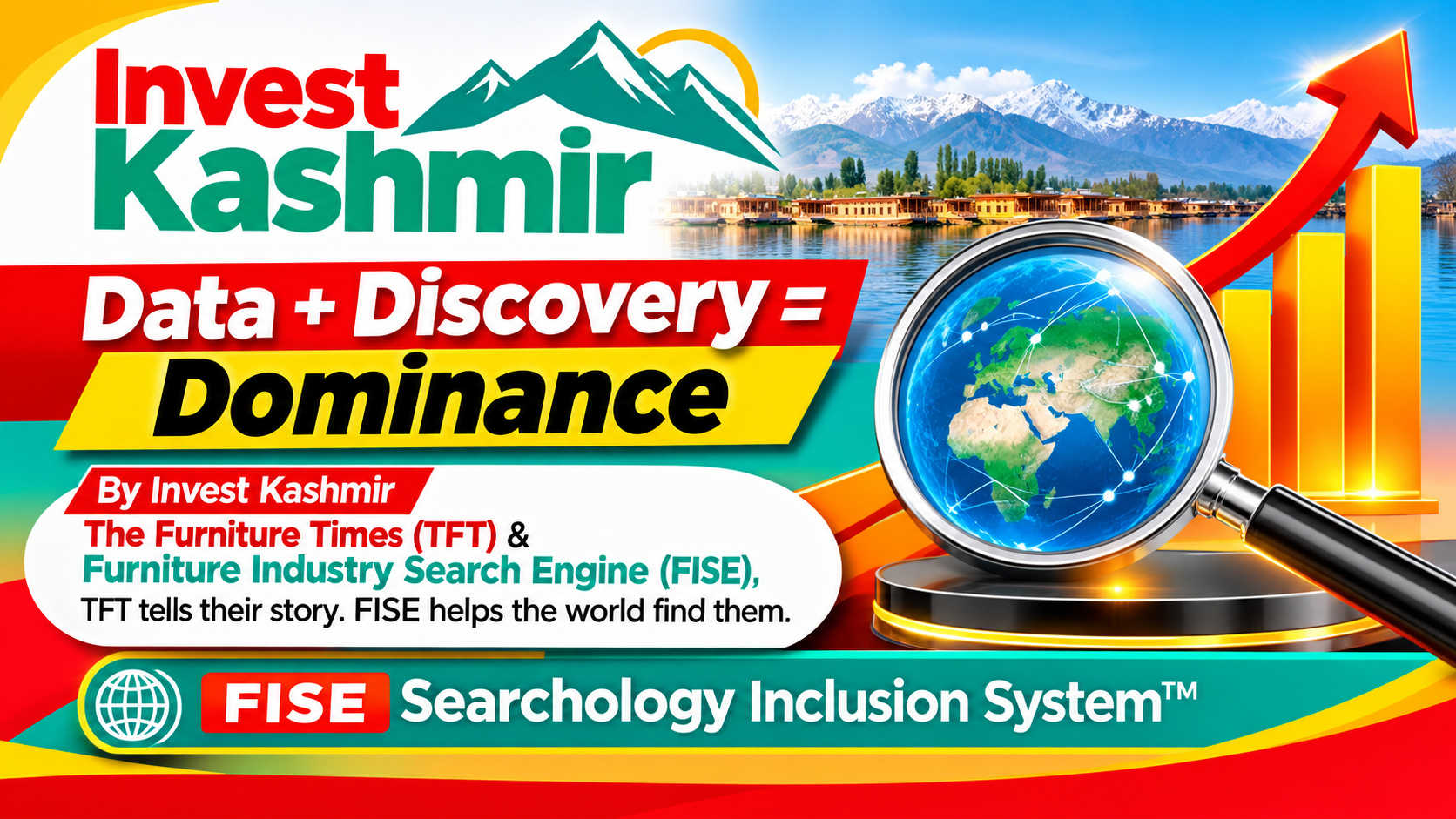
This is where a powerful equation begins to change the conversation: Data + Discovery = Dominance.
Invest Kashmir, The Furniture Times (TFT), and the Furniture Industry Search Engine (FISE) represent a vision in which business information becomes a bridge to opportunity. The goal is not simply to put businesses online. It is to help make their identities easier to discover, their stories easier to understand, and their capabilities easier to explore.
Because the future of business should not belong exclusively to those with the largest advertising budgets. It should also create meaningful opportunities for those with talent, determination, knowledge and something valuable to offer.
Why data alone is not enough to grow a business
Data has become one of the most important assets in the modern economy. Business names, product categories, locations, capabilities, services, specialties and contact information can all help potential customers understand what a company offers.
However, data creates greater value when it becomes useful and discoverable.
Imagine a furniture workshop producing high-quality wooden tables. Its team understands the materials, the finishing process, the craftsmanship and the needs of its customers. Yet a potential hotel buyer searching online for a suitable furniture supplier may never discover that workshop.
The workshop has capability, but the connection is missing.
Now imagine that the business has a clear digital identity, accurate information, relevant product descriptions and a structured presence that helps people understand what it offers. Its information becomes more useful to search systems, business directories, potential partners and prospective buyers.
The business has taken an important step toward being found.
That is the strategic value behind Data + Discovery. Data helps describe a business. Discovery helps connect that description with people searching for relevant products, services, skills and opportunities.
Dominance, in this context, is not about defeating competitors at any cost. It is about strengthening a business’s ability to participate in the digital economy, compete for attention and build sustainable recognition.
Invest Kashmir: Connecting local potential with wider opportunity
Every region has talent that deserves greater recognition. Kashmir is no exception.
Its entrepreneurs, manufacturers, artisans, craftspeople and emerging businesses represent a diverse landscape of knowledge, creativity and economic potential. Yet local talent does not automatically translate into global reach.
Businesses need pathways that help them communicate their value beyond their immediate communities.
The Invest Kashmir vision can be understood through this opportunity: helping businesses move from being locally known to being more widely discoverable, while highlighting the people, skills and products that contribute to economic development.
Consider a traditional artisan whose family has practised a craft for generations. The artisan may possess exceptional knowledge, but reaching a new audience can be difficult without the right digital presentation and access to relevant discovery channels.
Consider a small manufacturer that can fulfil commercial orders but lacks the resources to compete with larger brands in online advertising.
Consider a new entrepreneur who has a promising product but does not yet know how to establish a credible digital identity.
Each faces a different challenge, but all share a common need: the ability to communicate their value and connect with the people who may need what they offer.
Digital discovery can help create that bridge. When combined with business development, market access, reliable information and meaningful partnerships, it can support a broader vision of inclusive economic opportunity.
The real objective is not merely to make businesses visible. It is to help visibility become a starting point for relationships, enquiries, partnerships and potential commercial growth.
The Furniture Times tells their story
The Furniture Times (TFT) plays an important storytelling role within this broader vision.
Every business has a story, but not every business has the resources or platform to tell it effectively. Behind a furniture product may be decades of manufacturing experience, a family’s entrepreneurial journey, a workshop employing local craftspeople or a company working to improve its production capabilities.
These stories deserve more than a product photograph and a price tag.
They can explain what makes a business distinctive, how its products are made, which customers it serves, what challenges it has overcome and where it hopes to go next.
TFT’s role in telling business stories provides a way to communicate these dimensions of entrepreneurship. Storytelling can help buyers understand the people and capabilities behind a company rather than seeing only another name in a crowded marketplace.
For furniture manufacturers, artisans and industry suppliers, a well-presented story can provide useful context. It can introduce a company’s specialities, highlight its experience and help prospective partners understand whether its capabilities align with their needs.
For smaller businesses, this matters because credibility is often built through clear communication, consistency and evidence of what a business can deliver.
A story alone cannot guarantee a sale. But a relevant, informative story can give the right audience a reason to investigate further.
The Furniture Times tells their story. FISE helps the world find them.
Together, these two ideas express a powerful distinction between communicating a business’s value and helping people discover it.
FISE: Helping the world discover businesses that deserve to be found
The Furniture Industry Search Engine (FISE) represents the discovery side of this vision.
The internet contains an enormous amount of information, yet businesses can still be difficult to find. Information may be incomplete, poorly organised, disconnected from relevant categories or presented in ways that make it difficult for potential customers to understand a company’s capabilities.
FISE aims to address the discovery challenge by focusing on business visibility within the furniture industry and the wider ecosystem of makers, manufacturers, suppliers and related enterprises.
For a business, the fundamental question is straightforward: when someone searches for the product, service or capability you provide, can they find you and understand what you offer?
A useful discovery system needs more than names. It benefits from meaningful business information, relevant categories, clear descriptions and accessible pathways for people to learn more.
A furniture buyer may be looking for a hospitality furniture manufacturer. An interior designer may need a specialist supplier. A retailer may be searching for new product partners. An entrepreneur may want to identify manufacturers who can support a new venture.
In each case, discovery begins with understanding what the searcher needs and making relevant information easier to find.
FISE’s broader ambition is to help make the furniture business ecosystem more discoverable, connecting industry participants with opportunities that might otherwise remain outside their immediate networks.
For SMEs, artisans and makers, this approach offers a compelling principle: your business identity should communicate not only who you are, but also what you do, whom you serve and why someone should explore your offering.
FISE LIVE: Moving from visibility to participation
Visibility is an important first step, but businesses also need ways to engage with opportunities.
The FISE LIVE concept extends this vision toward a more active discovery experience, where business identity and industry participation can work together.
For manufacturers, suppliers, artisans and entrepreneurs, being part of a business ecosystem can create opportunities to introduce products, communicate capabilities, share updates and build relationships with potential customers or partners.
The underlying principle is that digital presence should not end with a static profile. It should help businesses take the next step toward meaningful interaction.
A furniture manufacturer might want to reach hospitality buyers. A maker might want to introduce a new collection. A small enterprise might be looking for distributors or collaboration opportunities. A growing business might need to communicate its capabilities to an international audience.
Each objective requires more than simply existing online. It requires clear information, an appropriate audience and a practical way to move from discovery to engagement.
FISE LIVE can be positioned within this larger vision as a step toward a more connected business environment, where visibility can support participation and participation can open the door to new relationships.
The opportunity is significant, but the principle remains practical: businesses should make it easy for interested people to understand their offerings and identify the next step.
FISE Searchology Inclusion System™: A global visibility engine for those often overlooked
The digital economy has created extraordinary opportunities, but access to those opportunities is not evenly distributed.
Large companies often have dedicated marketing teams, professional websites, established distribution networks and substantial advertising budgets. Smaller businesses may have limited time, technical expertise or resources to establish a strong digital presence.
Artisans and grassroots creators can face additional barriers. Their skills may be exceptional, but their businesses may lack the structured information and digital identity that make them easier to discover.
This is the challenge that makes the FISE Searchology Inclusion System™ an important concept within the wider vision.
Positioned as a global visibility engine for SMEs, artisans, makers and grassroots creators, the system represents an approach that places inclusion at the centre of digital discovery.
It asks a fundamental question: how can more businesses become discoverable without requiring every small entrepreneur to master the entire digital marketing landscape independently?
The answer begins with a stronger foundation for business identity.
A maker needs a clear description of their work. An artisan needs a way to communicate their craft and product categories. A small manufacturer needs to explain its capabilities. An SME needs accurate business information that helps potential customers understand its offering.
A structured discovery approach can help organise this information so it is easier for people and relevant search systems to interpret.
The inclusion principle is equally important. Businesses should not be overlooked simply because they are small, operate outside major commercial centres or have limited marketing resources.
However, meaningful inclusion must go beyond a promise of visibility. It should be supported by accessible participation, clear information standards, relevant discovery pathways and opportunities to turn attention into business relationships.
The ultimate ambition is to create a digital environment in which more entrepreneurs have the tools to present their identities and pursue opportunities beyond their immediate markets.
This is not just a business listing system
A conventional business listing can help people locate a company, but the wider FISE vision reaches toward something more ambitious.
It brings together several connected ideas: livelihood, human impact, digital identity, search discovery and global opportunity.
These ideas matter because small businesses are not merely entries in a database. They represent people, families, workers, communities and ambitions for a better future.
A livelihood system
For many entrepreneurs, a business is a source of income, independence and responsibility. For a craftsperson, it may represent years of learning and a family tradition. For a small manufacturer, it may provide employment and support a network of suppliers.
Improved discovery can help these businesses reach people who may be interested in their products and capabilities. When the right connections lead to genuine orders and sustainable commercial relationships, digital visibility can contribute to livelihoods.
Visibility alone does not guarantee income, but it can help reduce one barrier between a business and its potential market.
A human impact system
Behind every business profile is a human story.
There are artisans working to preserve traditional skills, young entrepreneurs trying to establish themselves, small manufacturers creating employment and local businesses seeking a fair opportunity to compete.
A human-centred discovery model recognises that the value of a business extends beyond its listing. It includes the people whose work, creativity and determination sustain it.
By giving these businesses better ways to present themselves, the wider ecosystem can help bring attention to the people behind the products.
A search revolution
Search is one of the primary ways people navigate the digital economy. Yet discoverability depends on more than simply having a website or social media page.
People need information that is clear, relevant, structured and consistent with what they are looking for.
The search revolution envisioned here is about improving the relationship between business information and business discovery. It encourages a shift from merely publishing information to organising it in ways that make products, services and capabilities easier to understand.
A digital identity movement
A business without a clear digital identity may struggle to communicate its value beyond existing contacts.
A useful digital identity brings together the essentials: business name, location, products, services, capabilities, relevant categories and ways to make contact.
For an artisan, that identity can introduce a craft to new audiences. For a manufacturer, it can clarify production capabilities. For a small enterprise, it can provide a foundation for building recognition.
A digital identity is not a substitute for quality, trust or reliable delivery. It is a way to communicate these strengths more effectively.
A global opportunity engine
Global opportunity begins when relevant people can discover one another.
A supplier may find a potential distributor. A furniture maker may attract interest from a hospitality project. A small business may identify a collaboration partner. An artisan may introduce a product to a new audience.
These outcomes are not automatic, and international business requires careful attention to quality, logistics, pricing, compliance and customer expectations. Nevertheless, a stronger discovery foundation can help businesses begin conversations that would otherwise be difficult to initiate.
That is the wider opportunity behind a system designed to connect business information with meaningful discovery.
Why SMEs and artisans must take digital identity seriously now
The way customers and business buyers discover suppliers continues to evolve. People increasingly use search engines, online directories, marketplaces, social platforms and AI-assisted tools to research products and evaluate possible partners.
A business that relies entirely on word of mouth may continue to serve existing customers successfully, but it can miss opportunities among people outside its current network.
The risk is not that every business must immediately adopt every new technology. The risk is remaining difficult to understand and discover while customers change how they search.
Consider five practical questions.
Can a potential buyer identify what your business offers within a few seconds? Is your product information accurate and sufficiently detailed? Can someone distinguish your business from competitors? Is there a clear way to contact you? Does your digital presence communicate the level of professionalism you want customers to associate with your brand?
If the answers are unclear, your business may have a visibility problem that deserves attention.
You do not need a massive marketing budget to begin addressing it. You need accurate information, a clear description of your offering, a consistent business identity and a plan for reaching relevant audiences.
This is why participation in a discovery-focused ecosystem can be valuable. It provides a reason to organise your information and consider how people outside your existing network might find you.
The time to build that foundation is before an important business opportunity arrives, not after a potential customer has already moved on to a competitor.
How data and discovery can support stronger business outcomes
The equation Data + Discovery = Dominance becomes meaningful when it is translated into practical action.
First, businesses need reliable information. Incorrect contact details, vague product descriptions and inconsistent business names can create confusion and undermine trust. Accurate information provides a stronger foundation for discovery.
Second, they need to communicate their specialities. A furniture manufacturer should explain whether it serves residential, commercial, hospitality or outdoor markets. An artisan should describe the products, materials and techniques associated with their work. Specificity helps potential buyers understand relevance.
Third, businesses need to present their value. Product quality, craftsmanship, experience, customisation options, production capabilities and service standards can help distinguish one business from another. Claims should be truthful and supported wherever possible.
Fourth, businesses should make it easy to take the next step. Contact details, enquiry pathways, product information and clear calls to action help interested people move from curiosity toward conversation.
Finally, businesses need to evaluate results. Relevant measures may include qualified enquiries, profile visits, referral traffic, partnership discussions, product requests and conversions. The right measures depend on the business objective.
This approach moves the conversation beyond visibility as a vanity metric. The goal is not simply to appear somewhere online. The goal is to become easier to discover, easier to understand and easier to contact.
From local craftsmanship to international discovery
Consider a small furniture workshop with excellent craftsmanship but limited online reach.
The workshop produces customised wooden furniture for homes, boutique hotels and commercial spaces. Its existing customers are satisfied, yet most new business comes through referrals. The company wants to reach buyers in other regions but does not know where to begin.
The first step is to create a clear digital identity. Its profile should explain the products it makes, the materials it works with, the types of customers it serves and the projects it can undertake.
The next step is to organise its product information. Clear descriptions, accurate photographs, relevant categories and useful contact information can help prospective buyers understand the workshop’s capabilities.
The business can then use appropriate discovery channels, industry storytelling and relevant networks to introduce its offering to wider audiences.
If a potential buyer discovers the workshop, understands its specialities and makes an enquiry, the business has moved beyond simply publishing information. It has begun building a commercial connection.
The same principle applies to a Kashmiri artisan, a grassroots maker, a small supplier or an emerging manufacturer.
The tools and requirements may differ, but the underlying opportunity is similar: make the value visible, help relevant people discover it and provide a clear path toward meaningful engagement.
This is the kind of outcome that makes the connection between Invest Kashmir, TFT and FISE worth exploring.
How to build a discoverable business identity
For businesses looking to strengthen their presence, the first steps are practical.
Start with your identity. Use a consistent business name and provide accurate location and contact information. Explain what you do in plain language instead of relying on slogans alone.
Describe your products and services specifically. Avoid generic statements such as “we provide the best quality.” Explain what you manufacture, what makes your offering distinctive, whom you serve and which needs you can address.
Show evidence of your capabilities. Relevant product photographs, project examples, accurate specifications, certifications where applicable and clear descriptions can help potential buyers assess your business.
Use categories that match how customers search. A company supplying outdoor hospitality furniture should communicate that specialisation rather than relying exclusively on a broad category such as furniture.
Keep your information updated. Changes to products, services, contact details and business capabilities should be reflected across relevant digital channels.
Explore credible discovery opportunities. Industry platforms, business directories, editorial features and relevant professional networks may each serve a different purpose. Evaluate them according to audience relevance, transparency, accessibility and the practical opportunities they offer.
Finally, measure meaningful outcomes. Track the enquiries and connections that matter to your business rather than judging success solely by the number of views or profile visits.
These actions cannot guarantee rankings, enquiries or sales. They can, however, create a more reliable foundation for discoverability and professional communication.
The next frontier: Making business information useful to AI-assisted search
Digital discovery is expanding beyond traditional search engine results. People increasingly ask AI-assisted tools questions such as where to find a furniture supplier, which manufacturer offers a particular capability or how to identify a suitable business for a project.
For businesses, this makes clear and consistent information increasingly valuable.
AI-assisted discovery systems may draw on a range of available sources, and no single directory or platform can guarantee inclusion in their answers. Nevertheless, businesses can improve the quality of their digital foundations by publishing accurate, specific and well-organised information.
A manufacturer should clearly describe its products, target markets, location and capabilities. An artisan should explain the craft, materials and products associated with their work. A supplier should provide useful details about the categories it serves.
These descriptions help human readers and may also help automated systems interpret business information.
The opportunity is to make business identities understandable across multiple discovery environments rather than relying on a single source of traffic.
FISE Searchology Inclusion System™ fits within this wider conversation as a vision centred on structured discovery and broader business inclusion. Its long-term value will depend on how effectively the system helps relevant audiences discover participating businesses and how clearly it demonstrates practical outcomes.
The future belongs not simply to businesses that publish the most information, but to businesses whose information is useful, credible and relevant to the people searching for it.
What makes this vision different from ordinary online promotion?
Advertising can purchase attention. Social media can create engagement. A website can communicate a brand’s message. Editorial storytelling can introduce a business to an audience.
Each has a role, but none automatically solves every discoverability challenge.
The broader Data + Discovery vision focuses on the relationship between business information and the people who need it.
Rather than treating every business as a campaign that must constantly compete for attention, a discovery-oriented approach asks how its identity, products and capabilities can be represented in ways that remain useful when potential customers search.
This distinction matters for SMEs and artisans with limited marketing resources. Their digital presence should help explain their value even when they are not running a paid advertising campaign.
It is equally important to recognise that no platform can promise universal exposure, guaranteed rankings or certain commercial outcomes. Effective discovery depends on the quality of information, audience demand, competition, distribution and many other factors.
A credible system should therefore focus on practical value, transparent participation and measurable progress.
The ambition is substantial: build pathways that help more businesses participate in digital commerce without losing sight of the human effort behind every enterprise.
The economic value of making overlooked businesses discoverable
When small businesses gain access to better discovery opportunities, the potential benefits can extend beyond individual companies.
More enquiries may create opportunities for business growth. New commercial relationships may encourage investment in production capabilities. Increased demand may support employment, supplier relationships and the continuation of traditional skills.
These outcomes depend on many factors, including the quality of the business, market conditions and its ability to fulfil customer requirements. Digital visibility is not a complete economic development strategy, but it can be one useful part of a wider effort to connect enterprise with demand.
For regions seeking to strengthen local entrepreneurship, this principle is especially relevant. Local businesses may have products and capabilities that appeal to customers elsewhere, yet the people who could benefit from those offerings may not know they exist.
Improving discoverability can help narrow that information gap.
For artisans, it can help introduce traditional skills to new audiences. For manufacturers, it can support supplier discovery. For SMEs, it can offer another pathway to communicate their capabilities. For grassroots creators, it can help establish a clearer identity in an increasingly digital marketplace.
The real measure of success is not how many businesses appear in a system. It is whether the system helps create useful connections, meaningful engagement and opportunities that participants can realistically pursue.
Why businesses should act before their competitors become easier to find
A strong digital identity takes effort. Product information must be prepared, business descriptions must be refined, photographs must be selected and contact details must remain accurate.
Many businesses postpone this work because they are busy serving customers and managing daily operations.
But waiting until a competitor has built stronger discovery pathways can make it harder to stand out. Potential customers cannot consider a business they cannot identify, and they may never know that a suitable local supplier exists if the supplier’s information is difficult to find.
The answer is not panic or blind participation in every new platform. It is deliberate action.
Review your current digital presence. Identify the information that is missing. Clarify the products and services you want to be known for. Make your business easier to understand. Explore discovery channels that genuinely align with your goals.
For businesses considering FISE, the important question is not simply whether they can create a profile. It is whether the platform’s audience, information structure, participation requirements and discovery features align with their commercial objectives.
For businesses interested in the wider Invest Kashmir vision, the question is how improved digital identity and industry connections might support their growth ambitions.
The sooner businesses begin building accurate and useful digital foundations, the better prepared they may be to pursue future opportunities.
Data + Discovery = Dominance: A call to the builders of the future
The next generation of business growth will be shaped by more than products, prices and production capacity. It will also be influenced by how effectively businesses communicate what they offer and connect with the people who need it.
Invest Kashmir, The Furniture Times and FISE bring together a compelling set of ideas: regional enterprise, business storytelling, structured discovery and broader inclusion for SMEs, artisans, makers and grassroots creators.
TFT tells their story. FISE helps the world find them.
FISE LIVE points toward active participation. The FISE Searchology Inclusion System™ expresses a vision in which discoverability becomes more accessible to businesses that have traditionally struggled to compete for digital attention.
Together, these concepts invite entrepreneurs to think differently about their digital presence. A business is not just a name, a product or a website. It is a collection of capabilities, relationships, experiences and human aspirations that deserve to be communicated clearly.
For a small business, one relevant enquiry can open a new conversation. One new relationship can introduce a different market. One discovery can become the starting point for a partnership that would otherwise never have existed.
None of these outcomes is guaranteed. Every opportunity still requires quality, trust, commitment and the ability to deliver.
But the first step is often being found.
If you are an SME, furniture manufacturer, artisan, supplier, maker or grassroots creator, now is the time to ask yourself a critical question: can the people who need what you offer actually discover you?
If the answer is uncertain, start building a better foundation today.
Strengthen your business identity. Tell your story. Organise your data. Explore relevant discovery opportunities. Make your capabilities clear and give interested people a reason to take the next step.
Because talent deserves opportunity. Craftsmanship deserves recognition. Small businesses deserve the chance to compete on the strength of what they can offer.
And in a world overflowing with information, discovery can become the connection between what a business creates and what the world needs.
The Furniture Times tells their story. FISE helps the world find them.
Discover the opportunity. Strengthen your identity. Make your business easier to find.
Take action today
Are you an SME, furniture manufacturer, artisan, maker, supplier or grassroots creator looking to strengthen your digital visibility?
Explore how your business information, product descriptions and digital identity can help the right audience understand what you offer. Learn more about Invest Kashmir, The Furniture Times (TFT), the Furniture Industry Search Engine (FISE), FISE LIVE and the FISE Searchology Inclusion System™ through their official channels.
Review the available participation options, confirm the features and terms relevant to your business, and choose the next step that supports your goals.
Do not wait for the world to discover your value by accident. Start making that value easier to find.