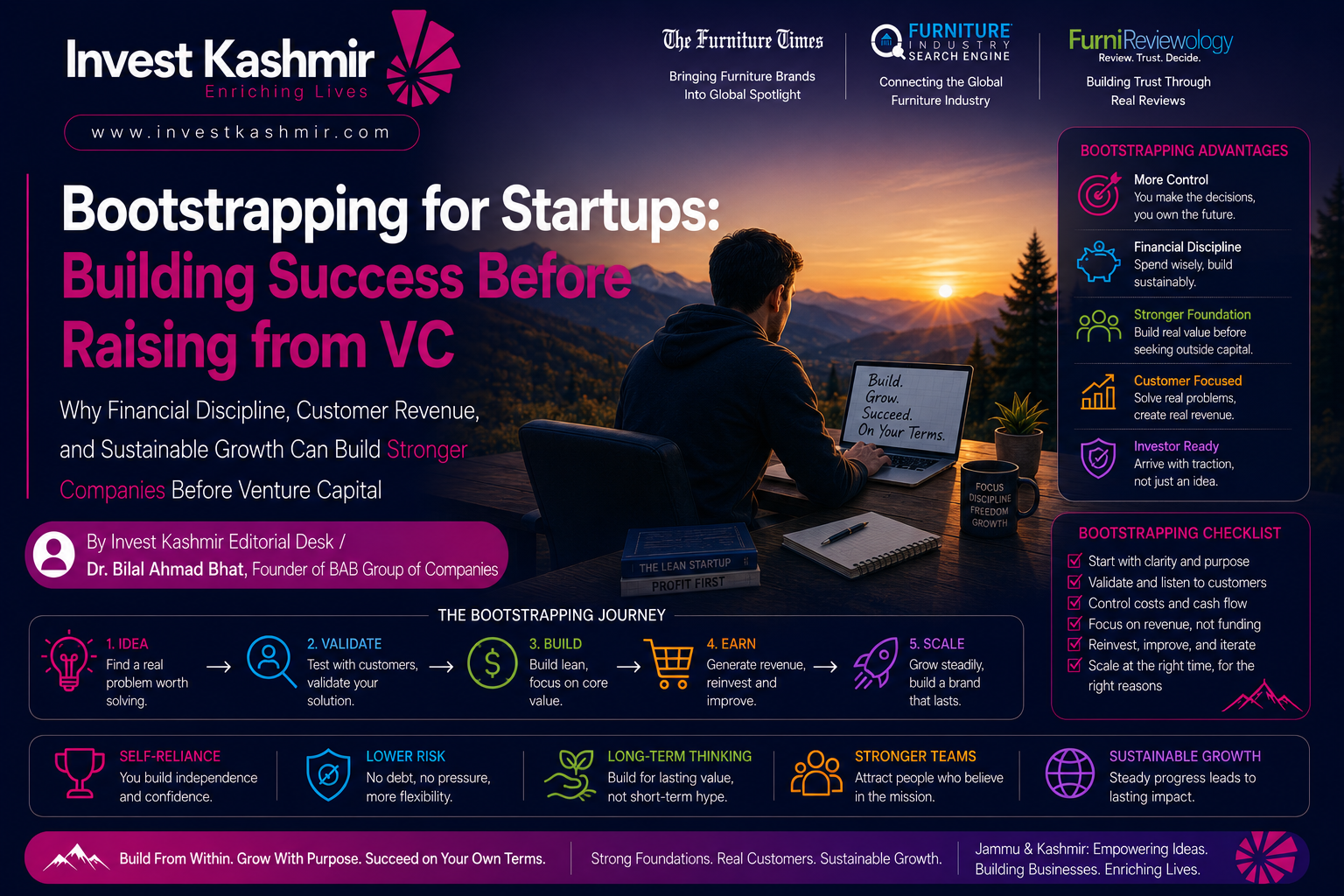
Why Financial Discipline, Customer Revenue, and Sustainable Growth Can Build Stronger Companies Before Venture Capital
By Invest Kashmir Editorial Desk / Dr. Bilal Ahmad Bhat, Founder of BAB Group of Companies
Every entrepreneur dreams of building a company that changes lives.
Some aspire to create breakthrough technologies.
Others want to solve local problems through innovative products and services.
Many hope to build businesses that generate employment, strengthen communities, and contribute to economic development.
Regardless of the vision, one question eventually arises for every founder:
Should I raise venture capital immediately, or should I build my business first?
For decades, venture capital has been portrayed as the ultimate milestone for startup success. Headlines frequently celebrate funding rounds worth millions of dollars, creating the impression that raising investment is the primary objective of entrepreneurship.
However, experienced founders often understand a different reality.
The first goal of a startup is not to raise money.
The first goal is to create value.
That is where bootstrapping becomes one of the most powerful entrepreneurial strategies.
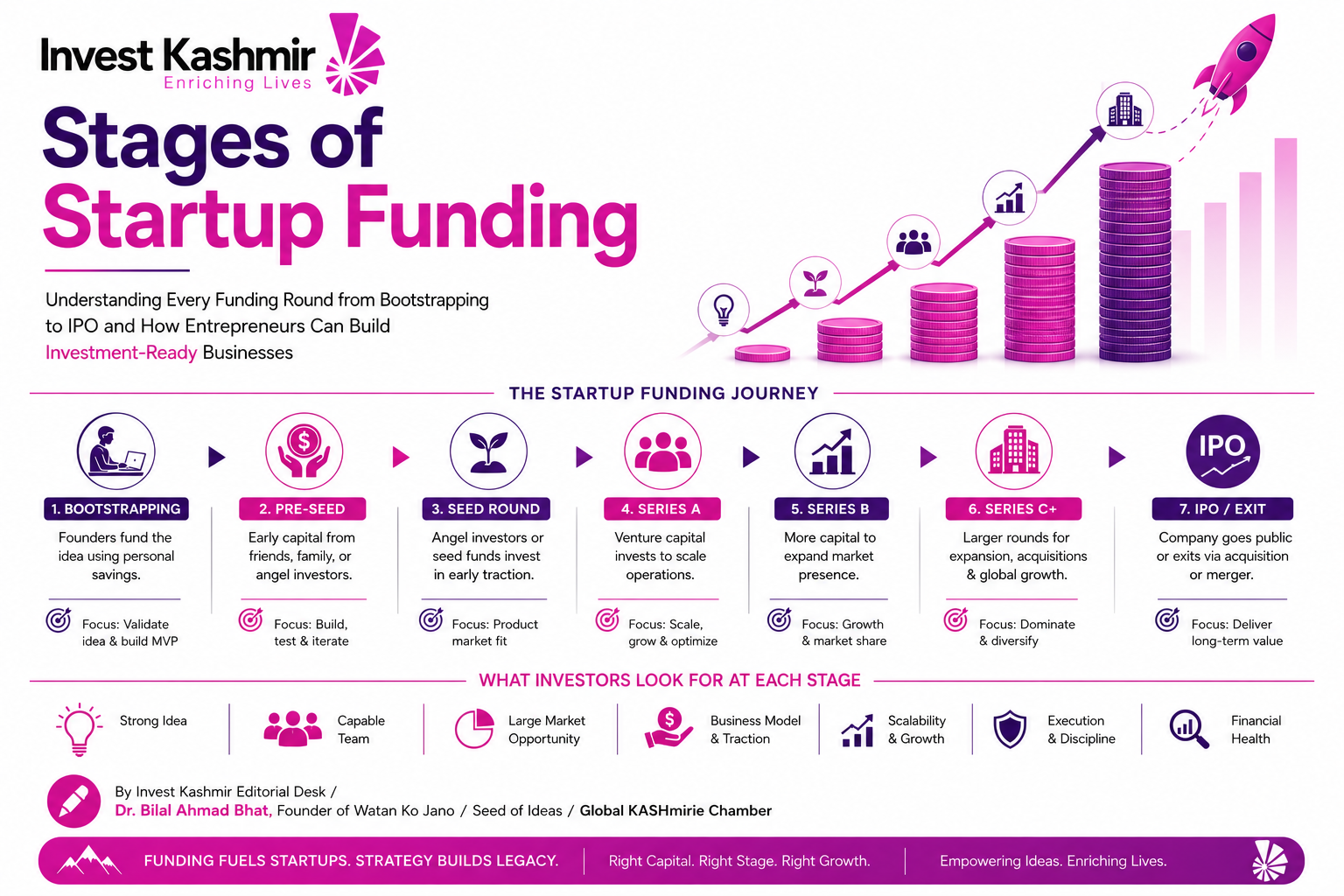
Bootstrapping is the practice of building and growing a company using personal resources, early customer revenue, disciplined spending, and operational efficiency rather than relying immediately on outside investment. Instead of focusing on fundraising, founders focus on solving customer problems, improving products, and building sustainable businesses that generate real revenue.
For Jammu & Kashmir, where entrepreneurship is growing across tourism, AgriTech, HealthTech, Artificial Intelligence, renewable energy, handicrafts, manufacturing, food processing, education, and digital services, bootstrapping offers an important pathway for founders who wish to validate their ideas before seeking external capital.
What Is Bootstrapping?
Bootstrapping means building a company with limited financial resources while relying on:
- Personal savings
- Founder contributions
- Early customer revenue
- Operational efficiency
- Lean business practices
- Continuous reinvestment
Instead of depending on investors from the beginning, entrepreneurs allow customers and disciplined execution to finance business growth.
Bootstrapping is not about avoiding investment forever.
It is about ensuring that investment accelerates an already healthy business rather than attempting to rescue an unproven one.
Why Many Great Companies Started by Bootstrapping
Numerous globally recognized companies began with limited resources.
Their founders focused first on:
- Building useful products.
- Winning paying customers.
- Improving operations.
- Creating sustainable revenue.
- Learning directly from the market.
Only after establishing strong foundations did many of them seek larger investments to accelerate growth.
This approach often results in stronger business fundamentals because growth is driven by customers rather than expectations.
Customers Become Your First Investors
Bootstrapped companies depend upon customers rather than investment rounds.
Every satisfied customer contributes to:
- Revenue.
- Product validation.
- Brand reputation.
- Market credibility.
- Business sustainability.
Revenue generated through customers represents one of the strongest indicators that a business is creating genuine market value.
Instead of asking investors whether an idea has potential, bootstrapped founders ask customers whether the solution improves their lives.
Financial Discipline Becomes a Competitive Advantage
Limited resources encourage thoughtful decision-making.
Bootstrapped founders learn to:
- Prioritize spending.
- Avoid unnecessary expenses.
- Improve operational efficiency.
- Monitor cash flow.
- Focus on profitability.
This discipline often becomes one of the company’s greatest long-term strengths.
Every financial decision is evaluated carefully because resources are limited.
As a result, founders frequently develop stronger business judgment.
Retaining Ownership and Independence
One of the most significant advantages of bootstrapping is maintaining ownership.
Without early equity investment, founders generally retain greater control over:
- Business strategy.
- Product direction.
- Hiring decisions.
- Company culture.
- Long-term vision.
This independence allows entrepreneurs to make decisions based primarily on customer value and sustainable growth rather than short-term funding milestones.
Product-Market Fit Before Scale
Many startups fail because they attempt to scale before confirming that customers genuinely want their product.
Bootstrapped founders usually spend more time:
- Talking with customers.
- Testing ideas.
- Refining products.
- Improving quality.
- Understanding market needs.
This process strengthens product-market fit before significant expansion begins.
Learning to Build Lean Businesses
Lean entrepreneurship focuses on creating maximum customer value with minimum waste.
Bootstrapped startups often embrace principles such as:
- Simple operations.
- Small teams.
- Continuous experimentation.
- Rapid customer feedback.
- Incremental improvement.
These practices encourage flexibility while reducing unnecessary financial risk.
The Role of Artificial Intelligence
Artificial Intelligence has significantly changed the economics of bootstrapping.
Today, founders can use AI to:
- Conduct market research.
- Draft marketing content.
- Automate administrative tasks.
- Improve customer support.
- Analyse business performance.
- Increase productivity.
These capabilities allow smaller teams to accomplish work that previously required much larger organisations.
Recent examples show founders using AI and disciplined operations to reach significant revenue milestones without early venture funding.
Challenges of Bootstrapping
Bootstrapping is rewarding.
It is also demanding.
Entrepreneurs may face:
- Limited financial resources.
- Slower expansion.
- Smaller teams.
- Personal financial pressure.
- Delayed hiring.
- Longer product development timelines.
Success therefore requires patience, resilience, and careful financial management.
When Venture Capital Makes Sense
Bootstrapping and venture capital are not competing philosophies.
They often complement one another.
After building:
- Product-market fit.
- Customer traction.
- Stable revenue.
- Strong leadership.
- Operational discipline.
venture capital can become a powerful tool for accelerating growth.
Investment is most valuable when it amplifies a healthy business rather than replacing sound business fundamentals.
Preparing for Future Investment
Bootstrapped startups often become attractive investment opportunities because they demonstrate:
- Revenue generation.
- Customer demand.
- Financial discipline.
- Founder commitment.
- Efficient operations.
- Sustainable growth.
Investors generally appreciate businesses that have already proven market demand before seeking external financing.
Opportunities for Jammu & Kashmir
Jammu & Kashmir possesses enormous entrepreneurial opportunities across:
- Tourism Technology.
- AgriTech.
- HealthTech.
- Artificial Intelligence.
- Renewable Energy.
- Food Processing.
- Horticulture.
- Handicrafts.
- Manufacturing.
- Education Technology.
Many businesses within these sectors can begin through disciplined bootstrapping before expanding through strategic investment.
Universities as Catalysts for Bootstrapped Innovation
Educational institutions can strengthen entrepreneurship by supporting:
- Startup incubation.
- Business mentoring.
- Financial literacy.
- Innovation laboratories.
- Product validation.
- Industry partnerships.
Students should understand that entrepreneurship is not measured by funding announcements alone.
It is measured by customer impact, sustainability, and long-term value creation.
Building Strong Entrepreneurial Habits
Bootstrapping teaches habits that remain valuable throughout a company’s life:
- Responsible spending.
- Customer focus.
- Continuous learning.
- Adaptability.
- Strategic thinking.
- Operational excellence.
These capabilities continue benefiting founders even after businesses begin attracting investment.
Creating a Sustainable Startup Ecosystem
Healthy entrepreneurial ecosystems require collaboration among:
- Entrepreneurs.
- Investors.
- Universities.
- Incubators.
- Accelerators.
- Government agencies.
- Financial institutions.
- Industry associations.
Some businesses will grow entirely through customer revenue.
Others will eventually raise venture capital.
Both approaches strengthen innovation when built upon strong business fundamentals.
Looking Ahead
Entrepreneurship should never become a race to raise funding.
It should become a journey toward creating meaningful value.
Bootstrapping reminds founders that customers—not investors—are the first measure of success.
It teaches discipline before expansion.
Profitability before publicity.
Execution before valuation.
For Jammu & Kashmir, encouraging founders to build resilient, customer-focused businesses before pursuing large investment opportunities can create a stronger, more sustainable entrepreneurial ecosystem.
The strongest companies are rarely defined by how much capital they raise.
They are defined by the problems they solve.
The trust they earn.
The value they create.
And the discipline with which they grow.
Bootstrapping is not simply a financing strategy.
It is a mindset.
A mindset that transforms limited resources into limitless possibilities through innovation, resilience, and purposeful entrepreneurship.